Contrarianism doesn’t have to be outright sexy: just look at TJX Companies (NYSE: TJX). At first glance, TJX stock may not seem like a compelling discount because the narrative is too much on the nose. After all, the off-price retailer specializes in providing name-brand goods at a reduced price. There’s no real hunting involved, no financial gymnastics to make the point stick.
However, being a contrarian investor shouldn’t exclusively cater to exotic ideas. Sometimes, you can find great value hiding in plain sight. I believe that’s the case for TJX stock. Yes, it’s a solid investment for all the reasons you think it is. But it also offers short-term profit scalpers — weaponizing the leverage of the options market — a legitimately compelling trade.
First, let’s consider the standard argument favoring TJX stock. On a year-to-date basis, the security’s performance is rather pedestrian at less than 1% up. Much of that stems from recent volatility. In the trailing five days, TJX suffered a loss of more than 6%, a negative rerating for reasons that I believe are excessive.
Clearly, the market didn’t like the more measured outlook that management provided following prior quarters of solid growth. Minor insider selling also didn’t help matters as it tends to send ambiguous (or even conflicting) messages. Still, these matters appear to resemble hiccups rather than deep-seated structural deficits.
Fundamentally, the trade-down effect should help keep the lights on for TJX stock. When difficult economic circumstances hit consumers, they don’t go cold turkey on their purchases. Instead, they look to cheaper alternatives for the products that they want or need. TJX Companies fills that need inherently, thus driving the case for permanent relevance.
Additionally, management has greenlighted sizable scale efficiencies, with TJX planning to add 146 new stores globally this year. Ultimately, the company is eyeballing a goal of 7,000 stores worldwide. Such ambitions likely wouldn’t arise if the fundamentals didn’t justify it.
Conditioned Data Points to a Compelling Trade for TJX Stock
Although the contrarian case for TJX stock may seem like a no-brainer, it’s also difficult to make the case strictly from the fundamental perspective. Sure, TJX Companies benefits from the trade-down effect but how do we know that the market didn’t already take that narrative into account?
In other words, who is to say that the “market is wrong”? It’s perfectly reasonable to believe that TJX stock fully deserved the 6.19% loss over the last five days based on its present risk-reward profile. Essentially, such reasoning becomes one opinion versus another. That’s very unsatisfying for the intellectual trader and fortunately, we can use a more empirical methodology to better determine true value.
It’s a reasonably safe bet that most of us reject the idea that the equities market is purely random; otherwise, you reading financial articles in a bid to gain an edge would be considered an exercise in collective delusion. Therefore, if you were to use a particular system or signal to trade TJX stock, at the very minimum, this methodology must consistently beat the performance of you trading TJX randomly.
Again, if the equities market were truly random, then you would just buy TJX stock at any time rather than read articles (like mine) telling you when you should buy…and when you shouldn’t buy. However, you don’t believe that, which is what brings you here. The difference that I’m bringing to the table is quantifying the decision-making process.
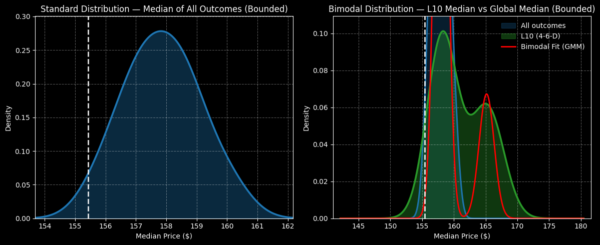
Using historical data over the last six-and-a-half years, if you were to buy TJX stock at random and hold it for a 10-week period, your expected forward distribution would land somewhere between $154 and $162 (assuming a starting price of $155.43, Friday’s close). Further, probability density would peak near $158, meaning that TJX commands an upward bias.
This is the random baseline performance that our trading signal needs to beat. Now, at this particular time, TJX stock has printed four up weeks over the last 10 weeks, resulting in a downward slope across the period. Conditioned for this 4-6-D sequence, bullish traders can expect a forward 10-week distribution landing between $150 and $175, with average probability density peaking around $160.
Because the net statistical tendency stemming from the 4-6-D sequence is noticeably superior to the baseline benchmark, traders arguably have a reason to consider the contrarian trade in TJX stock.
Narrowing Down a Specific Idea
Of course, when trading options, you’re dealing with specifics: hard price targets, hard expiration dates. While forward distributions are instructive, they cover a broad range of outcomes. Fortunately, we can break down the above data on a week-by-week basis.
Interestingly, TJX stock — upon flashing the 4-6-D signal — tends to rise higher in the seventh to eighth week in the projected distribution. Further, the 75th percentile pathway, along with the 25th percentile pathway, also tends to rise during the aforementioned period. Stated differently, the holistic risk-reward structure has been observed to elevate during this time, possibly allowing traders to exploit this information ahead of time.
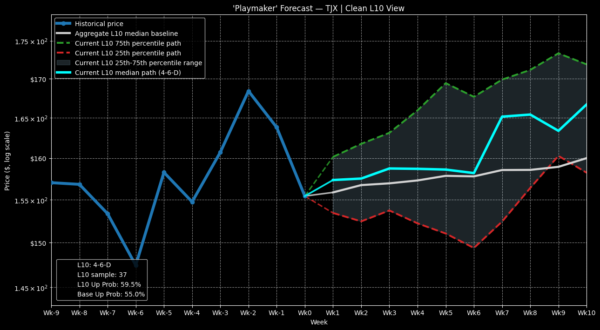
If you believe in the insights of this inductive model, one aggressive idea to consider is the 165/170 bull call spread expiring Aug. 21. On a good day, it is well within statistical reality for TJX stock to hit the $170 strike at expiration. If so, the maximum payout on this bull spread comes out to over 194%.
While the spread itself is quite narrow, the breakeven price comes in at $166.70. That’s roughly the median price that would be expected under 4-6-D conditions, thus providing the trade with a theoretical margin of safety.
Please don’t get this wrong, however. This is still an aggressive and risky proposition. Most importantly, all inductive methodologies are susceptible to the black swan risk: just because you see a thousand white swans doesn’t mean that all swans are white. All it takes is for TJX stock to not follow prior trends for this trade to blow up in a bad way — and there’s no rule that states past patterns must always repeat.
With that caveat aside, I believe an empirical analysis such as the one above is superior to fundamental or technical analysis, which relies on unverifiable opinions. No one can arbitrate whether the market is right or wrong. What we can do is to recognize how markets respond given certain conditions.
Right now, TJX stock is structurally in a bearish state — and that has tended to resolve itself bullishly. That’s the opportunity that options traders have to potentially exploit.