ajax loader

Loading...


Ride-the-Wave Strategy – Best for Stock Traders

Ride-the-Wave targets multi-day price momentum following a company’s earnings announcement (EA). With this strategy:

  1. Buy a stock one day post-EA if a stock reacts positively post-earnings:
    1. Near the close of trading the EA-day for a pre-market-EA
    2. Near the close of the following day for a post-market-EA
  2. Sell-to-close after 7-10 days, or possibly earlier if a desired price target is reached

Similarly,

  1. short a stock one day post-EA if a stock reacts negatively post-earnings:
    1. near the close of trading the EA-day for a premarket-EA
    2. near the close of the following day for a post-market-EA
  2. then buy-to-close after 7-10 days, or possibly earlier if a desired price target is reached

Important: Ride-the-Wave is predicated on significant price momentum triggered by an EA. The 7-10 day scenario is the maximum trade hold-time. If you see post EA-momentum is halted or reversed by a significant opposite move, re-evaluate your presence in the trade.

This popular StockEarnings screen below will give you a list of stocks that historically exhibit significant price momentum following an EA for the next seven days:

  1. Stocks exhibiting positive post-EA price moves are buy-candidates
  2. Stocks exhibiting negative post-EA price moves are sell/short-candidates

The screen includes those stocks whose Earnings just came out in last two days.

Screen criteria:

  1. Earnings Date Start Date : Current Date + -1 Day
  2. Earnings Date End Date : Current Date + -2 Days
  3. Predicted Move (Next Day) Max : 7%
  4. Predicted Move (On 7th Day) Min : 7%

Strategy Guideline:

  1. Buy the stock if stock has reacted positively. Short the stock if stock has reacted negatively (see above).
  2. Close the position in 7-10 days, or possibly earlier based on price move.

Volatility Crush Strategy - Best for Options Traders

The Volatility Crush strategy is used with stocks that typically experience relatively low-to-moderate price moves (≤4%) following their Earnings Announcements (EA). The basic trade idea is to sell put or call options right before the EA, collecting a credit when options premium is very high due to elevated implied volatility (IV). You then close the position right after the EA by buying the option back much cheaper due to the significant drop in IV that occurs after the mystery of the EA disappears. In assessing this trade, you need to do your homework to ensure you collect sufficient premium to make the trade worthwhile.

This trade is practical due to the low-to-moderate price-move after the EA, which generally won’t significantly affect the options price, unlike an “action” stock, which experience great price moves post-EA. With these symbols, if you’re on the right side of the price move, that’s a great thing. But if you’re on the wrong side of the move, not so great. Consequently, by minimizing the effect of the post-EA price move, you have a much better chance to profit from the reduction in IV without it being ruined by a violent price move.

For this trade, open the position either (1) the night before the EA when the company announces earnings or (2) during the EA day when it announces post-market, generally capturing IV at or close to its peak.

For this trade, open the position either (1) the night before the EA when the company announces earnings or (2) during the EA day when it announces post-market, generally capturing IV at or close to its peak.

This popular stockearnings screen will give you a list of stocks which do not react more than 4% fpost-EA. It includes only those stocks whose earnings are releasing next day.

Screen criteria:

  1. Earnings Date Start Date : Current Date + 1
  2. Earnings Date End Date : Current Date + 1
  3. Predicted Move (Next Day) Max : 4%
  4. Options Type: Weekly

Strategy Guideline:

  1. Options Strategy: Sell Call and Put
  2. Options Strike Price: Current Stock Price – (% Predicated Move x 2)
  3. Expiration Date: It should generally be the closest expiry immediately after the EA.
  4. Buy Insurance: Buying back Call and Put at Strike price which 10% lower than Sell Strike Price is optional but recommended.

Watch Video for More Detail

Volatility Rush Strategy - Best for Options Traders

The Volatility Rush takes advantage of increasing options premiums into earnings announcements (EA) caused by an anticipated rise in Implied Volatility (IV). With this strategy, Buy a Call and Put at-the-money (a long straddle) 2-3 weeks before the EA when IV is lower. Sell the position either (1) the night before the EA when the company announces earnings pre-market, or (2) during the EA day when it announces post-market, generally capturing IV at or close to its peak.

This popular screen will give you a list of stocks whose Options premiums tend to rise into Earnings. It includes only those stocks whose Earnings are at least two weeks away from today.

Screen criteria:

  1. Earnings Date Start Date : Current Date + 15 Days
  2. Earnings Date End Date : Current Date + 30 Days
  3. Predicted Move (Next Day) Min : 5%
  4. Options Type: Weekly or Monthly if that lines up with the two to three-week lead-time for entering the trade

Strategy Guideline:

  1. Buy a Straddle at or close to the money two to three weeks pre-EA.
  2. Sell the position either the night before the EA when the company announces earnings pre-market, or during the EA day when it announces post-market.
  3. Expiration date should generally be the closest expiry immediately after the EA.
  4. Straddle price should not be more 60% of predicted move.

Predicted Move (Volatility)

Similar to Implied Volatility in Options. Expected volatility % based on our Proprietary Volatility Predication Model. We are expecting that stock price will likely to reach % in either direction by the end of next trading session after Earnings are released and not necessarily the closing volatility %.

Why is it important?

    This indicator helps

  1. Knowing expected volatility in stocks after Earnings helps to decide trading stocks before Earnings Announcement.
  2. Taking Advantage of volatility collapse following Earnings Results by using Advance Options strategies such as Spread and Straddles.

Since Last Earnings

Change in share price since last Earnings release.

Why is it Important?

When share has gained more than 10% since it's last Earning release, it tends to over react to minor bad news and give up some gains if not all. So, it contains more downside volatility than upside When share has dropped more than 10% since it's last Earning release, it tends to over react to minor good news and recover some drops if not all. So, it contains more upside volatility than downside.

EPS Surprise (%)

Occurs when a company's reported quarterly or annual profits are above or below analysts' expectations. Here is the formula to derive % EPS Surprice:

Actual EPS - Estimated EPS
------------------------------------- x 100
Estimated EPS

Why is it Important?

Earnings surprises can have a huge impact on a company's stock price. Several studies suggest that positive earnings surprises not only lead to an immediate hike in a stock's price, but also to a gradual increase over time. Hence, it's not surprising that some companies are known for routinely beating earning projections. A negative earnings surprise will usually result in a decline in share price.

Next Day Price Change (%)

Next Regular trading session Closing price following Earnings result.

For After Market Close Earnings, It is a next trading day closing price. For Before Market Open Earnings, It is the same trading day closing price.

Why is it Important?

Next Day price change is a reaction of Earnings result.

Bullish on Netflix (NFLX) Stock? Here’s Why It’s Time to Pump the Brakes

Posted on Jun 29, 2026 by Joshua Enomoto

Bullish on Netflix (NFLX) Stock? Here’s Why It’s Time to Pump the Brakes

Among the most anticipated earnings disclosures next month will come from streaming giant Netflix (NASDAQ: NFLX). Since the beginning of the year, NFLX stock has lost more than 24% of market value. In the past 52 weeks, shares are down more than 44%. At some point, you’d figure that a turnaround is coming — and the catalyst could come from its second-quarter report.

Scheduled for release on July 16, analysts are looking for earnings per share to hit 79 cents on revenue of $12.58 billion. Investors are nervous, though, because circumstances have been shaky, thus contributing to the fallout in NFLX stock. For example, the most recent Q1 report wasn’t all that great, with the streaming service slightly missing against the bottom line while barely beating on the top line.

Fundamentally, stakeholders have been dumping NFLX stock due to concerns in leadership. Historically, Netflix has preferred to grow its business from within. Recently, though, management has been eyeballing what many experts view as unnecessary and costly acquisitions. Effectively, it sends a poor message about how the company views its future growth potential.

Still, there’s a common thought process that a security like NFLX stock has simply dropped too much. After all, we’re talking about one of the most popular services available in the digital ecosystem. People really don’t go out to the movies with as much fervor as they used to; now, it’s all about streaming your favorite content on Netflix.

Given this fundamental anchor, it stands to reason that shares could potentially rerate higher — basically due to the mean-reversion concept. If so, Netflix stock looks like a wildly enticing discount. Currently, its forward price-earnings ratio is only 22x. Last year, the multiple stood at almost 54x.

So, a great company at a great price — it’s time to buy, right? While anything can happen for the Q2 report, for right now, I’d consider pushing the pause button on Netflix stock.

Don’t Get Caught in the PE Trap for NFLX Stock


This piece of knowledge goes for any security, not just NFLX stock: a cheap multiple (compared to a prior level) doesn’t necessarily signal a discount. If this were a universal rule, everybody would simply buy red-ink-stained securities. Obviously, it doesn’t work that way.

When it comes to Netflix specifically, the new, lower multiple could be a reflection of growth moderation. At 54x, you’re basically pricing NFXL stock as a hypergrowth tech disruptor. Unfortunately, recent financial results — along with management’s acquisitive hunger — suggest that the underlying paradigm has matured. Therefore, this situation could be the market simply de-rating the stock to account for its new baseline.

Investors must also consider the structural regime shift in content costs. At its peak multiple, Netflix ranked as the undisputed aggregator of global content. Increasingly, however, the competitive landscape has required a different playbook. As such, Netflix had to pivot heavily into live sports and entertainment programming.

This pivot, while it kept the streaming giant relevant, has resulted in a spike in capital intensity. Namely, live sports rights require enormous up-front, non-negotiable cash outlays. Further, while sports attract massive ad-tier eyes, they carry heavy content amortization costs that can depress future cash flow margins.
netflix-StockEarnings

Put differently, the market isn’t stupid. It recognizes that the long-term capital intensity of the business has structurally shifted. Subsequently, sophisticated investors are scaling back the multiple of NFLX stock that they are willing to pay for those cash flows.

Besides, it’s difficult to declare that the market is “wrong” about Netflix stock and that it deserves a higher multiple. That’s the type of argument you would expect from a less-sophisticated analysis. However, the onus would be on the expert making the claim to identify what portion of the positive news has not been baked into the share price.

As far as we know, the price is the price. Unless there is compelling evidence to suggest that the market has failed to account for critical datapoints that would impact NFLX stock, we should take the price at face value.

Inferring the Next Steps for Netflix Stock

Those who are still contrarian and bullish on Netflix stock will likely point to the technical damage already incurred. Philosophically speaking, it’s assumed that future bad news will need to be sufficiently repugnant to make an already terrible stock lose even more value. However, with the bears potentially exhausted, it may only take a small bit of good news to move shares positively.

I think most of us believe in this mean-reversion concept. The difference today is that with current technology, we can measure this concept.

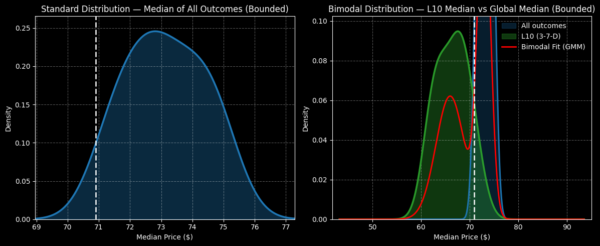
If you were to buy NFLX stock at its current price of $70.90 and hold it for a 10-week period, you would expect a range between $69 and $77, with peak probability density reaching around $72.90 (indicative of a positive bias). This is our random baseline and any signal that we trade off of must beat this baseline to make sense.

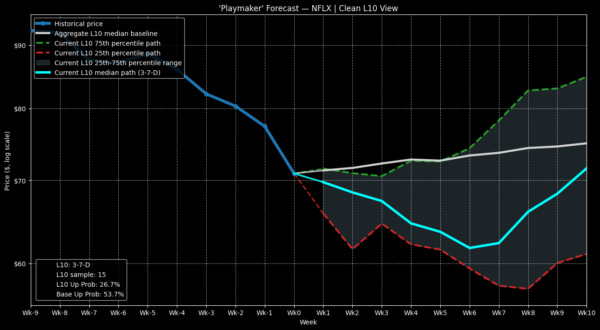
Over the last 10 weeks, NFLX stock printed only three up weeks, leading to an overall downward slope. If we condition the forward 10-week performance of NFLX on this 3-7-D signal, the expected forward distribution actually worsens to between $56 and $77. So, from a median 10-week perspective, it’s not worth taking a risk if you’re bullish.
netflix - StockEarnings

Indeed, when you consider the week-to-week inference of NFLX stock following the 3-7-D signal flashing, it has historically demonstrated weakness for the next six weeks until popping higher. So, if anything, I would be near-term bearish on Netflix stock prior to the Q2 earnings disclosure.

If you want to follow the inference, you may consider the 69/68 bear put spread expiring July 10. Based on probabilistically conditioned data, there’s an observed tendency for NFLX stock to drop to around $68 over the next two weeks. The net debit of this spread is only $32, which may appeal to those speculators on a budget.

However, I wouldn’t expose myself to the bearish trade when it comes to the Q2 earnings disclosure. You just really don’t know what’s going to happen — and personally, I don’t want the smoke. That said, the historical data shows that NFLX stock may still give up some value prior to the Q2 report.


Joshua Enomoto is a seasoned financial writer with a strong track record of in-depth stock analysis, offering clear, insightful commentary for retail investors across all levels of expertise. Renowned for his ability to blend analytical rigor with engaging wit, Joshua's work has been featured on leading investment platforms, including TipRanks, InvestorPlace, Barchart, Benzinga, and Fintel. He was also handpicked to spearhead high-impact initiatives such as InvestorPlace's "Trade of the Day" and Benzinga’s ETF coverage. As a frequent guest expert for CGTN America, Joshua discusses a wide range of economic, societal, and consumer market trends. A graduate of U.C. San Diego, Joshua brings a thoughtful and fresh perspective to complex financial narratives, helping enterprise clients connect with their audiences. He also composes music in his spare time.

Join over 1.2M+ investors/traders who receive daily and weekly notable earnings alerts with predicted move