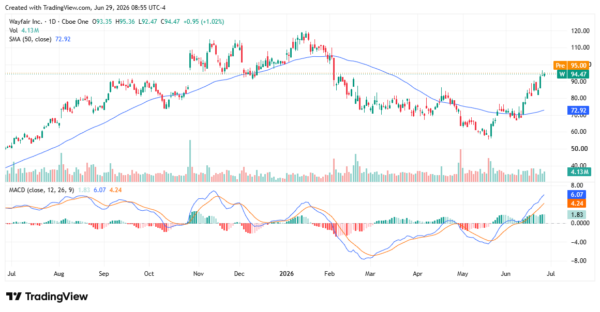
Wayfair Inc. (NYSE: W) has staged one of the sharpest rebounds among consumer discretionary stocks over the last three months. As of this writing, shares are trading near $94 after bottoming around $55 in May 2026, a rally of more than 70%. The catalyst is a strategic shift few investors saw coming when the company went public: a deliberate pivot from pure-play e-commerce into large-format physical retail.
The thesis driving the move has merit. But with the stock now extended against analyst targets and the next earnings report due August 3, investors chasing the rally should think carefully about what could go wrong.
Physical Retail Pivot Is Reshaping the Investment Case
Wayfair opened its first 150,000-square-foot store in Wilmette, Illinois, in 2024. The store was a test of whether a digital-native brand could compete in furniture’s most natural sales channel. Early results have been encouraging. Management says more than 50% of shoppers at Wilmette are new to the brand, and that the store generates a “sales halo” effect in nearby ZIP codes.
That data has emboldened a national expansion plan. A second flagship opens in Atlanta in late 2026. Additional stores in Fort Lauderdale and Cincinnati are slated for 2027. The strategic logic is sound. Most home furnishings purchases in the U.S. still happen in person, and Wayfair has spent two decades building the catalog, logistics, and brand recognition to compete in that channel.
Price-Conscious Positioning Could Win the Cycle
Wayfair’s business model targets value-driven consumers, and that orientation is becoming an asset. The U.S. furniture category remains 25% to 30% below its 2021 peak, and management has repeatedly called the timing of a recovery “hard to predict.” But Wayfair is gaining share against that backdrop. First-quarter 2026 U.S. revenue grew 7.5% year over year, with total revenue of $2.93 billion, up 7.4%.
The company’s loyalty program now exceeds 1 million members. Adjusted EBITDA margin of 5.2% in the first quarter was the highest first-quarter print in five years. Operating expenses are down nearly 40% from the 2022 peak, representing more than $800 million in annualized run-rate savings. Wayfair is doing more with less.
Technical Picture Looks Stretched After the Run
The chart confirms the bullish momentum, but it also raises questions about how much is already priced in. Shares trade well above the 50-day simple moving average of $72.92 — a gap of more than 20 points. That kind of distance from trend support typically resolves through either consolidation or a pullback.
The MACD indicator has turned aggressively positive, with the MACD line at 6.07, the signal line at 4.24, and a positive histogram. That is a clear bullish reading, but extended readings often precede mean reversion. Volume of 4.13 million shares has supported the move, suggesting institutional participation rather than a thin short-covering rally. Pullback support sits near $80, with the 50-day average as a deeper buy zone.
Analyst Targets Suggest Limited Upside From Here
Here is where investors should pause. The consensus price target for Wayfair is around $99.89, implying upside of only about 5% from current levels. That is a small reward for a name with this much beta.
The range of estimates is wide. Oppenheimer has a $144 target on Wayfair stock, while RBC Capital’s target sits at $51. That dispersion reflects genuine disagreement about whether the retail strategy will eventually deliver sustained GAAP profitability, or whether category headwinds will outlast the cost discipline.
Insiders are not bullish at current prices. Wayfair insiders have made 91 open-market trades over the last six months. All 91 were sales. Co-founder Steven Conine alone sold roughly $75 million of stock during that window — a signal worth weighing against the recent rally.
Interest Rates and the August 3 Earnings Report Are the Key Risks
The biggest macro risk is the Federal Reserve. Wayfair sells discretionary, big-ticket items that are often financed through credit. If the Fed holds rates at current restrictive levels through the back half of 2026, the housing turnover that drives furniture demand will remain frozen. Existing-home sales remain near multi-decade lows. That backdrop directly limits how fast Wayfair can grow, even with share gains and a strong retail strategy.
The next test arrives on August 3 when the company reports second-quarter results. Management has guided to mid-single-digit revenue growth, gross margin between 29.5% and 30.5%, and adjusted EBITDA margin of 6% to 7%. Those numbers are achievable, but the bar has moved higher with the stock.
Shares dropped roughly 11% after the first-quarter report despite a revenue beat. That was a reminder of how quickly sentiment can flip on this name when management strikes a cautious tone. With shares now sitting near the consensus target, anything short of a clean beat-and-raise could trigger a sharper correction.
What to Do With Wayfair Stock Right Now
The bull case on Wayfair is intact. Retail expansion, share gains, EBITDA improvement, and a leaner cost base all support the multi-year story. But the easy money in this cycle appears to have been made. The setup now favors patience.
Investors who already own the stock might consider trimming part of the position ahead of August 3 and waiting for either a pullback toward the 50-day moving average or a clean earnings beat to add exposure. New money has a limited margin for error at current levels.