Apple spent two decades teaching the technology industry that waiting for the perfect product pays off. Artificial intelligence is proving the opposite and both Microsoft and Meta seem to be following suit.
Microsoft is already monetizing artificial intelligence at scale through products businesses use every day, generating a $37 billion artificial intelligence business growing 123% year over year. Meta is preparing to spend as much as $135 billion in 2026 expanding its AI infrastructure after artificial intelligence improvements boosted the advertising engine funding the company. Apple, meanwhile, is still working to deliver the Siri overhaul it unveiled two years ago, relying on Google’s Gemini to power capabilities it originally intended to build itself.
Strange thing is, this gap has been widening every earnings season. And even if you’re just noticing it for the first time, the question you should be asking isn’t whether Apple can catch up.
It’s what happens to Microsoft Corp (NASDAQ: MSFT), Meta Platform Inc (NASDAQ: META), and Apple Inc (NASDAQ: AAPL) valuations if the gap keeps getting wider.
Microsoft Already Owns Where Businesses Use AI
The biggest misconception about Microsoft’s AI strategy is that it depends on OpenAI. It doesn’t. Granted, OpenAI gave Microsoft a head start, but distribution is what’s turning that lead into revenue now. Rather than confining artificial intelligence to a chatbot, Microsoft threaded it through Azure, Microsoft 365, GitHub, Windows, Dynamics, and its enterprise security products. This means that customers and businesses didn’t need to discover a new platform since AI arrived inside the software they already depended on.
The FY26 Q3 earnings showed revenue climbed to $82.9 billion, Azure continued growing 40%, commercial backlog reached $627 billion after nearly doubling from a year earlier, and Copilot paid seats surged 250% to 20 million. Management also secured access to OpenAI’s frontier models through 2032, ensuring Microsoft’s enterprise ecosystem remains at the center of AI adoption for years to come.
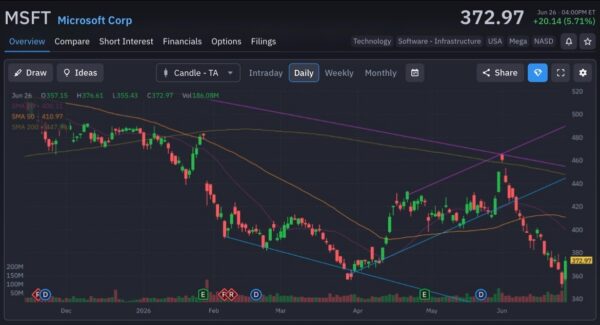
The tape shows that after failing to hold above roughly $460 earlier this month, Microsoft broke below its rising trendline and both the 20-day and 50-day moving averages before finding buyers near $360. So even though investors still believe in AI supremacy, they still took profit. Further proving that they now expect every quarter to justify an increasingly expensive valuation.
Just like other artificial intelligence companies, Meta is also spending aggressively. The only difference is that Meta is spending more because artificial intelligence is now paying off, while the same can’t be said for others.
The company’s recommendation systems, advertising tools, and engagement algorithms continue improving as AI becomes more embedded across Facebook, Instagram, WhatsApp, and Messenger. Those gains are producing stronger advertising performance, giving Mark Zuckerberg confidence to increase investment instead of protecting margins.
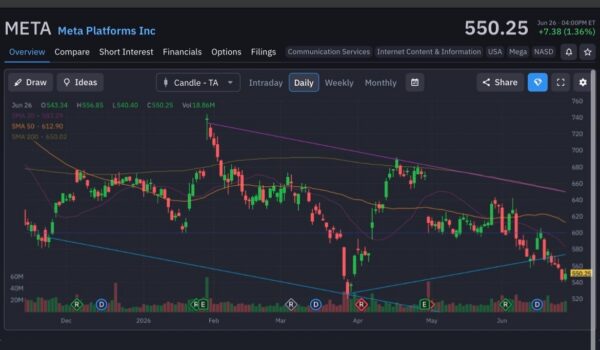
That explains why Meta now expects between $115 billion and $135 billion in capital expenditures next year despite criticism surrounding the size of those investments. Zuckerberg has repeatedly argued the business is already generating returns significant enough to justify spending even more. Investors immediately scooped up its stock as its shares recovered, indicating that artificial intelligence was improving Meta’s core advertising business, but the latest pullback has pushed the stock toward support near $550 after failing to break a descending trendline stretching back to February. So just like Microsoft, they’re questioning how quickly future returns will justify today’s spending…which is different from what they’re asking of Apple’s shares as you’ll see below.
Apple’s Greatest Strength Became Its Biggest Weakness
I struggle to remember the last time Apple pioneered a revolutionary product or idea. Yet every time it enters an existing market, it somehow walks away with the largest share. That philosophy conquered smartphones, smartwatches, tablets, and even silicon chips.
Today, generative AI is rewarding something entirely different from that philosophy. I’m talking about speed of execution and deployment. It’s simple: companies that improve do so by deploying products quickly, collecting billions of interactions, refining models, and repeating the process. Microsoft and Meta have spent the last two years living by that playbook. Apple, however, has spent much of the same period delaying its personalized Siri rollout, restructuring its artificial intelligence leadership, and ultimately turning to Google’s Gemini after struggling to deliver Apple Intelligence on schedule.
That decision says less about Apple’s engineering talent than its product philosophy.
The company still controls one of the strongest ecosystems in technology and generates enough cash to compete with anyone. The problem is that artificial intelligence compounds through usage. Every month Microsoft and Meta deploy new capabilities; they gather more data, improve their models, and widen the gap, thereby leaving Apple in the dust.
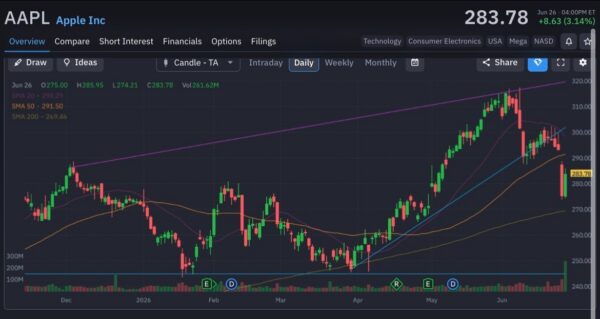
And I’m not alone in this, the chart is now suggesting Wall Street has started recognizing that same reality. Apple surged above $310 earlier this year before a high-volume selloff erased months of momentum, driving shares below both the 20-day and 50-day moving averages before buyers finally emerged near the 200-day trendline. Indicating that investors may now be repricing expectations after realizing the company’s artificial intelligence roadmap remains further behind than many initially believed
The AI Race Is Already Reshaping Portfolios
Markets reward companies that compound advantages before everyone else recognizes them. From what you’ve seen, Microsoft and Meta are already doing that.
By no means am I saying Apple doesn’t have the opportunity to compete anymore. If anything, Apple still has the balance sheet, ecosystem, and engineering talent to respond, but catching up is no longer the same as leading.
And for me, that’s the difference between owning tomorrow’s leader and waiting for yesterday’s leader to catch up.