Artificial intelligence is rapidly moving into the physical world, creating one of the biggest investment opportunities of the next several decades.
From warehouse automation and manufacturing to healthcare, logistics, and space exploration, humanoid robots are expected to transform the global economy.
Why Wall Street Is Bullish on Humanoid Robots
According to Morgan Stanley, the humanoid robotics market could generate nearly $5 trillion in annual revenue by 2050, making it one of the largest technological revolutions since the Internet.
With Wall Street forecasting explosive growth in humanoid adoption over the next decade, investors are increasingly looking for the best stocks and ETFs positioned to benefit from the rise of physical AI and advanced robotics.
In addition, new estimates from Morgan Stanley analysts forecast $4.7 trillion in global humanoid revenue by 2050, which the firm said is double the total revenue of the 20 largest automakers in 2024. What’s more, while auto revenue could “very well shrink over the next 25 years,” analysts estimate that global humanoid adoption will accelerate and reach roughly 1 billion units by 2050, the investment bank said, as noted by CNBC.
Goldman Sachs says global humanoid robot demand potentially achieving a $38 billion total addressable market by 2035. Bank of America. believes global humanoid robot shipments will reach 18,000 units in 2025 and 10 million units by 2035.
And Wedbush analyst Dan says humanoid robots could be oneof the biggest opportunities in the AI boom. The market will be worth trillions of dollars over the next decade, Ives added, as noted by CNBC, and “will change the way consumers and businesses operate over time.”
When that happens, humanoid robots could assist patients, assist with physical therapy and rehab exercises, reduce staffing shortages, automate demand tasks, assist with rescues, perform maintenance and operations in space, the list goes on.
The only question now is – how can we make money from it?
Nvidia Is Building the Infrastructure for Physical AI
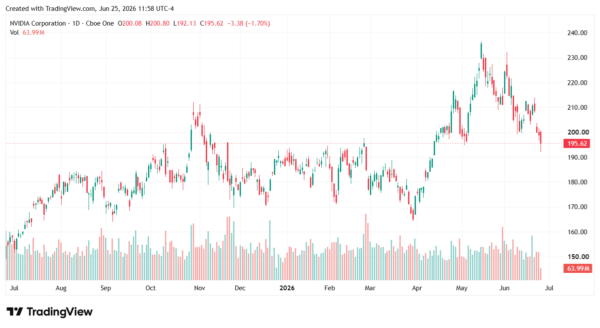
NVIDIA (NASDAQ: NVDA) is now betting that the next major wave of artificial intelligence will exist in the Physical AI world by walking, moving, lifting boxes, operating machinery, and working with humans.
Fueling momentum is Nvidia’s Halos for Robotics, which, according to the company, is the industry’s first, full-stack, open safety system for physical AI and robotics. The platform is designed to help robots and humanoids operate safely in human environments by combining AI computing software, including IGX Thor and the Holoscan Sensor Bridge for AI, with safety operating systems using Nvidia Halos OS. Even better, it’s already seeing early adoption.
A Diversified Way to Invest in Robotics
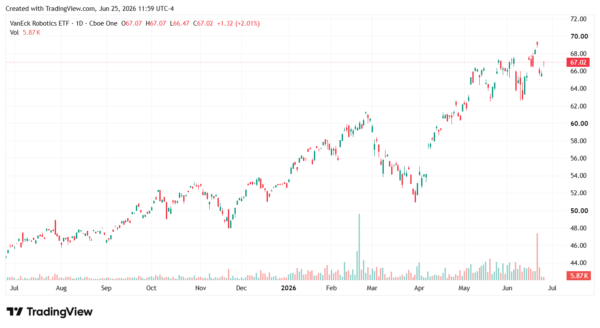
There’s also the VanEck Robotics ETF (NASDAQ: IBOT). With an expense ratio of 0.47%, the fund replicates the price and yield performance of the BlueStar Robotics Index, which tracks companies involved with robotics and automation technologies. Some of its 67 holdings include Nvidia, ASML Holding, Siemens, Autodesk, and Teledyne Technologies.
The ETF offers investors diversified exposure to several key trends driving the robotics revolution, including artificial intelligence, industrial automation, machine vision, semiconductor manufacturing, and autonomous systems. That diversification can be especially attractive for investors who want exposure to the humanoid robotics boom without having to pick individual winners in what is still an emerging industry.
The Next Phase of AI Could Be Physical—Here’s How to Invest
As advances in artificial intelligence, sensors, and computing power continue to accelerate, humanoid robots could become as commonplace in the workplace as computers are today. For investors looking to gain exposure to this long-term trend, Nvidia offers a direct play on the AI infrastructure powering next-generation robotics, while the VanEck Robotics ETF provides diversified exposure to a broad basket of companies helping drive automation forward.
If forecasts from Morgan Stanley, Goldman Sachs, and other Wall Street firms prove accurate, today’s investments in robotics and physical AI could get explosive.