Qualcomm Incorporated (NASDAQ: QCOM) jumped more than 7% on June 25, 2026. Wall Street is digesting a fresh set of AI-related catalysts from the chipmaker’s Investor Day. The move continues a pattern of sharp swings that has defined QCOM stock for most of 2026. Shares have traded from the low $140s in spring to the high $250s in May before retreating again.
At roughly $212 per share, Qualcomm trades around 26 times trailing earnings. That sits well below AI infrastructure peers like Broadcom (NASDAQ: AVGO) and NVIDIA (NASDAQ: NVDA). For long-term investors, the question is whether QCOM is a mispriced AI data center story finally breaking out of its smartphone shell.
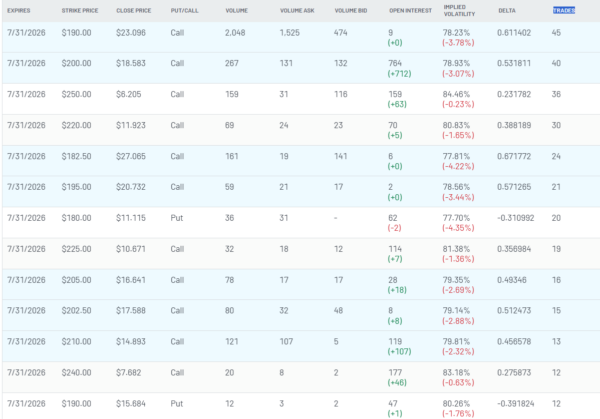
For short-term traders, the question is very different. The July 31, 2026, options chain shows implied volatility running between 78% and 84% across most strikes. Heavy call interest extends as far up as $250, with active put positioning below $190. That expiration falls just days after Qualcomm’s expected fiscal Q3 earnings release, which TipRanks currently pegs for August 5, 2026.
The combination of a transformational Investor Day, a near-term earnings catalyst, and a six-month trading range of nearly 90 points makes QCOM one of the more interesting setups in the semiconductor group right now.
Why Qualcomm’s Data Center Pivot Could Re-Rate the Stock
At its June 24 Investor Day, Qualcomm raised its fiscal 2029 non-handset revenue target to $40 billion, roughly double its prior guidance. The company also set a data center revenue target of more than $15 billion by fiscal 2029.
Meta Platforms (NASDAQ: META) was disclosed as a multi-generational customer for the forthcoming Dragonfly C1000 CPU. Microsoft’s (NASDAQ: MSFT) Azure cloud unit has been tapped for the High Bandwidth Compute chip architecture, slated for mid-2027.
For a business that still draws roughly two-thirds of product revenue from smartphones, that mix shift is significant. Qualcomm also targets $10 billion in automotive revenue, more than $14 billion in IoT revenue, and non-GAAP earnings per share of more than $18 by fiscal 2029. Analysts polled by LSEG currently model fiscal 2029 EPS of $15.26, which means Qualcomm’s own targets are nearly 18% above consensus.
The strategy extends beyond merchant silicon. Qualcomm reported two major hyperscaler custom-silicon wins, each expected to exceed one billion dollars in fiscal 2027. The Modular acquisition, while dilutive, addresses Qualcomm’s historic software gap relative to Nvidia’s CUDA ecosystem.
The Chart Says Conviction Has Yet to Return
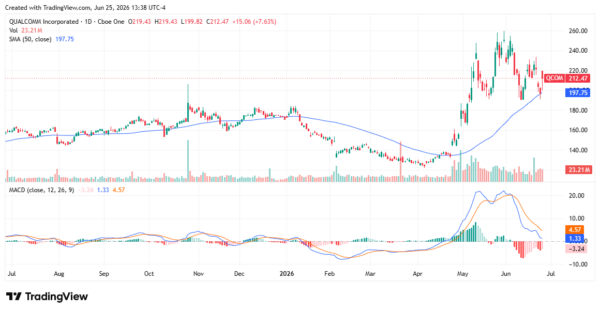
Despite Wednesday’s rally, the QCOM chart shows signs of indecision. The stock peaked near $260 in May and has been carving lower highs and lower lows since. The 50-day simple moving average at $197.75 has acted as a battleground rather than a launchpad. Friday’s surge took shares back above that level on volume of more than 23 million.
The MACD indicator, however, remains bearish on a daily basis. The MACD line at 1.33 sits below the signal line at 4.57. The histogram is negative at -3.24. That configuration typically suggests momentum has not yet flipped back in favor of the bulls, even with the strong intraday move.
Options traders appear to be positioning for sharp movement in either direction. The July 31 expiration shows implied volatility above 78% across the call chain and similar levels on puts. The largest open interest in the high-volume calls sits near the $200 strike, with active put hedging at $190 and $180. That pricing implies an expected move of roughly 12% to 15% through expiration. Traders are clearly bracing for an outsized reaction to the August earnings print.
The Bear Case: Why 26x Earnings May Still Be Right
The skeptical view starts with timing. The Dragonfly C1000 microprocessor will be available in 2028. That means none of Meta or Microsoft’s revenue will contribute meaningfully to the next two fiscal years. The all-stock Modular acquisition is valued at $3.92 billion and is expected to close in the second half of 2026, introducing near-term dilution that hits earnings now rather than later.
Smartphone exposure remains the dominant near-term variable. Management guided fiscal Q3 revenue of $9.2 billion to $10.0 billion and non-GAAP EPS of $2.10 to $2.30. Both numbers sit below the company’s fiscal Q2 results of $10.6 billion and $2.65. CEO Cristiano Amon has said China handset shipments should bottom in Q3 before recovering, but memory price inflation continues to pressure Chinese OEMs.
Competition is also intensifying. Broadcom reported $10.8 billion in AI-related revenue in its most recent quarter, up 143% year over year, while Marvell is guiding to 40% growth for the current year. Even Intel and AMD have server CPUs with core counts comparable to Dragonfly’s 250-plus design, and those parts ship years before Qualcomm’s.
Bottom Line: The Setup Favors Patience, Not Conviction
Qualcomm has given long-term investors a credible bull case. Real customer commitments from Meta and Microsoft, ambitious financial targets above current consensus, and a software acquisition that addresses a known weakness all support the thesis. The stock still trades at a discount to AI infrastructure peers, which keeps the “undervalued” framing in play.
The bear case is just as easy to assemble. Data center revenue is years away, the Modular deal is dilutive, and smartphones remain the swing factor for the next several quarters. With earnings on the calendar in early August and options markets pricing in a double-digit percentage move, QCOM is likely to keep behaving more like a trader’s vehicle than a buy-and-hold compounder in the near term.