ajax loader

Loading...


Ride-the-Wave Strategy – Best for Stock Traders

Ride-the-Wave targets multi-day price momentum following a company’s earnings announcement (EA). With this strategy:

  1. Buy a stock one day post-EA if a stock reacts positively post-earnings:
    1. Near the close of trading the EA-day for a pre-market-EA
    2. Near the close of the following day for a post-market-EA
  2. Sell-to-close after 7-10 days, or possibly earlier if a desired price target is reached

Similarly,

  1. short a stock one day post-EA if a stock reacts negatively post-earnings:
    1. near the close of trading the EA-day for a premarket-EA
    2. near the close of the following day for a post-market-EA
  2. then buy-to-close after 7-10 days, or possibly earlier if a desired price target is reached

Important: Ride-the-Wave is predicated on significant price momentum triggered by an EA. The 7-10 day scenario is the maximum trade hold-time. If you see post EA-momentum is halted or reversed by a significant opposite move, re-evaluate your presence in the trade.

This popular StockEarnings screen below will give you a list of stocks that historically exhibit significant price momentum following an EA for the next seven days:

  1. Stocks exhibiting positive post-EA price moves are buy-candidates
  2. Stocks exhibiting negative post-EA price moves are sell/short-candidates

The screen includes those stocks whose Earnings just came out in last two days.

Screen criteria:

  1. Earnings Date Start Date : Current Date + -1 Day
  2. Earnings Date End Date : Current Date + -2 Days
  3. Predicted Move (Next Day) Max : 7%
  4. Predicted Move (On 7th Day) Min : 7%

Strategy Guideline:

  1. Buy the stock if stock has reacted positively. Short the stock if stock has reacted negatively (see above).
  2. Close the position in 7-10 days, or possibly earlier based on price move.

Volatility Crush Strategy - Best for Options Traders

The Volatility Crush strategy is used with stocks that typically experience relatively low-to-moderate price moves (≤4%) following their Earnings Announcements (EA). The basic trade idea is to sell put or call options right before the EA, collecting a credit when options premium is very high due to elevated implied volatility (IV). You then close the position right after the EA by buying the option back much cheaper due to the significant drop in IV that occurs after the mystery of the EA disappears. In assessing this trade, you need to do your homework to ensure you collect sufficient premium to make the trade worthwhile.

This trade is practical due to the low-to-moderate price-move after the EA, which generally won’t significantly affect the options price, unlike an “action” stock, which experience great price moves post-EA. With these symbols, if you’re on the right side of the price move, that’s a great thing. But if you’re on the wrong side of the move, not so great. Consequently, by minimizing the effect of the post-EA price move, you have a much better chance to profit from the reduction in IV without it being ruined by a violent price move.

For this trade, open the position either (1) the night before the EA when the company announces earnings or (2) during the EA day when it announces post-market, generally capturing IV at or close to its peak.

For this trade, open the position either (1) the night before the EA when the company announces earnings or (2) during the EA day when it announces post-market, generally capturing IV at or close to its peak.

This popular stockearnings screen will give you a list of stocks which do not react more than 4% fpost-EA. It includes only those stocks whose earnings are releasing next day.

Screen criteria:

  1. Earnings Date Start Date : Current Date + 1
  2. Earnings Date End Date : Current Date + 1
  3. Predicted Move (Next Day) Max : 4%
  4. Options Type: Weekly

Strategy Guideline:

  1. Options Strategy: Sell Call and Put
  2. Options Strike Price: Current Stock Price – (% Predicated Move x 2)
  3. Expiration Date: It should generally be the closest expiry immediately after the EA.
  4. Buy Insurance: Buying back Call and Put at Strike price which 10% lower than Sell Strike Price is optional but recommended.

Watch Video for More Detail

Volatility Rush Strategy - Best for Options Traders

The Volatility Rush takes advantage of increasing options premiums into earnings announcements (EA) caused by an anticipated rise in Implied Volatility (IV). With this strategy, Buy a Call and Put at-the-money (a long straddle) 2-3 weeks before the EA when IV is lower. Sell the position either (1) the night before the EA when the company announces earnings pre-market, or (2) during the EA day when it announces post-market, generally capturing IV at or close to its peak.

This popular screen will give you a list of stocks whose Options premiums tend to rise into Earnings. It includes only those stocks whose Earnings are at least two weeks away from today.

Screen criteria:

  1. Earnings Date Start Date : Current Date + 15 Days
  2. Earnings Date End Date : Current Date + 30 Days
  3. Predicted Move (Next Day) Min : 5%
  4. Options Type: Weekly or Monthly if that lines up with the two to three-week lead-time for entering the trade

Strategy Guideline:

  1. Buy a Straddle at or close to the money two to three weeks pre-EA.
  2. Sell the position either the night before the EA when the company announces earnings pre-market, or during the EA day when it announces post-market.
  3. Expiration date should generally be the closest expiry immediately after the EA.
  4. Straddle price should not be more 60% of predicted move.

Predicted Move (Volatility)

Similar to Implied Volatility in Options. Expected volatility % based on our Proprietary Volatility Predication Model. We are expecting that stock price will likely to reach % in either direction by the end of next trading session after Earnings are released and not necessarily the closing volatility %.

Why is it important?

    This indicator helps

  1. Knowing expected volatility in stocks after Earnings helps to decide trading stocks before Earnings Announcement.
  2. Taking Advantage of volatility collapse following Earnings Results by using Advance Options strategies such as Spread and Straddles.

Since Last Earnings

Change in share price since last Earnings release.

Why is it Important?

When share has gained more than 10% since it's last Earning release, it tends to over react to minor bad news and give up some gains if not all. So, it contains more downside volatility than upside When share has dropped more than 10% since it's last Earning release, it tends to over react to minor good news and recover some drops if not all. So, it contains more upside volatility than downside.

EPS Surprise (%)

Occurs when a company's reported quarterly or annual profits are above or below analysts' expectations. Here is the formula to derive % EPS Surprice:

Actual EPS - Estimated EPS
------------------------------------- x 100
Estimated EPS

Why is it Important?

Earnings surprises can have a huge impact on a company's stock price. Several studies suggest that positive earnings surprises not only lead to an immediate hike in a stock's price, but also to a gradual increase over time. Hence, it's not surprising that some companies are known for routinely beating earning projections. A negative earnings surprise will usually result in a decline in share price.

Next Day Price Change (%)

Next Regular trading session Closing price following Earnings result.

For After Market Close Earnings, It is a next trading day closing price. For Before Market Open Earnings, It is the same trading day closing price.

Why is it Important?

Next Day price change is a reaction of Earnings result.

Amazon Gives Investors a Prime Buying Opportunity

Posted on Jun 24, 2026 by Chris Markoch

Amazon Gives Investors a Prime Buying Opportunity

Amazon.com Inc. (NASDAQ: AMZN) kicked off its 2026 Prime Day event on June 23, the same week shares slid more than 4% to close near $234. The pullback offers long-term investors a “prime” buying opportunity in a name that has been mispriced as a single-story tech stock. The narrative around AMZN has fixated on artificial intelligence capex. That framing misses what Prime Day actually showcases. Amazon is a conglomerate, and the sum looks worth more than the parts the market is currently paying for.

The Prime Day Reminder Investors Should Not Ignore


Prime Day 2026 runs from June 23 through June 26 across 26 countries. Amazon moved the event up from its usual July window, with reports tying the shift to a crowded July calendar that includes the 2026 FIFA World Cup and the U.S. 250th Independence Day celebrations. Amazon called Prime Day 2025 its biggest ever, with savings spanning more than 35 product categories.

amazon - StockEarnings

Prime now has more than 240 million members worldwide, according to industry research. Each one pays $14.99 a month or $139 a year. That recurring revenue base anchors the retail flywheel. It also funds same-day delivery, Prime Video, Whole Foods discounts, and Amazon Music. The membership is a subscription engine wrapped inside an e-commerce business.

Sum-of-the-Parts Is the Right Lens

Amazon’s Q1 2026 results, reported April 29, framed the conglomerate story clearly. Net sales rose 17% year-over-year to $181.5 billion, with operating income climbing to $23.9 billion from $18.4 billion a year earlier. CEO Andy Jassy highlighted four growth engines in his earnings statement:

  • AWS grew 28%, its fastest pace in 15 quarters
  • The chips business topped a $20 billion run rate
  • Advertising crossed $70 billion in trailing revenue
  • Stores unit growth hit 15%, the highest since the tail end of COVID lockdowns.

This should serve as a reminder to investors that Amazon is not one business. It is four, possibly five, growing in tandem.

AWS and AI Investments Continue to Drive Growth

AWS generated $37.6 billion in Q1 revenue and $14.2 billion in operating income, bringing its annualized run rate to $150 billion. The Q1 backlog stood at $364 billion, excluding a separate $100 billion deal with Anthropic.

Amazon also secured a commitment from OpenAI to consume approximately two gigawatts of Trainium capacity beginning to ramp in 2027, and Anthropic agreed to secure up to five gigawatts of current and future Trainium chips.

AWS AI revenue is now growing on a run rate above $15 billion. That makes Amazon a credible third silicon vendor inside its own data centers.

Amazon Advertising Is Becoming a Major Profit Engine

Ad revenue reached $17.2 billion in Q1, up 22% year over year. The platform sits on purchase-intent data that Google and Meta cannot fully replicate. Thursday Night Football on Prime Video averaged 15.3 million viewers last season, according to industry coverage. Streaming ads, sponsored search, and connected TV continue to compound. Margins screen closer to software than retail. Yet the segment is largely buried in headline reporting.

Entertainment, Groceries, and Space

Amazon also owns MGM, Twitch, Prime Video, Whole Foods, Amazon Pharmacy, and Project Kuiper. The company has flagged roughly $1 billion in added costs for Project Leo, its satellite broadband initiative, with more than 150 satellites already deployed per company disclosures. Each unit operates in a different multiple zone. None gets full credit when Amazon is valued like a single tech stock. That mispricing is the opportunity.

AMZN Stock Valuation Suggests Attractive Long-Term Upside

AMZN trades at a P/E ratio near 28x, in line with the elevated S&P 500 multiple and a meaningful discount to Amazon’s own five-year historical average. Investors are paying a market multiple for a company growing revenue by 17% as AWS reaccelerates.

Truist Securities maintained a Buy with a $320 target on May 29, while Benchmark holds the high target at $370. DA Davidson sits at the low end at $175, issued in February.

AMZN Stock Valuation Suggests Attractive Long-Term Upside

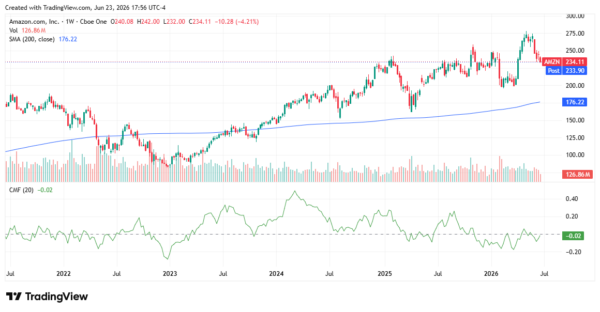
The weekly chart shows AMZN pulled back from highs near $275 to $234, a drawdown of roughly 14%. The 200-week simple moving average sits at $176.22, providing a long-term trend floor well below current prices. Chaikin Money Flow on the 20-period weekly registered -0.02, neutral but showing modest distribution after recent strength.

Weekly volume of 126.86 million suggests engaged but not panicked sellers. The longer-term uptrend remains intact. Buyers may want to watch the prior support shelf near $200 if the pullback extends.
amazon - StockEarnings

Risks Investors Should Consider Before Buying Amazon

The bear case is real. Cash capex hit $43.2 billion in Q1 alone, primarily directed at AWS and generative AI infrastructure, with full-year spend tracking near $200 billion. Trailing twelve-month free cash flow collapsed to $1.2 billion from $25.9 billion a year earlier, with the company attributing the swing mainly to a $59.3 billion increase in property and equipment purchases tied to AI investments. AI infrastructure has to monetize, and the payback window is uncertain.

AWS still trails Microsoft Azure on growth rate. Regulatory pressure from the FTC and EU DMA continues. Competition from Temu, TikTok Shop, and Walmart’s e-commerce build remains intense. The Anthropic-related gains that flattered Q1 EPS will not repeat each quarter.

The Bottom Line

Prime Day is more than a sale. It is a once-a-year showcase of how many businesses sit inside Amazon. Investors fixating on capex are valuing the entire conglomerate at a market multiple while ignoring the individual engines. AWS, advertising, retail, devices, entertainment, healthcare, and Kuiper each move on different fundamentals. With AMZN trading near $234 against a $312.78 consensus target, the risk-reward skews positive for patient holders. The capex bill is real. So is the conglomerate underneath it.


A former marketing copywriter turned freelance financial writer and market analyst. I have a passion for delivering insights to investors. I write regularly about stocks for StockEarnings and MarketBeat. Posts are not advice.

Join over 1.2M+ investors/traders who receive daily and weekly notable earnings alerts with predicted move