It’s almost like clockwork. Thanks to Fox Corp’s (NASDAQ: FOX) buyout of Roku (NASDAQ: ROKU), FOX stock tanked sharply. Over the past five sessions, the security incurred a loss of more than 14%. In the trailing month, shares of the mass media company have given up roughly 23%. Since the start of the year, stakeholders are looking at a near 31% hemorrhaging.
That’s not the predictable element that I’m drawing attention to. Rather, it’s the inevitable articles distributed by various financial publication firms that declare FOX stock to be undervalued, largely due to the thesis that the market has become too pessimistic. Since the media giant is relatively financially robust and will enjoy a larger streaming footprint, the assumption is that the positives haven’t been fully and fairly reflected.
It raises the obvious question: how the heck can anyone make such an audacious statement?
I get it. We all talk about undervalued opportunities but at face value, this phrase really is an impossibility. Analysts typically state that because the target security is trading at a lower multiple relative to some time period in the past, the underlying earnings should rerate to this higher valuation.
Again, such conclusions raise the obvious question: how is it possible that anyone — let alone a random independent contributor who has no access to advanced, proprietary datasets — can even begin to shed light on this inquiry?
There’s no scientific law that states low multiples must rerate higher. Worse, I have yet to see a demonstrable inference that low multiples statistically rerate higher than multiples that are deemed fair or high. So when finpub writers talk about undervaluation, don’t just take their word for it — you should assess the evidence they provide.
Unfortunately, there is no evidence to definitively suggest that FOX stock is undervalued. Sure, someone can retort that the 31% year-to-date selloff is too harsh but again, what’s the evidence that it’s too harsh? Maybe the loss is generous and should in fact be much, much worse.
It’s an impossible question to answer but that doesn’t mean we’re left with no insights.
Being Honest About What We Can Decipher About FOX Stock
Despite trashing on cookie-cutter analyses of FOX stock, I do believe that the media giant is “undervalued” — but I use the term with nuance. As stated previously, it’s impossible to know if FOX is undervalued in the abstract or not. That’s because if I say it’s undervalued, I’m essentially saying that the market hasn’t fully priced in the good news.
I simply lack the hubris to make such claims. Let’s look at it from a topical view and consider what’s more plausible? That the aggregate of hedge funds, institutional investors, options traders and retail buyers overlooked critical positives when evaluating FOX stock or some random guy with a Seeking Alpha subscription cracked the secret sauce that has confounded the minds of the greatest scientific experts in human history?
Unless compelling reason exists to suggest otherwise, the current share price of FOX stock represents the aggregation of all meaningful, publicly available data. That’s one hard fact we can depend on.
The other hard fact, though, is that we can observe the statistical variance in performance relative to the target security’s behavioral state. In sports terminology, a soccer ball reacts differently to natural grass than it does on artificial turf.
Stated differently, a security coming off a bullish cycle will likely respond differently over a certain period of time compared to the same security coming off a bearish cycle. This is not a controversial statement. If I ran uphill, I would be more tired than if I ran downhill, all other things being equal.
By measuring the observed performance differences relative to behavioral state, we can estimate where FOX stock may end up in the near future. We can also better determine if it’s worth the risk by comparing the performance variance between trading a targeted signal versus a random long position.
In both counts, I observe FOX stock to be favorable — and that’s why I consider it “undervalued.”
Running a Markov Simulation
Basically, the above framework borrows heavily from a simplified Markov principle: the probability of the future state hinges on the current state. In the case of FOX stock, the security is coming off a bearish cycle — and if we presume a continuation of the overall sentiment regime, the immediate future state is likely to be more positive than what would be expected from a random long position.
Specifically, if we were to hold FOX stock at random for a 10-week period, we would expect the outcome to range between roughly $44.50 and $46.50 (assuming a starting price of $44.93, Monday’s close). However, with FOX stock coming off a bearish cycle — printing only three up weeks over the past 10 weeks, thereby generating a negative slope across the period — this particular signal has been observed to generate a forward 10-week distribution between $43 and $51.
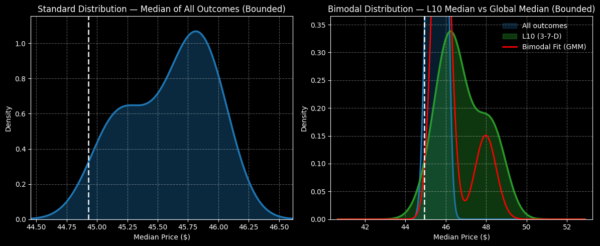
Of course, we don’t have a guarantee that FOX stock will follow prior observed trends; the forecast above is an inference and not a logical deduction. Nevertheless, I believe there’s enough positive variance relative to the random baseline to justify a modest bullish position.
If so, I like the 45/50 bull call spread expiring Aug. 21. Statistically speaking, the $50 strike price falls within the realistic distribution of the aforementioned 3-7-D signal. Additionally, the spread’s breakeven price of $47.55 stands roughly in between the expected distribution’s endpoints.
I must reiterate from a risk management perspective that inferences are always subject to the black swan risk; that is, just because you see a thousand white swans doesn’t mean all swans are white. All it takes is one black swan to enter the picture for the inference to instantly blow up.
Still, I will defend the Markov simulation above as being leagues more insightful than hand-waved assertions of misaligned value. Anyone can make a claim about value based on some arbitrary benchmark. With Markov, we’re at least observing empirical data that can be falsified.