ajax loader

Loading...


Ride-the-Wave Strategy – Best for Stock Traders

Ride-the-Wave targets multi-day price momentum following a company’s earnings announcement (EA). With this strategy:

  1. Buy a stock one day post-EA if a stock reacts positively post-earnings:
    1. Near the close of trading the EA-day for a pre-market-EA
    2. Near the close of the following day for a post-market-EA
  2. Sell-to-close after 7-10 days, or possibly earlier if a desired price target is reached

Similarly,

  1. short a stock one day post-EA if a stock reacts negatively post-earnings:
    1. near the close of trading the EA-day for a premarket-EA
    2. near the close of the following day for a post-market-EA
  2. then buy-to-close after 7-10 days, or possibly earlier if a desired price target is reached

Important: Ride-the-Wave is predicated on significant price momentum triggered by an EA. The 7-10 day scenario is the maximum trade hold-time. If you see post EA-momentum is halted or reversed by a significant opposite move, re-evaluate your presence in the trade.

This popular StockEarnings screen below will give you a list of stocks that historically exhibit significant price momentum following an EA for the next seven days:

  1. Stocks exhibiting positive post-EA price moves are buy-candidates
  2. Stocks exhibiting negative post-EA price moves are sell/short-candidates

The screen includes those stocks whose Earnings just came out in last two days.

Screen criteria:

  1. Earnings Date Start Date : Current Date + -1 Day
  2. Earnings Date End Date : Current Date + -2 Days
  3. Predicted Move (Next Day) Max : 7%
  4. Predicted Move (On 7th Day) Min : 7%

Strategy Guideline:

  1. Buy the stock if stock has reacted positively. Short the stock if stock has reacted negatively (see above).
  2. Close the position in 7-10 days, or possibly earlier based on price move.

Volatility Crush Strategy - Best for Options Traders

The Volatility Crush strategy is used with stocks that typically experience relatively low-to-moderate price moves (≤4%) following their Earnings Announcements (EA). The basic trade idea is to sell put or call options right before the EA, collecting a credit when options premium is very high due to elevated implied volatility (IV). You then close the position right after the EA by buying the option back much cheaper due to the significant drop in IV that occurs after the mystery of the EA disappears. In assessing this trade, you need to do your homework to ensure you collect sufficient premium to make the trade worthwhile.

This trade is practical due to the low-to-moderate price-move after the EA, which generally won’t significantly affect the options price, unlike an “action” stock, which experience great price moves post-EA. With these symbols, if you’re on the right side of the price move, that’s a great thing. But if you’re on the wrong side of the move, not so great. Consequently, by minimizing the effect of the post-EA price move, you have a much better chance to profit from the reduction in IV without it being ruined by a violent price move.

For this trade, open the position either (1) the night before the EA when the company announces earnings or (2) during the EA day when it announces post-market, generally capturing IV at or close to its peak.

For this trade, open the position either (1) the night before the EA when the company announces earnings or (2) during the EA day when it announces post-market, generally capturing IV at or close to its peak.

This popular stockearnings screen will give you a list of stocks which do not react more than 4% fpost-EA. It includes only those stocks whose earnings are releasing next day.

Screen criteria:

  1. Earnings Date Start Date : Current Date + 1
  2. Earnings Date End Date : Current Date + 1
  3. Predicted Move (Next Day) Max : 4%
  4. Options Type: Weekly

Strategy Guideline:

  1. Options Strategy: Sell Call and Put
  2. Options Strike Price: Current Stock Price – (% Predicated Move x 2)
  3. Expiration Date: It should generally be the closest expiry immediately after the EA.
  4. Buy Insurance: Buying back Call and Put at Strike price which 10% lower than Sell Strike Price is optional but recommended.

Watch Video for More Detail

Volatility Rush Strategy - Best for Options Traders

The Volatility Rush takes advantage of increasing options premiums into earnings announcements (EA) caused by an anticipated rise in Implied Volatility (IV). With this strategy, Buy a Call and Put at-the-money (a long straddle) 2-3 weeks before the EA when IV is lower. Sell the position either (1) the night before the EA when the company announces earnings pre-market, or (2) during the EA day when it announces post-market, generally capturing IV at or close to its peak.

This popular screen will give you a list of stocks whose Options premiums tend to rise into Earnings. It includes only those stocks whose Earnings are at least two weeks away from today.

Screen criteria:

  1. Earnings Date Start Date : Current Date + 15 Days
  2. Earnings Date End Date : Current Date + 30 Days
  3. Predicted Move (Next Day) Min : 5%
  4. Options Type: Weekly or Monthly if that lines up with the two to three-week lead-time for entering the trade

Strategy Guideline:

  1. Buy a Straddle at or close to the money two to three weeks pre-EA.
  2. Sell the position either the night before the EA when the company announces earnings pre-market, or during the EA day when it announces post-market.
  3. Expiration date should generally be the closest expiry immediately after the EA.
  4. Straddle price should not be more 60% of predicted move.

Predicted Move (Volatility)

Similar to Implied Volatility in Options. Expected volatility % based on our Proprietary Volatility Predication Model. We are expecting that stock price will likely to reach % in either direction by the end of next trading session after Earnings are released and not necessarily the closing volatility %.

Why is it important?

    This indicator helps

  1. Knowing expected volatility in stocks after Earnings helps to decide trading stocks before Earnings Announcement.
  2. Taking Advantage of volatility collapse following Earnings Results by using Advance Options strategies such as Spread and Straddles.

Since Last Earnings

Change in share price since last Earnings release.

Why is it Important?

When share has gained more than 10% since it's last Earning release, it tends to over react to minor bad news and give up some gains if not all. So, it contains more downside volatility than upside When share has dropped more than 10% since it's last Earning release, it tends to over react to minor good news and recover some drops if not all. So, it contains more upside volatility than downside.

EPS Surprise (%)

Occurs when a company's reported quarterly or annual profits are above or below analysts' expectations. Here is the formula to derive % EPS Surprice:

Actual EPS - Estimated EPS
------------------------------------- x 100
Estimated EPS

Why is it Important?

Earnings surprises can have a huge impact on a company's stock price. Several studies suggest that positive earnings surprises not only lead to an immediate hike in a stock's price, but also to a gradual increase over time. Hence, it's not surprising that some companies are known for routinely beating earning projections. A negative earnings surprise will usually result in a decline in share price.

Next Day Price Change (%)

Next Regular trading session Closing price following Earnings result.

For After Market Close Earnings, It is a next trading day closing price. For Before Market Open Earnings, It is the same trading day closing price.

Why is it Important?

Next Day price change is a reaction of Earnings result.

Despite Ugly Economics, Chipotle (CMG) Stock Might Serve Up Some Upside

Posted on Jun 25, 2026 by Joshua Enomoto

Despite Ugly Economics, Chipotle (CMG) Stock Might Serve Up Some Upside

It’s alarmingly difficult to build a forecast for Chipotle Mexican Grill (NYSE: CMG). Sure, the performance of CMG stock is horrendous, with the equity down more than 16% on a year-to-date basis. Even worse, since mid-June 2024, Chipotle has dropped roughly 53%. What used to be a popular fast-casual outlet has quickly lost favor with discerning investors.

Still, that’s not the basis of my forecasting concerns for CMG stock. In a deterministic system — such as a criminal trial — evidence is additive. The more evidence that is presented, the narrower the probability space becomes for plausible explanations for the event at hand. However, in a non-deterministic system (like the equities market), evidence is multiplicative.

That right there presents a mathematical dilemma for the investment analyst. Basically, the more rigorous a thesis becomes, the less likely it is that the custody of interlinking propositions turns true.

While this concept initially sounds confusing, it’s quite logical. In a criminal trial, something happened. Therefore, evidence accumulates toward an explanation of the crime that occurred. However, in the equities space, the projected outcome is exactly that — a projection. It hasn’t happened and as such, what we would call evidence are really assumptions.

The kicker is that each assumption must be true for the conditioned outcome to materialize. In the case of CMG stock, the bullish argument — at its most distilled — states that the business will remain fundamentally sound and that the share price is now so low that the market will rerate it higher.

At first glance, these two assumptions might seem relatively reasonable. But if we were to assign a confidence level of 70% that each of these factors will ring true, the combined probability that they will simultaneously materialize — and thus lead to a higher CMG stock price — would come out to only 49%.

You might as well flip a coin and that’s the problem. Unless we truly have incredibly high confidence in the assumptions undergirding Chipotle stock, any narrative-based thesis for the security is going to be mathematically weak.

Using an Inductive Approach to Trade CMG Stock


It’s one of the more shocking realizations but most articles that utilize fundamental analysis on volatile securities like CMG stock are likely to be useless. That’s not necessarily because the analysts writing them are incompetent. No, the more plausible answer is the nature of the beast.

If you look at a rock-solid blue chip armed with a durable core business, fundamental analysis should work beautifully. Basically, you would be making two assumptions: first, key financial metrics like growth or earnings will expand and second, that the metrics will be robust enough to attract investor capital.

For a reliable industry leader, you can probably assign a 95% confidence level on both of these factors. Compounded, the probability that these two assumptions will ring true comes out to 90.25% — a strong investment, at least from a plausibility standpoint. However, highly plausible investments tend to generate less-generous returns, which brings us back to CMG stock.

Any assumptions we make about Chipotle at this rough economic juncture will invariably suffer from low confidence. When compounded, the chain of projected implausible events leads to a weak forecast. Fortunately, we can sidestep this problem by considering the conditional structure that leads to various outputs.

For example, Amazon (NASDAQ: AMZN) doesn’t just guess what you will buy. Instead, it runs extensive datamining algorithms and predicts consumer behavior, which correlates with the underlying environment. That’s why Amazon will have umbrellas stacked in warehouse inventory as a storm approaches a major metropolitan area.

We can use a similar principle in the equities market. I think it’s fair to say that most of us accept the presupposition that the equities market is not purely random. And if that is indeed the case, then it stands to reason that a stock will respond differently when coming off from a bullish cycle as opposed to a bearish cycle.

Most importantly, if trading CMG stock based on conditioned signals leads to a forward performance that positively diverges from a random baseline, this dynamic could potentially be exploited. My argument is that because Chipotle stock has recently suffered extensive downside, the next series of movements may be more robust than usual due to mean reversion.

Drilling Deeper into the Numbers for Chipotle Stock

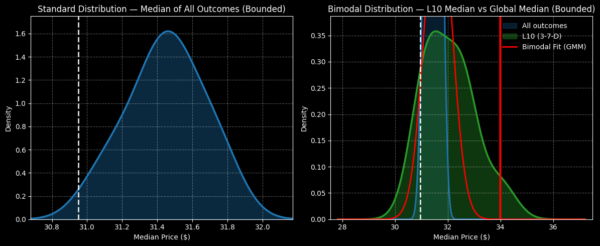
Let’s dig further into the hard numbers. Using a dataset from January 2019 onward, if we were to trade CMG stock randomly and hold it for a 10-week period, the expected forward distribution would be between $30.60 and $32.20 (assuming a closing price of $30.95, Tuesday’s close). Probability density has been observed to peak at around $31.45, meaning that Chipotle enjoys a positive bias.
chipotle-StockEarnings

However, in the last 10 weeks, CMG stock printed only three up weeks, leading to an overall downward slope across the period. Conditioned under this signal, CMG is likely to range between $29 and $36 over the next 10 weeks. It’s fair to point out that peak probability density would likely be similar to the random baseline. Still, the overall expansion of observed outcomes is net positive, which may incentivize bullish speculation.

What’s particularly interesting regarding the above 3-7-D sequence is that in the fourth to fifth week, Chipotle stock has been observed to reach near the $33 level. If these observed trends were to continue this time around, the 32/33 bull call spread expiring July 24 would be a tempting proposition.

As mentioned above, the $33 second-leg strike would represent a realistic target. Further, the spread’s breakeven price of $32.49 adds some modest margin for traders. That comes out to a 5% lift relative to CMG’s most recent closing price. Finally, the nominal cost is arguably very reasonable at $49 per spread.

I can’t tell you whether Chipotle is a good investment opportunity over the long run — the compounded math makes such pronouncements dubious. But if we’re talking about the near-term picture, CMG stock does look intriguing for the risk-tolerant speculator.


Joshua Enomoto is a seasoned financial writer with a strong track record of in-depth stock analysis, offering clear, insightful commentary for retail investors across all levels of expertise. Renowned for his ability to blend analytical rigor with engaging wit, Joshua's work has been featured on leading investment platforms, including TipRanks, InvestorPlace, Barchart, Benzinga, and Fintel. He was also handpicked to spearhead high-impact initiatives such as InvestorPlace's "Trade of the Day" and Benzinga’s ETF coverage. As a frequent guest expert for CGTN America, Joshua discusses a wide range of economic, societal, and consumer market trends. A graduate of U.C. San Diego, Joshua brings a thoughtful and fresh perspective to complex financial narratives, helping enterprise clients connect with their audiences. He also composes music in his spare time.

Join over 1.2M+ investors/traders who receive daily and weekly notable earnings alerts with predicted move