If anyone was waiting for NVIDIA (NASDAQ: NVDA) to show signs that the AI boom was running out of steam, its quarter 3 earnings just put that argument on the back foot. Revenue more than doubled to $115.8 billion, Data Center sales climbed 110% to $107.6 billion, and management expects another $130 billion quarter.
Those figures are staggering for a company already operating at this scale. But the bigger story is the fact that NVIDIA is increasingly securing the supply, infrastructure, and financing needed to keep the AI buildout moving, just as its founder and longtime CEO, Jensen Huang, has exited amid a national security controversy.
The Doubters Have A Demand Problem
NVIDIA’s third-quarter fiscal 2027 revenue increased 103% year over year and 20% sequentially. Data Center accounted for $107.6 billion, with hyperscale revenue growing 71% and AI clouds, industrial and enterprise customers surging 195%. The last figure suggests that demand is spreading beyond the handful of technology giants that initially drove the infrastructure race.
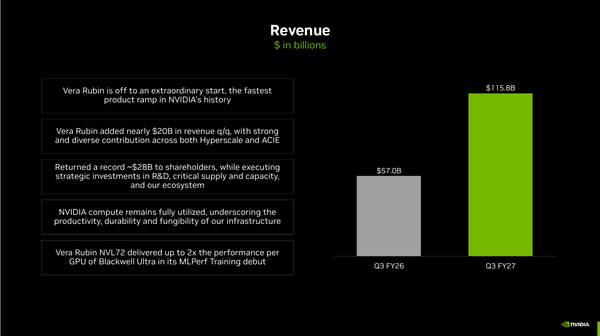
GAAP operating income climbed 115% to $77.5 billion, while diluted EPS rose 108% to $2.70. Management then guided for $130 billion in fourth-quarter revenue, plus or minus 3%. At this scale, the argument that AI demand is just hype holds no water.
The elephant in the room is whether customers can generate enough returns from AI to sustain this spending. Yes, NVIDIA’s results establish that buyers are still ordering at scale, but they do not settle how profitable the wider ecosystem will become.
Expansion Beyond Chips
NVIDIA’s Vera Rubin platform has entered production and begun shipping, with systems operating across partners including Microsoft Azure, Google Cloud, Oracle Cloud Infrastructure and CoreWeave. Its edge comes from selling an integrated computing platform, combining processors, networking, systems and software rather than relying on individual GPU sales.
That gives NVIDIA a deeper position in the infrastructure customers are building. As AI models become more demanding, customers need entire systems capable of processing and moving enormous volumes of data. NVIDIA wants to supply more of that stack, making it harder for customers to replace one component without reconsidering the wider architecture.
Of course, that ambition comes with a bigger responsibility. And NVIDIA just revealed how much it is committing to make that happen.
Future Commitments Reveal The Other Side Of The Boom
NVIDIA disclosed $518 billion in future commitments across supply and capacity, cloud services, data-center leases, equity investments, and capital expenditures. Supply commitments alone reached $390 billion, up from $279 billion the previous quarter, primarily because of multi-year memory procurement. Cloud services and data-center leases added another $102 billion.
These are future commitments, not bills already paid. Still, their scale shows how aggressively the company is preparing for continued demand. More revealing are its arrangements with neocloud providers, which carry up to $32 billion in commitments and depend on those customers securing financing and deploying infrastructure.
Then there are $118 billion in maximum gross guarantees, including $105 billion supporting an Ohio data-center development tied to OpenAI leases. NVIDIA says it has made no payments under these guarantees so far. These arrangements create another connection between NVIDIA’s growth and the financial health of its customers.
The strategy makes sense. NVIDIA can help customers secure infrastructure, sell them the systems that fill it, and potentially participate in the revenue generated by that capacity. But when the supplier also becomes a financier and infrastructure partner, the risks of the AI boom become more interconnected.
The Leadership Scandal Adds a Second Layer Of Uncertainty
There is a reason the phrase “I invested in Jensen’s brain, not the company” resonates with investors. Huang co-founded NVIDIA in 1993 and led it for more than three decades, becoming the strategic architect and public face of the AI infrastructure race. These latest results reflect the decisions and execution of his leadership. They cannot tell us how NVIDIA will perform under someone else.
Huang resigned on Nov. 12 following reports of relationships, including one involving Alice Huang, a former Megaspeed executive whom US intelligence reportedly suspects of passing information to Beijing. Those allegations remain unproven. NVIDIA has said it has no reason to believe company secrets or national security were compromised.
The controversy has also intensified scrutiny of its China exposure. NVIDIA shipped $2.4 billion in Data Center Hopper products to China during Q3, but its Q4 guidance assumes zero Data Center compute revenue from the country.
Huang has said he would be honored to return, while the board chairman has said the board unanimously accepted his resignation and does not intend to reinstate him. That public support for Huang shows how personally investors associate NVIDIA’s success with its founder. His departure creates a genuine succession question, and one spectacular quarter delivered under his leadership cannot take the sting out of that uncertainty.
NVDA Stock Has Already Suffered A Historic Repricing
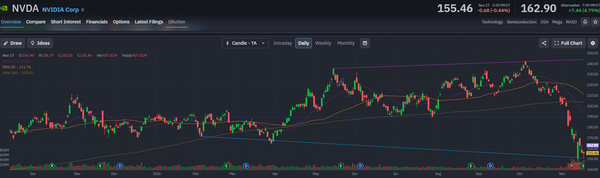
NVDA shares have fallen roughly 35% from the October peak, with the wider selloff wiping out approximately $2 trillion in market value. The decline began amid concerns about AI infrastructure spending and the financing behind it, before Huang’s departure added another source of uncertainty.
The post-earnings close at $155.46 left NVDA below its 20-day average of $192.59, 50-day average of $211.76, and 200-day average of $203.87. The after-hours rebound to $162.90 is encouraging, but the stock still has substantial ground to recover. The $190 area is the first major resistance level, followed by the moving-average cluster above $200.
The AI doubters and doom-mongers now have a lot more to contend with. NVIDIA generated $115.8 billion in revenue, $77.5 billion in operating income, and expects another $130 billion quarter. It also authorized an additional $150 billion in share repurchases, with approximately $227.3 billion remaining under its authorization at quarter-end. That is an extraordinary demonstration of the cash-generating power behind the AI revolution. The demand is real, the earnings are enormous, and the AI doubters have a lot more explaining to do.