For decades, energy stocks rose and fell with the price of a barrel of oil. That link still exists. But for long-term investors, it’s becoming a less useful guide.
That’s because global energy demand keeps climbing. AI data centers, advanced manufacturing and liquefied natural gas (LNG) exports all need reliable power. Much of that demand runs on natural gas. It also runs on the pipelines, processing plants and equipment that move it. Many of those businesses earn fees that are agnostic to commodity prices.
That’s why energy stocks can still anchor a retirement portfolio focused on growth and income. A stock screener of energy names highlights five worth a closer look. Each pays a dividend or distribution. Each carries a Buy or Moderate Buy consensus rating. And each has a consensus price target implying roughly 20% upside or more as of the market close on Nov. 17, 2026.
The takeaway for investors. Oil prices will stay volatile. The long-term trend in energy demand, however, still points higher.
Enbridge: A Toll Road for North American Energy
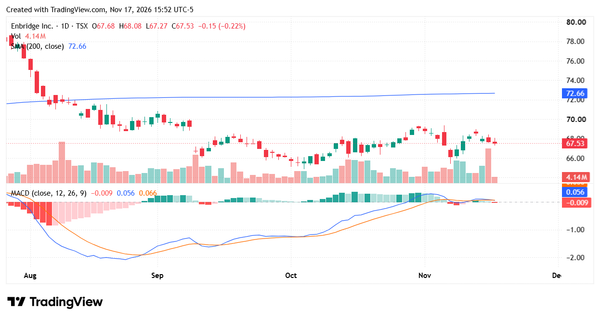
Enbridge (NYSE: ENB) is one of the most familiar energy stocks for income investors. The dividend yields about 5.8%. Analysts rate the stock a Moderate Buy, and the $65.88 consensus price target implies nearly 40% upside.
Enbridge operates pipelines, gas utilities, and renewable power. Most of its cash flow comes from contracts and regulated rates, not commodity prices. In the third quarter, adjusted EBITDA rose to C$4.4 billion from C$4.3 billion. The company also placed more than C$3 billion of gas transmission projects into service.
Growth looks durable. Enbridge has a secured capital backlog of about C$38 billion. Management reaffirmed its 2026 guidance and its medium-term outlook of roughly 5% annual growth. It also points to AI infrastructure as a driver of accelerating energy demand. For a retirement portfolio, that means a dividend backed by contracted assets. A CEO transition takes effect on Jan. 1, 2027.
Williams Companies: Natural Gas Is the Growth Engine
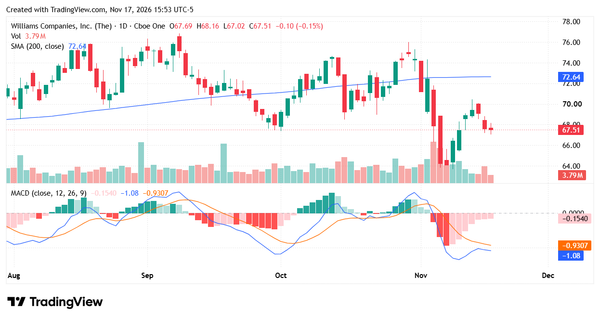
Williams Companies (NYSE: WMB) carries a Buy rating, the strongest consensus rating in this group. The stock’s $86.33 price target implies about 28.5% upside. The dividend yields about 3.1%, and the stock trades at a premium of roughly 26x earnings.
That premium reflects growth. Third-quarter adjusted EPS rose 10% to $0.54. Adjusted EBITDA reached a third-quarter record of $2.04 billion, up 6%. Williams is tracking toward the upper half of its $8.3 billion to $8.5 billion 2026 EBITDA guidance.
Two trends support the story. The Momentum Midstream acquisition deepens Williams’ position in the Haynesville, which management calls the fastest-growing U.S. natural gas basin. The company is also booking new power generation revenue. Meanwhile, the dividend is well covered at 2.42x. Leverage rose to 3.8x as spending increased, which growth and income investors should monitor.
Energy Transfer: High Income With Growth Attached
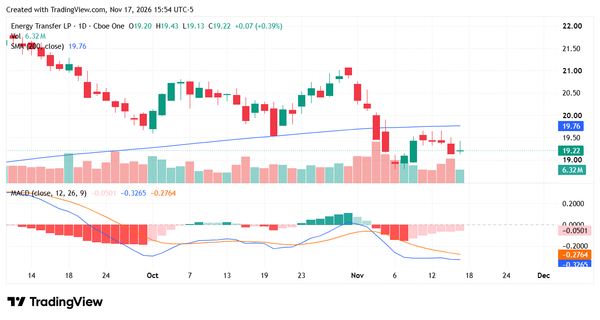
Energy Transfer (ET) offers the highest dividend yield among these energy stocks at about 7.2%. It also has one of the lowest valuations, at roughly 13x earnings. Analysts rate it a Moderate Buy with a $24.73 price target, implying about 29% upside.
Third-quarter results showed strong cash generation. Adjusted EBITDA climbed 31% to $5.03 billion. Distributable cash flow rose 33% to $2.52 billion. Earnings of 33 cents per share missed estimates. But for income investors, cash flow is what funds the distribution.
The latest quarterly distribution of $0.3425 per unit was up more than 3% from a year earlier. It marked the partnership’s twentieth consecutive increase. Energy Transfer is also expanding, with a $2.6 billion Vaquero Midstream deal and a tenth fractionator planned at Mont Belvieu. One caution: as a limited partnership, ET issues a K-1. Holding it in a retirement account can create unrelated business taxable income, so investors should consult a tax advisor.
Canadian Natural Resources: The Oil Producer Built for Downturns
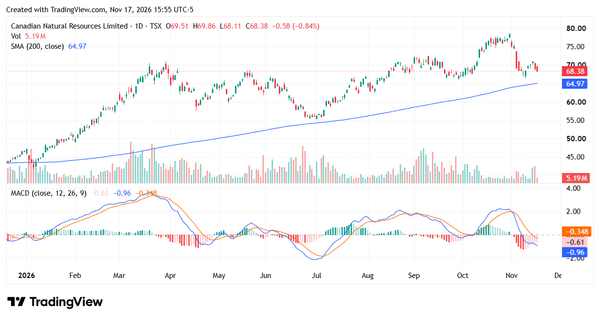
Canadian Natural Resources (NYSE: CNQ) is the only pure producer on this list. It trades at under 10x earnings and yields about 3.8%. The Moderate Buy rating comes with a $57 price target, implying about 19% upside.
Why include an oil producer in a thesis about looking beyond oil prices? Because Canadian Natural doesn’t need high prices to reward shareholders. Its long-life, low-decline assets need less reinvestment than shale wells. In 2026, the company raised its dividend for the 26th consecutive year. Over that span, the payout has grown at a 20% compound annual rate.
The third quarter added to the case. Production averaged about 1.65 million barrels of oil equivalent per day, despite a planned turnaround at its Horizon oil sands site. The company also reached its C$13 billion net debt target. It now plans to direct 100% of free cash flow to share buybacks.
Baker Hughes: Growth From Gas, LNG and Data Centers
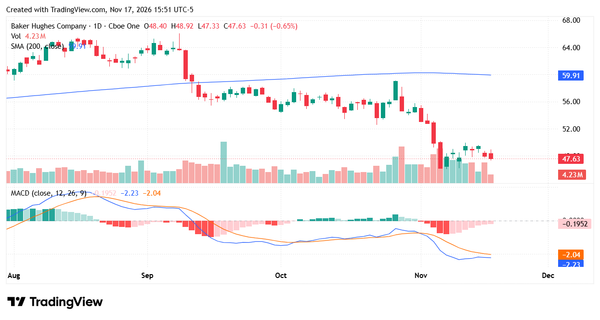
Baker Hughes (NASDAQ: BKR) is the growth engine of this group. Its 1.9% yield is the lowest of the five. But its $70.27 consensus price target implies nearly 48% upside, the most on this list. Analysts rate the stock a Moderate Buy.
Baker Hughes has shifted toward energy technology. Its Industrial & Energy Technology (IET) segment sells equipment for LNG, gas infrastructure, and power generation. In the third quarter, total orders rose 31% to $10.8 billion. IET’s backlog of remaining performance obligations reached a record $39.4 billion.
Management cited demand from data centers, LNG, and gas infrastructure. It raised its IET order outlook to more than $50 billion. Adjusted EPS of $0.70 beat estimates, although GAAP net income fell 33%. That backlog gives Baker Hughes a level of revenue visibility that few oil-linked energy stocks can match.
Energy Stocks Built for the Long Haul
Oil prices will keep making headlines. But a retirement portfolio built for growth and income doesn’t have to live and die by them. These five energy stocks offer different ways to own the long-term demand story. Enbridge, Williams, and Energy Transfer collect fees on rising volumes. Canadian Natural pairs low costs with 26 straight years of dividend growth. Baker Hughes supplies equipment behind the LNG and power buildout. None is immune to volatility, and position sizing still matters. But for long-term investors, durable cash flow matters more than next month’s barrel price.