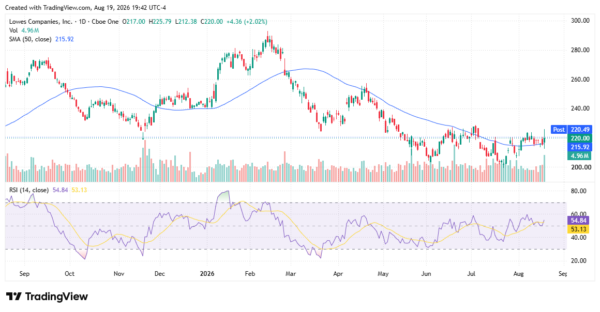
Lowe’s Companies (NYSE: LOW) stock rose more than 2% after the home improvement company delivered its second-quarter 2026 earnings report. Ironically, the company may have had its competitor Home Depot (NYSE: HD) to thank for the market’s response to its report.
Lowe’s delivered a mixed report, with a slight revenue miss offset by a solid beat on adjusted earnings per share (EPS). Both numbers were higher year over year (YOY). However, the report itself confirmed what many investors expected. The do-it-yourself (DIY) market continues to be in a malaise due to a locked-up housing market.
That said, Lowe’s did deliver results that could qualify as better than feared. That’s where Home Depot fits in. Home Depot reported earnings on Aug. 18, the day before Lowe’s. The company beat estimates on both revenue and adjusted EPS, posting $47.86 billion in sales against a $47.23 billion estimate, and adjusted EPS of $4.92 versus a $4.73 forecast. Like Lowe’s, the numbers were higher YOY.
After an initial drop, HD stock closed the day with a slight gain, and the momentum continued after Lowe’s results. The reason wasn’t because of what either company said, but rather what analysts are starting to believe. That is, the worst may be priced into these stocks, creating an opportunity in stocks with a history of delivering a good mix of capital gains and shareholder value.
The Numbers Behind the Headline
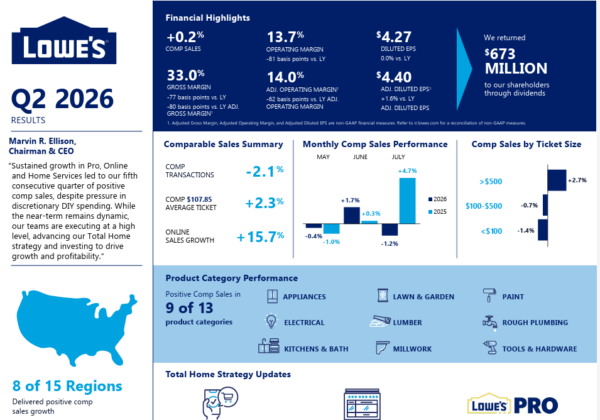
Lowe’s reported diluted EPS of $4.27 for the quarter ended July 31, 2026, flat compared to the same period last year. Adjusted diluted EPS, which strips out $96 million in acquisition-related expenses, came in at $4.40, up 1.6% YOY. Both figures included an 11-cent per-share benefit from IEEPA tariff refunds, a tailwind that offset some of the pressure elsewhere in the business.
Total sales for the quarter reached $26 billion, up from $24 billion a year earlier. Comparable sales inched up just 0.2%, marking the company’s fifth straight quarter of positive comps. That growth leaned heavily on Pro and home services sales, along with a 15.7% jump in online sales, while DIY spending remained soft.
CEO Marvin Ellison credited the “sustained growth in Pro, Online and Home Services” for keeping the streak alive, even as discretionary DIY spending stayed under pressure.
A Trifecta of Trouble to Navigate
That Lowe’s increased revenue from the prior year was an accomplishment. In the earnings report, the company cited the same litany of issues that have plagued the company for the better part of a year:
- Ongoing weakness in the DIY sector
- Residential construction pressure due to a locked-up housing market
- Higher transportation costs due to rising energy prices
And to be fair, that showed up in comparable store sales being essentially flat. Lowe’s is also guided to the lower end of its prior guidance. In fact, the company acknowledged that it was adopting a defensive posture, including what it termed a “disciplined approach to expense management.”
The company narrowed its full-year 2026 outlook across nearly every metric. Total sales guidance tightened to $92 billion, down from a prior range of $92 to $94 billion. Comparable sales guidance shifted from “flat to up 2%” to simply flat. Diluted EPS guidance narrowed to approximately $11.75, the bottom of its previous range, while adjusted diluted EPS guidance settled at roughly $12.25. Operating margin guidance also moved to the low end, now pegged at 11.2%.
None of these revisions is dramatic on its own. Taken together, though, they paint a picture of a management team bracing for a housing market that isn’t turning a corner anytime soon.
Controlling the Controllables
Lowe’s is taking a disciplined approach to capital allocation. This included a temporary pause to its share buyback program, first to fund acquisitions and currently to reduce debt. This is something that investors may be latching onto.
The numbers back that up. Lowe’s repaid $2.4 billion in debt during the first half of 2026, more than triple the $796 million it repaid over the same period last year. Share repurchases, meanwhile, slowed to $366 million in the first half of the year, and the company bought back no stock at all during the second quarter.
Dividends remain untouched. Lowe’s paid out $702 million in dividends during the quarter, up from $673 million a year earlier, and raised its quarterly payout to $1.25 per share from $1.20. That’s a signal the company isn’t treating its dividend as a lever to pull if conditions worsen further.
Firming up the balance sheet with a dividend that’s in no trouble sets the stage for a powerful recovery when business conditions improve. The only question is when that improvement will occur.
With mortgage rates still hovering near 6.7% and housing turnover stuck near multi-year lows, that answer likely isn’t coming from the housing market anytime soon. Instead, both Lowe’s and Home Depot appear to be betting that Pro customers, smaller repair projects, and disciplined cost control can carry results until the housing cycle eventually turns.
For now, investors seem willing to reward that patience. Two beaten-down home improvement stocks posting gains on earnings, even with soft headline numbers, suggest the bar had already been set low. Whether that becomes a durable floor or just a brief reprieve may depend less on what Lowe’s or Home Depot does next quarter, and more on what the Federal Reserve does with interest rates.