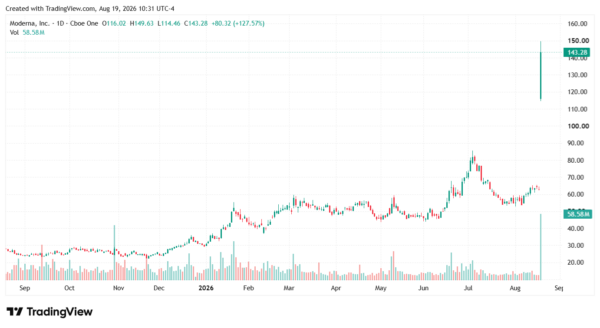
An experimental cancer vaccine from Merck (NYSE: MRK) and Moderna (NASDAQ: MRNA) has shown positive results in a large, late-stage clinical trial, bringing the companies closer to potentially offering a new treatment for people with melanoma.
At the moment, about 1.4 million people currently live with melanoma in the U.S. It’s also estimated that about 234,860 new U.S. cases could be diagnosed this year. We should also note that melanoma is one of the most serious types of skin cancer. It makes up only about 1% of skin cancer cases, but it causes most skin cancer deaths.
The Vaccine is Designed Specifically for Each Patient
It uses mRNA technology to teach the immune system to recognize and attack cancer cells. The treatment is being tested alongside Merck’s Keytruda, a widely used cancer immunotherapy. The Phase 3 trial included more than 1,100 people with high-risk or advanced melanoma. All of the patients had surgery to remove all detectable cancer, but they still faced a high risk of the disease coming back.
Researchers found that patients who received the personalized cancer vaccine along with Keytruda went longer without their melanoma returning than patients who received Keytruda alone. The combination also reduced the risk of the cancer spreading to other parts of the body.
“It’s a big moment for medicine, a big moment for patients,” Moderna CEO Stephane Bancel said in an interview with CNBC.
The Trial Is Not Finished Yet
Researchers will continue to study whether the treatment helps patients live longer overall. Merck and Moderna also plan to present the full results at an upcoming medical meeting.
In addition, the companies have not yet announced when they will ask U.S. regulators to approve the treatment. Dr. Dean Li, president of Merck Research Laboratories, said the companies expect to begin discussions with regulators about the treatment and its safety in the next few months.
Dr. Jane Healy, Merck’s head of oncology early development, said the new treatment could provide patients with another option. She described the results as “very exciting” and said the treatment produced a meaningful improvement compared with Keytruda alone.
The treatment was also generally well tolerated. Healy said the side effects were similar to those seen with other vaccines.
How Does the Personalized Vaccine Work?
One of the most interesting parts of the treatment is that the vaccine is made for each individual patient. Cancer cells can have different genetic mutations from one patient to another. Even two people with the same type of cancer may have tumors with very different characteristics. Merck and Moderna use information from a patient’s tumor to identify specific mutations that could be targeted. They then create a personalized mRNA vaccine designed to help the patient’s immune system recognize those cancer cells.
The goal is to train the immune system to identify and destroy cancer cells that contain those specific markers. The vaccine is then given with Keytruda, which helps the immune system fight cancer by blocking a mechanism that cancer cells can use to hide from the body’s defenses. Together, the two treatments are designed to give the immune system a more powerful and targeted response. “We think [the results are] very meaningful for patients with this disease,” Healy said. She also suggested that the results could point to the potential of personalized cancer vaccines for other types of cancer.
What Comes Next?
The positive melanoma results are especially important for Moderna. The company is looking for new sources of growth beyond its COVID-19 vaccine business, and its cancer vaccine program has become an important part of that effort.
Merck and Moderna are already studying the personalized vaccine in trials involving other cancers, including non-small cell lung cancer, bladder cancer and kidney cancer. The companies still have more work to do before the treatment could become widely available. Researchers need to finish the trial, study whether the treatment helps patients live longer and work with regulators on a possible approval.
Still, the early results are an important step. If future studies continue to show benefits, personalized mRNA cancer vaccines could become a new way of treating cancer — with treatments designed around the unique characteristics of each patient’s tumor rather than using the same approach for everyone.