Oil stocks are proving volatile again, and the Strait of Hormuz is the reason why. Roughly a fifth of the world’s oil still moves through that narrow waterway. When it’s effectively closed, prices swing hard, and oil stocks feel it first.
But oil isn’t stuck. It’s moving, just through different routes. Tankers are rerouting around Africa, pipelines are picking up slack, and buyers are shifting suppliers. Today, that looks inefficient, and shipping costs reflect it.
Still, this disruption may leave a lasting mark. The pandemic exposed how fragile global supply chains really were, and companies responded by rebuilding them. The Strait of Hormuz crisis looks similar. Energy companies are already adjusting how oil gets from wellhead to buyer, and some of those changes will likely outlast the current conflict.
There’s a second force pushing oil prices higher: demand. The AI data center buildout is consuming enormous amounts of power, and much of it still comes from gas- and oil-adjacent infrastructure. Add in a global wave of infrastructure spending, and you get a demand picture that doesn’t depend on Hormuz at all.
Together, these two forces explain why oil prices are likely to stay elevated through the rest of the decade. Below are three oil stocks positioned to benefit, each in a different way: an integrated major, an independent producer, and a pipeline operator.
Chevron Stock Offers Scale, LNG and AI Infrastructure Exposure
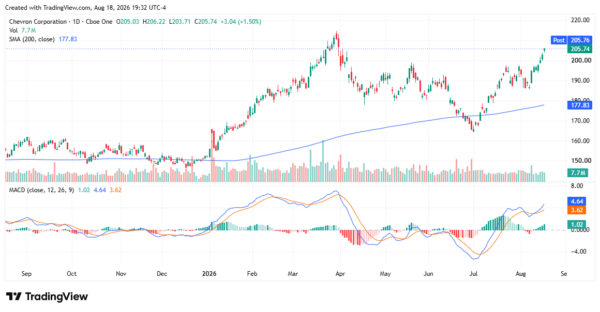
The first name on this list is Chevron Corp. (NYSE: CVX). The integrated oil company is one of the blue-chip names in the sector with a history of increasing shareholder value through stock buybacks and dividends.
In the current economy, Chevron has increased production in North America, particularly in the prized Permian Basin. It is also one of the key exporters of liquified natural gas (LNG), which is becoming more important as the war between Russia and Ukraine continues with no end in sight.
Chevron has recently taken a leading role in the artificial intelligence (AI) infrastructure buildout through a 20-year take-or-pay agreement with Microsoft Corp. (NASDAQ: MSFT) to supply 2.67 gigawatts of behind-the-meter power to a data center complex. The project, known as Project Kirby, is expected to deliver mid-teens returns.
In its Q2 2026 earnings report, Chevron also disclosed that it has already realized $1.5 billion in synergies from its merger with Hess, which puts the company more than six months ahead of schedule.
As of this writing, CVX is up more than 34% in 2026. That’s pushed the stock close to its 52-week high and pushed the company’s price-to-earnings (P/E) ratio up to 19x. However, the stock still appears to be trading at a discount based on its expected free cash flow and earnings per share (EPS) growth.
APA Stock Offers High-Growth Leverage to Rising Oil Prices
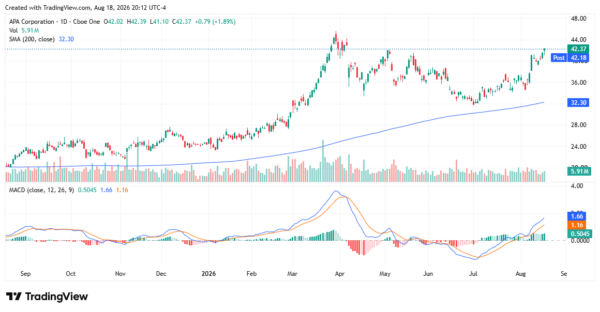
APA Corp. (NYSE: APA) is an independent exploration and production company engaged in the acquisition, development, and production of oil and natural gas resources. The company’s core operations are in the United States, Egypt, and the North Sea.
APA is a tiny company compared to Chevron. In Q2 2026, the company generated $2.37 billion as opposed to the $67.20 billion generated by Chevron. That size also factored into the company’s U.S. oil production, which came in at 123,500 barrels a day, a fraction of the over 1 million barrels per day produced by Chevron.
However, independent producers tend to outperform in times of oil spikes. Plus, if you believe that the conflict surrounding the Strait of Hormuz will change the flow of oil, perhaps permanently, then APA has several projects that may come online later this decade. That may eat into earnings in the short term, but with output and revenue increasing, the balance sheet will remain healthy.
APA is up 73% in 2026 and, like CVX, is trading near its 52-week high. But analysts may be starting to re-rate the stock, which trades at an attractive valuation of around 8x forward earnings.
Kinder Morgan Stock Benefits From Rising Energy Infrastructure Demand
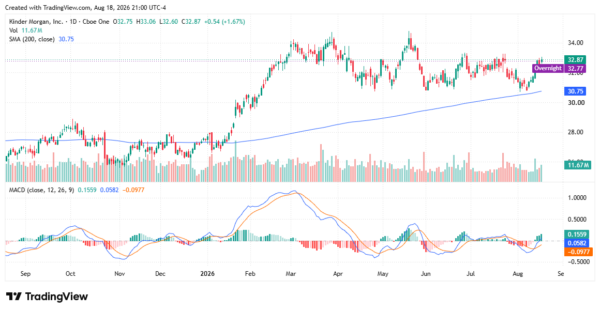
The last stock on this list is a toll booth for oil and natural gas. Kinder Morgan (NYSE: KMI) owns and operates an extensive network of pipelines and terminals across North America. A company like Kinder Morgan is agnostic to the price of oil. What drives growth instead is volume.
In Q2 2026, Kinder Morgan had a beat-and-raise quarter with several highlights that explain why the company is likely to be one of the best oil and gas stocks for the rest of 2026 and beyond.
The company highlighted a robust growth pipeline, with a backlog that remains near record levels and is likely to expand further as demand for gas-fired power and LNG-linked infrastructure accelerates. Kinder Morgan also has several major gas projects that are on schedule and on budget, which will expand its network.
In the short term, Kinder Morgan will continue to benefit from a restricted flow of oil through the Strait of Hormuz. However, that demand for domestically produced and transported energy is only likely to grow.
KMI is up just over 19% this year and, like the other stocks on this list, is trading near its 52-week high. But price targets are rising as is the dividend payout, which the company has now increased for nine consecutive years.
These 3 Stocks Offer Different Ways to Play Higher Oil Prices
Chevron, APA, and Kinder Morgan each offer a different way to play this environment. Chevron brings scale, LNG exposure, and a growing role in AI infrastructure. APA offers leverage to rising prices through smaller, more agile production. Kinder Morgan sidesteps price swings entirely, profiting instead from rising volume across its pipeline network.
What ties them together is the same thesis. The disruption in the Strait of Hormuz is forcing a permanent rethink of how oil moves globally. At the same time, data center buildout and infrastructure spending are driving demand unrelated to the Middle East.
For investors, that’s a signal worth taking seriously. Elevated oil prices may not be a temporary spike tied to one chokepoint. They may be the new baseline for the rest of the decade, and these three stocks are built to benefit from it.