Baidu Inc (NASDAQ: BIDU) has reached the awkward stage of its AI transition where the new business is no longer a side project, but still isn’t large enough to replace what the old business is losing. It’s no wonder why Q2 revenue fell 4% to RMB31.3 billion, while non-GAAP EPS plunged 43% year over year to RMB7.22, giving investors a very different picture from the one suggested by Baidu’s rapidly expanding AI operations.
And that shift inside the company is becoming harder to miss as the Chinese company Core AI-powered Business generated RMB12.5 billion, up 25% year over year, and now accounts for 50% of Baidu General Business revenue, compared with 38% a year ago.
That is enough to tell us Baidu Inc is genuinely changing, but not enough to tell us whether the change is economically working yet.
Because while Baidu’s AI business is getting bigger, the part of the company that used to pay the bills is getting smaller. And the next numbers show just how wide that gap has become.
Baidu’s AI Growth Has A Big Hole To Fill
Baidu’s legacy business has deteriorated quickly enough that the company now needs its AI operations to carry far more weight, with Online Marketing Services revenue falling 19% year over year to RMB13.1 billion and Legacy Business revenue dropping 23% to RMB10.4 billion.
That makes the growth coming from AI Cloud much more consequential than the headline numbers suggest, because AI Cloud Infrastructure revenue jumped 50% to RMB7.3 billion while GPU Cloud revenue surged 283% year over year. Baidu is clearly finding demand for the computing infrastructure behind the AI boom, and that business is becoming large enough to change the company’s revenue mix.
The problem is that the two sides aren’t moving at the same scale yet: AI Cloud added roughly RMB2.4 billion of revenue year over year, while Online Marketing surrendered about RMB3.1 billion, leaving the newer business with a sizeable gap to close before it can fully offset the deterioration in search and advertising.
That tension is also what makes the criticism surrounding Baidu’s aggressive AI investment worth taking seriously as the company is trying to build a much larger AI business while its established profit engine is weakening underneath it, a dynamic highlighted in recent coverage of the results.
I wouldn’t bet against the transition yet, because 283% GPU Cloud growth is far too substantial to dismiss as corporate AI theater; I’d watch whether that growth can become large enough to replace what Baidu is losing elsewhere.
The 283% Surge That Could Change The Economics
The strongest part of the quarter is in the AI Cloud, where GPU Cloud revenue surged 283% year over year, accelerating from 184% growth in the previous quarter. That kind of acceleration is difficult to dismiss, particularly when total AI Cloud Infrastructure revenue also climbed 50% to RMB7.3 billion.
What makes the GPU number even more useful than a flashy growth rate is where it sits inside the broader transition: Baidu is selling the computing capacity needed to support the AI workloads moving through its ecosystem, while its AI-powered business has already reached 50% of General Business revenue.
There is still a lot to prove before that becomes a convincing earnings engine, especially with AI Applications revenue growing only 3% to RMB2.5 billion. The infrastructure side is doing the heavy lifting right now – while the higher-value question is whether Baidu can turn that infrastructure demand into a broader AI business with stronger economics, which is important for the stock, because spectacular infrastructure growth can make a company look transformed long before the income statement actually reflects the transformation. Baidu has the first part now. The next stage is getting the money to follow the growth.
$41.7 Billion Gives The AI Bet Room To Run
Baidu finished 2nd quarter with RMB283.1 billion, or about $41.7 billion, in cash, cash equivalents, restricted cash, short-term investments and long-term investments, while operating cash flow remained positive at RMB3.4 billion for the fourth consecutive quarter.
That gives management something Alibaba Group (NYSE: BABA), Tencent Holdings (OTC: TCEHY)/(HKEX: 0700) and JD.Com (NASDAQ: JD)/ (HKEX: 9618) also have as they pour money into their own AI ambitions – the financial room to wait for those investments to pay off.
Baidu can continue funding AI infrastructure, cloud capacity and applications without having to immediately turn every new investment into a profitable business.
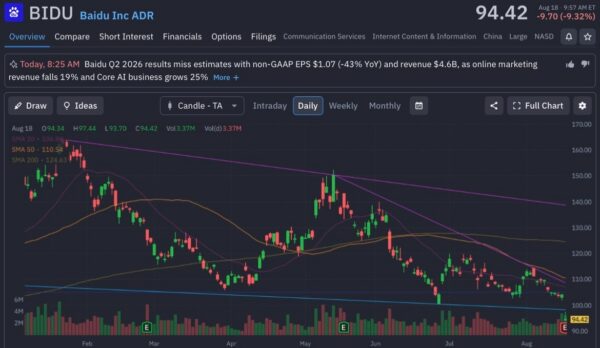
The stock, however, isn’t giving management unlimited time. At $94.42, BIDU has fallen below its 20-day, 50-day and 200-day moving averages, sitting at roughly $106.86, $110.54 and $124.63, respectively. The latest selloff also pushed shares back toward the $90-$100 area that has acted as an important floor on the chart.
That leaves the company with a pretty straightforward job from here – keep growing the AI businesses fast enough to make today’s deterioration in search and advertising look temporary rather than structural.
The Stock Has More To Prove Than The AI Story
At $94.42, BIDU is sitting below every major moving average on the chart, and today’s 9.3% decline has pushed it back toward the $90-$100 area after failing to hold its August rebound. That is not the chart of a stock investors are eagerly pricing for an AI transformation.
The business itself is more complicated. AI Cloud is accelerating, GPU Cloud growth is extraordinary and AI-powered revenue now represents half of Baidu General Business revenue, but advertising is still declining fast enough to drag the consolidated company lower.
Still, I wouldn’t write off the stock here. The balance sheet gives Baidu enough firepower to keep building, and the AI transition has already become too substantial to dismiss. But until that growth starts showing up more convincingly in revenue and earnings, BIDU has something to prove before it deserves a rerating.