ajax loader

Loading...


Ride-the-Wave Strategy – Best for Stock Traders

Ride-the-Wave targets multi-day price momentum following a company’s earnings announcement (EA). With this strategy:

  1. Buy a stock one day post-EA if a stock reacts positively post-earnings:
    1. Near the close of trading the EA-day for a pre-market-EA
    2. Near the close of the following day for a post-market-EA
  2. Sell-to-close after 7-10 days, or possibly earlier if a desired price target is reached

Similarly,

  1. short a stock one day post-EA if a stock reacts negatively post-earnings:
    1. near the close of trading the EA-day for a premarket-EA
    2. near the close of the following day for a post-market-EA
  2. then buy-to-close after 7-10 days, or possibly earlier if a desired price target is reached

Important: Ride-the-Wave is predicated on significant price momentum triggered by an EA. The 7-10 day scenario is the maximum trade hold-time. If you see post EA-momentum is halted or reversed by a significant opposite move, re-evaluate your presence in the trade.

This popular StockEarnings screen below will give you a list of stocks that historically exhibit significant price momentum following an EA for the next seven days:

  1. Stocks exhibiting positive post-EA price moves are buy-candidates
  2. Stocks exhibiting negative post-EA price moves are sell/short-candidates

The screen includes those stocks whose Earnings just came out in last two days.

Screen criteria:

  1. Earnings Date Start Date : Current Date + -1 Day
  2. Earnings Date End Date : Current Date + -2 Days
  3. Predicted Move (Next Day) Max : 7%
  4. Predicted Move (On 7th Day) Min : 7%

Strategy Guideline:

  1. Buy the stock if stock has reacted positively. Short the stock if stock has reacted negatively (see above).
  2. Close the position in 7-10 days, or possibly earlier based on price move.

Volatility Crush Strategy - Best for Options Traders

The Volatility Crush strategy is used with stocks that typically experience relatively low-to-moderate price moves (≤4%) following their Earnings Announcements (EA). The basic trade idea is to sell put or call options right before the EA, collecting a credit when options premium is very high due to elevated implied volatility (IV). You then close the position right after the EA by buying the option back much cheaper due to the significant drop in IV that occurs after the mystery of the EA disappears. In assessing this trade, you need to do your homework to ensure you collect sufficient premium to make the trade worthwhile.

This trade is practical due to the low-to-moderate price-move after the EA, which generally won’t significantly affect the options price, unlike an “action” stock, which experience great price moves post-EA. With these symbols, if you’re on the right side of the price move, that’s a great thing. But if you’re on the wrong side of the move, not so great. Consequently, by minimizing the effect of the post-EA price move, you have a much better chance to profit from the reduction in IV without it being ruined by a violent price move.

For this trade, open the position either (1) the night before the EA when the company announces earnings or (2) during the EA day when it announces post-market, generally capturing IV at or close to its peak.

For this trade, open the position either (1) the night before the EA when the company announces earnings or (2) during the EA day when it announces post-market, generally capturing IV at or close to its peak.

This popular stockearnings screen will give you a list of stocks which do not react more than 4% fpost-EA. It includes only those stocks whose earnings are releasing next day.

Screen criteria:

  1. Earnings Date Start Date : Current Date + 1
  2. Earnings Date End Date : Current Date + 1
  3. Predicted Move (Next Day) Max : 4%
  4. Options Type: Weekly

Strategy Guideline:

  1. Options Strategy: Sell Call and Put
  2. Options Strike Price: Current Stock Price – (% Predicated Move x 2)
  3. Expiration Date: It should generally be the closest expiry immediately after the EA.
  4. Buy Insurance: Buying back Call and Put at Strike price which 10% lower than Sell Strike Price is optional but recommended.

Watch Video for More Detail

Volatility Rush Strategy - Best for Options Traders

The Volatility Rush takes advantage of increasing options premiums into earnings announcements (EA) caused by an anticipated rise in Implied Volatility (IV). With this strategy, Buy a Call and Put at-the-money (a long straddle) 2-3 weeks before the EA when IV is lower. Sell the position either (1) the night before the EA when the company announces earnings pre-market, or (2) during the EA day when it announces post-market, generally capturing IV at or close to its peak.

This popular screen will give you a list of stocks whose Options premiums tend to rise into Earnings. It includes only those stocks whose Earnings are at least two weeks away from today.

Screen criteria:

  1. Earnings Date Start Date : Current Date + 15 Days
  2. Earnings Date End Date : Current Date + 30 Days
  3. Predicted Move (Next Day) Min : 5%
  4. Options Type: Weekly or Monthly if that lines up with the two to three-week lead-time for entering the trade

Strategy Guideline:

  1. Buy a Straddle at or close to the money two to three weeks pre-EA.
  2. Sell the position either the night before the EA when the company announces earnings pre-market, or during the EA day when it announces post-market.
  3. Expiration date should generally be the closest expiry immediately after the EA.
  4. Straddle price should not be more 60% of predicted move.

Predicted Move (Volatility)

Similar to Implied Volatility in Options. Expected volatility % based on our Proprietary Volatility Predication Model. We are expecting that stock price will likely to reach % in either direction by the end of next trading session after Earnings are released and not necessarily the closing volatility %.

Why is it important?

    This indicator helps

  1. Knowing expected volatility in stocks after Earnings helps to decide trading stocks before Earnings Announcement.
  2. Taking Advantage of volatility collapse following Earnings Results by using Advance Options strategies such as Spread and Straddles.

Since Last Earnings

Change in share price since last Earnings release.

Why is it Important?

When share has gained more than 10% since it's last Earning release, it tends to over react to minor bad news and give up some gains if not all. So, it contains more downside volatility than upside When share has dropped more than 10% since it's last Earning release, it tends to over react to minor good news and recover some drops if not all. So, it contains more upside volatility than downside.

EPS Surprise (%)

Occurs when a company's reported quarterly or annual profits are above or below analysts' expectations. Here is the formula to derive % EPS Surprice:

Actual EPS - Estimated EPS
------------------------------------- x 100
Estimated EPS

Why is it Important?

Earnings surprises can have a huge impact on a company's stock price. Several studies suggest that positive earnings surprises not only lead to an immediate hike in a stock's price, but also to a gradual increase over time. Hence, it's not surprising that some companies are known for routinely beating earning projections. A negative earnings surprise will usually result in a decline in share price.

Next Day Price Change (%)

Next Regular trading session Closing price following Earnings result.

For After Market Close Earnings, It is a next trading day closing price. For Before Market Open Earnings, It is the same trading day closing price.

Why is it Important?

Next Day price change is a reaction of Earnings result.

Intuitive Machines’ $1.8 Billion Backlog Is Building A Different Company

Posted on Aug 17, 2026 by Grayson Cavern

Intuitive Machines’ $1.8 Billion Backlog Is Building A Different Company

Intuitive Machines (NASDAQ: LUNR) just delivered the kind of quarter that makes the -$0.29 adjusted EPS headline feel almost deliberately incomplete, because revenue surged to a record $206.2 million, up 310% year over year, while the company continued adding major contracts across the space business. 

The earnings miss is real, and I’m not going to pretend otherwise, but Intuitive Machines is accumulating work at a pace that could fundamentally change the scale of the business, with Q2 bringing $920 million in new awards and another $300 million already awarded in Q3. 

That is where this earnings report starts to get a lot more consequential than the quarterly EPS number, because the company is no longer relying on one lunar mission or one type of customer to carry the story; something much broader is taking shape in the order book, and the numbers are beginning to show it.

This is why I want to start with where that demand is coming from, why national-security work suddenly accounts for 30% of Q2 revenue, and whether the $1.8 billion backlog can turn LUNR’s spectacular revenue growth into a business that eventually produces cash rather than continually consuming it. 

The Moon Is No Longer Carrying LUNR’s Growth


The lunar missions still get most of the attention, but they are no longer doing all the heavy lifting for Intuitive Machines, and that shift is becoming difficult to ignore now that national-security work jumped from 3% of revenue a year ago to 30% in QAMDT

At the same time, Intuitive Machines picked up a $600 million-plus commercial GEO satellite contract, another NASA CLPS award and two prime contracts tied to lunar reconnaissance, while its national-security business added an 18-spacecraft award under the AMDT3 program. 

That is a very different company from the one investors were primarily betting on through its lunar landers. The Moon is still part of the story, but now there are satellites, communications, mission operations, ground infrastructure and defense programs sitting alongside it.

And the order book is starting to look the part – backlog reached $1.76 billion at the end of Q2, compared with just $213.1 million at the end of 2025, after the company booked $1.34 billion in new awards during the first half. 

That changes the risk-reward conversation around LUNR. A bigger and more diversified backlog gives the company considerably more room to grow, but it also raises the bar for execution – and that is where the financials become much more important.

The Backlog Is OutGrowing Cash Generation

There is one part of Intuitive Machines’ numbers that keeps the bullish case from becoming too easy: the company is winning work much faster than it is converting that work into cash.

LUNR finished Q2 with $367 million in cash, but operating cash flow was negative $59.8 million for the quarter and negative $111.9 million through the first six months of 2026. That is not fatal for a company building spacecraft, communications infrastructure and other capital-intensive systems, but it does put a limit on how aggressively I would price in that $1.76 billion backlog.

That puts LUNR in an interesting part of the space race. Rocket Lab? (NYSE: RKT) has been building a vertically integrated space business around launch, spacecraft and satellite systems, while AST SpaceMobile? (NASDAQ: ASTS) is building a satellite network designed to deliver connectivity directly to phones. Intuitive Machines is taking its own route, combining spacecraft manufacturing, lunar infrastructure, communications, ground stations and national-security work into one increasingly broad platform. But investors are ultimately asking how much capital has to go into the business before all that contracted demand becomes durable economics?

Because while backlog gives it visibility, only cash conversion will determine how much of that visibility belongs to shareholders.

LUNR’s $19.34 Test Could Decide What Comes Next

The stock has already done some of the work for the bulls, climbing from the mid-$14 area earlier this month to $19.16, while reclaiming both its 20-day moving average at $14.72 and 50-day at $18.29. The problem is that LUNR is now sitting almost directly beneath its 200-day moving average at $19.34, which has become the first serious technical hurdle.

I wouldn’t call this a breakout yet. A clean move through $19.34, followed by a hold above it, would give the recent recovery more credibility; failure here would leave LUNR trapped beneath a level it has struggled to reclaim.

The setup is still constructive, though, particularly because the stock is attempting to make that move while the fundamental story is expanding rather than deteriorating. If the $1.8 billion backlog keeps converting into revenue and the stock can finally reclaim the 200-day, the market may have to start valuing LUNR as something much bigger than a lunar-lander trade.
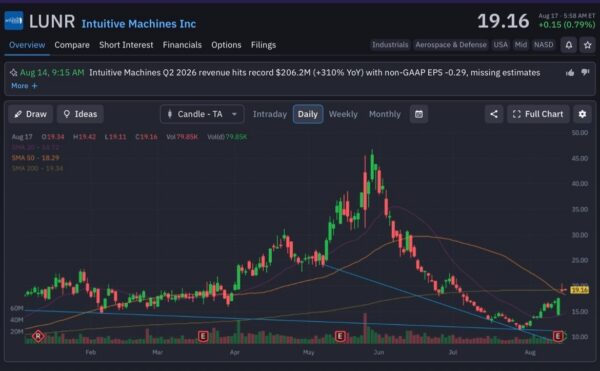
intuitive machines-StockEarnings

More Than A Moonshot, But…

I wouldn’t chase LUNR blindly after the recent run, not with the stock sitting at the 200-day moving average and cash generation still lagging the pace of its expansion. But the $1.76 billion backlog, $920 million of Q2 awards and rapidly expanding national-security business give the bulls something far more substantial than another lunar-landing headline. 

For me, that puts LUNR in the moderate BUY region. The execution risk is real, but so is the transformation underway – and $19.34 is the level I’d want to see the stock conquer next.


Join over 1.2M+ investors/traders who receive daily and weekly notable earnings alerts with predicted move