Football season means something different depending on where you live. In the United States, August is the countdown to college kickoffs and NFL Sundays. In England, football means the Premier League, which opens on Aug. 21. Fresh off a 2026 World Cup summer, plenty of new bettors may be looking to put their tournament strategies to work.
Even without the Premier League in the mix, football drives more sportsbook revenue than any other sport in America. That combination of a global season starting abroad and a domestic season looming makes this a good moment to check in on three of the biggest names in gaming: DraftKings (NASDAQ: DKNG), Flutter Entertainment (NYSE: FLUT), and MGM Resorts (NYSE: MGM).
Each company is fighting a different version of the same battle. That is, proving that traditional sports betting can continue to grow even as prediction markets reshape how people wager on games.
Here’s how each company is positioned as football season gets underway, and why prediction markets complicate the picture for all three.
DraftKings: Can Scale Help It Outrun Prediction Markets?
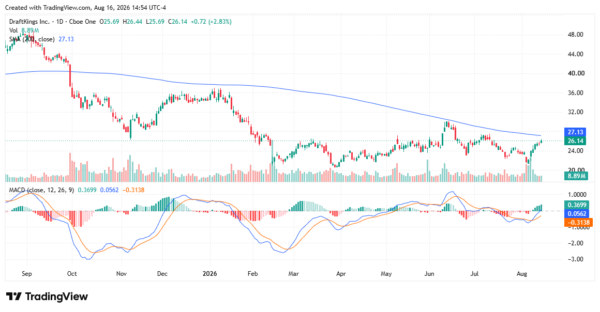
DraftKings enters the football season under real pressure. Shares are down roughly 24% year-to-date as of the market close on Aug. 14. In Q2 2026, the company’s revenue and adjusted earnings per share (EPS) came in below analysts’ estimates and were lower year over year. Much of that pressure traces back to prediction markets.
The company isn’t standing still. In December 2025, DraftKings launched its own prediction market platform, DraftKings Predictions, to compete directly with rivals like Kalshi. The product reuses DraftKings’ existing sportsbook licensing, wallet, and KYC infrastructure, providing sportsbook-grade liquidity for major sports like the NFL and NBA.
That brand strength is DraftKings’ best case heading into football season. Millions of existing customers already trust the app. Whether that loyalty holds against lower-fee, nationwide competitors is the question investors are pricing in right now.
Flutter Entertainment: Global Growth Offers a Cushion
Flutter, the parent of FanDuel, is leaning on an international scale to offset a rougher U.S. picture. First-quarter revenue rose 17% year-over-year to $4.3 billion, with international EBITDA reaching $587 million, helping offset weaker U.S. performance.
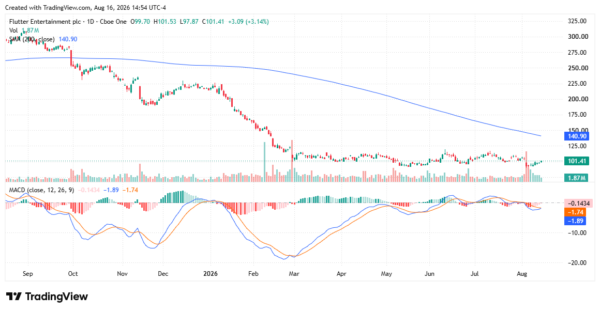
But the second quarter told a tougher story, which shows up in a stock that’s down 52% in 2026. Flutter missed second-quarter earnings expectations, cut full-year U.S. profit guidance by 22%, and announced that CEO Peter Jackson will depart at the end of the quarter. The company is now investing roughly $270 million of additional EBITDA into its U.S. business through the back half of 2026, aimed at winning back share.
Flutter is also playing offense in the prediction markets. FanDuel Predicts is backed by a reported $300 million investment and a partnership with Crypto.com targeting all 50 states. With the World Cup already behind it and the NFL season next, Flutter’s global footprint gives it flexibility DraftKings doesn’t have — but leadership turnover adds its own uncertainty.
MGM: Resorts Give Investors a More Diversified Bet
MGM offers a different kind of exposure. Its Las Vegas Strip and regional casino business gives it a cushion that pure-play sportsbooks lack. That was on display in the company’s Q2 2026 earnings report, in which it beat on both the top and bottom lines. However, adjusted EPS was lower year over year.
Revenue from MGM’s Las Vegas resorts rose 3% to $2.2 billion, and Macau rebounded following the World Cup. The digital side, run through the BetMGM joint venture with Entain, has been choppier. Second-quarter net revenue rose 3% to $711 million, but adjusted EBITDA fell 14% to $74 million, pressured by prediction-market competition and unusually customer-friendly betting outcomes. BetMGM now expects full-year net revenue and EBITDA toward the lower end of its existing guidance range.
Still, MGM’s physical footprint means it isn’t betting the whole company on digital wagering. Analysts expect a sizable earnings drop for MGM in 2026, though some see the stock as undervalued on a cash-flow basis. That combination of resort cash flow and digital upside makes MGM the most diversified of the three.

Prediction Markets Could Reshape Sports Betting
This is where the football-season story gets complicated. Prediction markets like Kalshi and Polymarket let users trade contracts on game outcomes, often at lower fees than a traditional sportsbook. DraftKings charges roughly 4.5% in vig on a typical bet, compared with 1% to 2% for prediction-market platforms.
The “friend or foe” debate genuinely splits opinion. One investor argues DraftKings’ aggressive move into its own prediction market validates the category as much as it competes with it, even as DraftKings’ CEO pushes back on claims that rivals pose a real threat. BetMGM’s leadership, by contrast, has said it’s seen little measurable impact on its existing customer base so far.
For investors, that disagreement is worth noting. Prediction markets could expand the total pool of bettors — or simply take a cut of the pie.
DraftKings, Flutter, and MGM are all playing football season with a similar hand: strong brands, real football-driven demand, and a prediction-market wildcard nobody has fully solved. DraftKings offers the purest bet on sports betting brand loyalty. Flutter offers global diversification paired with fresh leadership risk. MGM offers a real-asset hedge that neither pure digital name can match.
None of these stocks is a sure thing this season. But for investors comfortable with volatility, football’s return gives all three a genuine catalyst to watch.