ajax loader

Loading...


Ride-the-Wave Strategy – Best for Stock Traders

Ride-the-Wave targets multi-day price momentum following a company’s earnings announcement (EA). With this strategy:

  1. Buy a stock one day post-EA if a stock reacts positively post-earnings:
    1. Near the close of trading the EA-day for a pre-market-EA
    2. Near the close of the following day for a post-market-EA
  2. Sell-to-close after 7-10 days, or possibly earlier if a desired price target is reached

Similarly,

  1. short a stock one day post-EA if a stock reacts negatively post-earnings:
    1. near the close of trading the EA-day for a premarket-EA
    2. near the close of the following day for a post-market-EA
  2. then buy-to-close after 7-10 days, or possibly earlier if a desired price target is reached

Important: Ride-the-Wave is predicated on significant price momentum triggered by an EA. The 7-10 day scenario is the maximum trade hold-time. If you see post EA-momentum is halted or reversed by a significant opposite move, re-evaluate your presence in the trade.

This popular StockEarnings screen below will give you a list of stocks that historically exhibit significant price momentum following an EA for the next seven days:

  1. Stocks exhibiting positive post-EA price moves are buy-candidates
  2. Stocks exhibiting negative post-EA price moves are sell/short-candidates

The screen includes those stocks whose Earnings just came out in last two days.

Screen criteria:

  1. Earnings Date Start Date : Current Date + -1 Day
  2. Earnings Date End Date : Current Date + -2 Days
  3. Predicted Move (Next Day) Max : 7%
  4. Predicted Move (On 7th Day) Min : 7%

Strategy Guideline:

  1. Buy the stock if stock has reacted positively. Short the stock if stock has reacted negatively (see above).
  2. Close the position in 7-10 days, or possibly earlier based on price move.

Volatility Crush Strategy - Best for Options Traders

The Volatility Crush strategy is used with stocks that typically experience relatively low-to-moderate price moves (≤4%) following their Earnings Announcements (EA). The basic trade idea is to sell put or call options right before the EA, collecting a credit when options premium is very high due to elevated implied volatility (IV). You then close the position right after the EA by buying the option back much cheaper due to the significant drop in IV that occurs after the mystery of the EA disappears. In assessing this trade, you need to do your homework to ensure you collect sufficient premium to make the trade worthwhile.

This trade is practical due to the low-to-moderate price-move after the EA, which generally won’t significantly affect the options price, unlike an “action” stock, which experience great price moves post-EA. With these symbols, if you’re on the right side of the price move, that’s a great thing. But if you’re on the wrong side of the move, not so great. Consequently, by minimizing the effect of the post-EA price move, you have a much better chance to profit from the reduction in IV without it being ruined by a violent price move.

For this trade, open the position either (1) the night before the EA when the company announces earnings or (2) during the EA day when it announces post-market, generally capturing IV at or close to its peak.

For this trade, open the position either (1) the night before the EA when the company announces earnings or (2) during the EA day when it announces post-market, generally capturing IV at or close to its peak.

This popular stockearnings screen will give you a list of stocks which do not react more than 4% fpost-EA. It includes only those stocks whose earnings are releasing next day.

Screen criteria:

  1. Earnings Date Start Date : Current Date + 1
  2. Earnings Date End Date : Current Date + 1
  3. Predicted Move (Next Day) Max : 4%
  4. Options Type: Weekly

Strategy Guideline:

  1. Options Strategy: Sell Call and Put
  2. Options Strike Price: Current Stock Price – (% Predicated Move x 2)
  3. Expiration Date: It should generally be the closest expiry immediately after the EA.
  4. Buy Insurance: Buying back Call and Put at Strike price which 10% lower than Sell Strike Price is optional but recommended.

Watch Video for More Detail

Volatility Rush Strategy - Best for Options Traders

The Volatility Rush takes advantage of increasing options premiums into earnings announcements (EA) caused by an anticipated rise in Implied Volatility (IV). With this strategy, Buy a Call and Put at-the-money (a long straddle) 2-3 weeks before the EA when IV is lower. Sell the position either (1) the night before the EA when the company announces earnings pre-market, or (2) during the EA day when it announces post-market, generally capturing IV at or close to its peak.

This popular screen will give you a list of stocks whose Options premiums tend to rise into Earnings. It includes only those stocks whose Earnings are at least two weeks away from today.

Screen criteria:

  1. Earnings Date Start Date : Current Date + 15 Days
  2. Earnings Date End Date : Current Date + 30 Days
  3. Predicted Move (Next Day) Min : 5%
  4. Options Type: Weekly or Monthly if that lines up with the two to three-week lead-time for entering the trade

Strategy Guideline:

  1. Buy a Straddle at or close to the money two to three weeks pre-EA.
  2. Sell the position either the night before the EA when the company announces earnings pre-market, or during the EA day when it announces post-market.
  3. Expiration date should generally be the closest expiry immediately after the EA.
  4. Straddle price should not be more 60% of predicted move.

Predicted Move (Volatility)

Similar to Implied Volatility in Options. Expected volatility % based on our Proprietary Volatility Predication Model. We are expecting that stock price will likely to reach % in either direction by the end of next trading session after Earnings are released and not necessarily the closing volatility %.

Why is it important?

    This indicator helps

  1. Knowing expected volatility in stocks after Earnings helps to decide trading stocks before Earnings Announcement.
  2. Taking Advantage of volatility collapse following Earnings Results by using Advance Options strategies such as Spread and Straddles.

Since Last Earnings

Change in share price since last Earnings release.

Why is it Important?

When share has gained more than 10% since it's last Earning release, it tends to over react to minor bad news and give up some gains if not all. So, it contains more downside volatility than upside When share has dropped more than 10% since it's last Earning release, it tends to over react to minor good news and recover some drops if not all. So, it contains more upside volatility than downside.

EPS Surprise (%)

Occurs when a company's reported quarterly or annual profits are above or below analysts' expectations. Here is the formula to derive % EPS Surprice:

Actual EPS - Estimated EPS
------------------------------------- x 100
Estimated EPS

Why is it Important?

Earnings surprises can have a huge impact on a company's stock price. Several studies suggest that positive earnings surprises not only lead to an immediate hike in a stock's price, but also to a gradual increase over time. Hence, it's not surprising that some companies are known for routinely beating earning projections. A negative earnings surprise will usually result in a decline in share price.

Next Day Price Change (%)

Next Regular trading session Closing price following Earnings result.

For After Market Close Earnings, It is a next trading day closing price. For Before Market Open Earnings, It is the same trading day closing price.

Why is it Important?

Next Day price change is a reaction of Earnings result.

Can Lockheed Martin Deliver After Backlog Of Back-Breaking Missile Demand?

Posted on Jul 24, 2026 by Grayson Cavern

Can Lockheed Martin Deliver After Backlog Of Back-Breaking Missile Demand?

Lockheed Martin Corp (NYSE: LMT) reported second-quarter sales of $20.1 billion, up 11% year-over-year, with diluted EPS of $7.94, $2.9 billion in free cash flow, $65 billion in new orders, and a record $230 billion backlog… numbers strong enough to send the stock surging 10.54% to $568.59 on 3.28 million shares, one of the heaviest trading sessions of the year.

The headline read exactly as investors expected from a defense contractor riding elevated global military spending. 

But here’s the thing, for the better part of two years, the debate surrounding Lockheed Martin centered on one question: would governments sustain elevated defense spending once geopolitical tensions eventually cooled, or would today’s order books prove temporary? 

This quarter makes that question feel outdated because a $230 billion backlog isn’t projected demand, but a contracted work. Management then spent more time discussing production agreements, manufacturing partnerships, and munitions ramps than convincing investors demand still exists, and that shift in emphasis tells you more about where this business actually stands than any single metric in the release.

Why The Factory Must Come Alive Now 


The clearest evidence of that shift is where the backlog is growing. Missiles and Fire Control backlog nearly doubled to $87.9 billion from $46.7 billion at the end of 2025, accounting for more than the entire increase in Lockheed’s consolidated backlog during the first half of the year alone. Segment sales rose 19% to $4.1 billion, driven by higher production on PAC-3, THAAD, and the Precision Strike Missile program, and none of those are new demand signals. They’re production signals, confirming that the commercial argument has already been won and the industrial argument is only now beginning.

Jim Taiclet reinforced that framing throughout the earnings release. Alongside the $35 billion multi-year THAAD contract announced earlier this year, he highlighted the company’s agreement with Rheinmetall to co-produce ATACMS in Europe and its collaboration with General Motors Defense to expand manufacturing capabilities. A CEO who is negotiating co-production agreements across multiple continents is not a CEO still selling the product. That’s a dedicated chief trying to build enough of it, and as such, it carries real investment implications because winning contracts only creates backlog, but expanding production capacity determines how fast that backlog converts into revenue, cash flow, and shareholder returns.

Market Just Repriced The Business

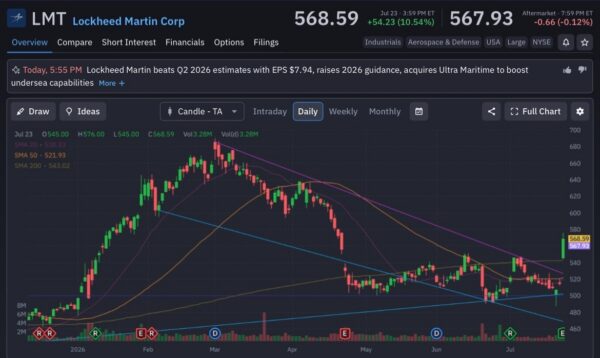
Lockheed Martin (NYSE: LMT) spent most of the past five months trapped in a downtrend that rejected every meaningful rally attempt. The 20-day moving average at $520.33 and the 50-day at $521.93 acted as consistent overhead resistance as institutions questioned whether defense spending had peaked after an extraordinary multi-year run. The stock made a series of lower highs from the March peak near $680, and each bounce into the declining moving averages met sellers who weren’t yet convinced the execution story justified a higher price.

Thursday’s session changed that picture decisively. Shares opened at $545.00, ran to an intraday high of $576.00, and closed at $568.59 on 3.28 million shares, volume that dwarfs every session visible on the daily chart and confirms this wasn’t retail enthusiasm chasing an earnings headline. Institutions were repricing the business. The stock sliced through both the 20-day and 50-day moving averages in a single session, closing well above both, while the 200-day at $543.02, which had acted as a gravitational floor during the deepest part of the decline, now sits below current price as potential support rather than resistance.

The next meaningful test sits near the declining long-term trendline in the high-$570s to low-$580s, where the stock found sellers repeatedly since March. Clearing that level would complete a decisive structural break from the multi-month downtrend and shift the conversation from whether the stock deserves to recover toward whether it deserves to make new highs.
lockheed martin-StockEarnings

How I’m Playing This

I’ll be direct about where I stand. The demand debate is already settled. What I’m watching now is the execution debate, which is only beginning, and I think that’s the more interesting investment question for the next several quarters.

What I find most compelling about Taiclet’s commentary is what he didn’t spend time on. He didn’t defend demand. He didn’t cite geopolitical tailwinds or argue that defense budgets would remain elevated. He talked about production agreements, co-manufacturing partnerships, and capacity expansion, the language of a company whose biggest bottleneck has moved from the sales floor to the factory floor. That’s exactly the phase transition I want to own in a defense contractor, because it means incremental revenue growth no longer requires incremental selling, it requires incremental building.

The breakout above the 20-day and 50-day on record volume tells me institutions agree with that read. I’d be comfortable owning Lockheed at current levels with the 200-day at $543.02 as the first meaningful support to watch on any pullback, and the declining trendline near $580 as the level that determines whether this is a sustained re-rating or simply a post-earnings pop. If the stock consolidates above the moving averages over the next couple of sessions, the structure is clean enough to hold with conviction. The execution debate is just beginning and so is the next phase of this chart.


Join over 1.2M+ investors/traders who receive daily and weekly notable earnings alerts with predicted move