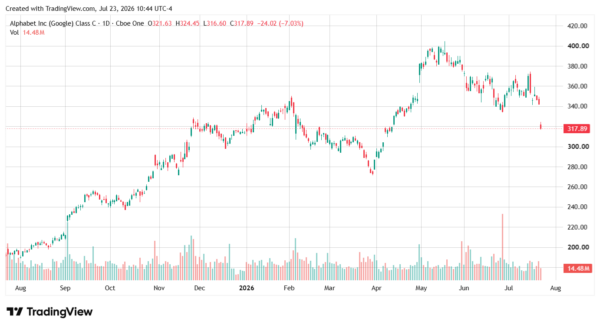
Alphabet (NASDAQ: GOOG) had another strong quarter, beating Wall Street’s revenue expectations thanks to booming demand for artificial intelligence and cloud computing. But while the company’s business continues to grow, investors were more focused on one thing: how much it plans to spend to stay ahead in the AI race.
The Google parent reported better-than-expected revenue, led by Google Cloud, where sales jumped more than 80% from a year earlier. The results show that Alphabet is benefiting from growing demand for AI services as businesses continue investing in cloud computing.
Still, the strong earnings weren’t enough to keep the Street happy.
GOOG said it now expects to spend between $195 billion and $205 billion on capital expenditures this year, up from its previous forecast of $180 billion to $190 billion. The increased spending will help fund new data centers, AI infrastructure and the development of more advanced AI models.
The higher investment plans sent shares down.
AI Remains Alphabet’s Top Priority
Alphabet has been moving quickly to roll out AI products across its business. The company has integrated its Gemini AI model into Google Search, launched the Gemini Spark personal AI agent and expanded Google AI Studio for developers building AI applications.
The challenge is that all of those initiatives require enormous investment. With competition heating up—especially from Chinese AI companies—Alphabet believes it needs to keep spending aggressively to remain a leader.
Many Wall Street analysts agree.
Roth analysts mentioned that Alphabet’s rising AI costs could pressure profits over time, but believe the spending is necessary. “We are increasingly worried about long-term structural capital requirements to keep Google winning,” said the firm, as quoted by CNBC. “But we view rising capital expenditures as necessary to capture a rapidly expanding AI market.”
Their advice to investors was simple: buy the stock after the pullback. Roth maintained its Buy rating and a $440 price target.
Wall Street Still Sees Upside
Several other firms also remained bullish, even after lowering their price targets to reflect the higher spending outlook.
Citizens kept its Outperform rating and has one of the highest price targets on the Street at $515. Analysts said the bigger question isn’t how much Alphabet is spending on AI, but whether those investments continue to produce strong returns. So far, he believes they have.
JPMorgan also sees the recent weakness as a buying opportunity. Analysts lowered their price target to $420 from $460 but said GOOG is already seeing returns from its AI investments across Search, Google Cloud, and subscription businesses.
Evercore ISI took a similar view. Although the firm expects higher spending to reduce future free cash flow, analysts said GOOG’s long-term investment story remains intact. Evercore maintained its Outperform rating and a $420 price target.
Cantor Fitzgerald also lowered its target to $420 while keeping its Overweight rating. Analysts called the second quarter a strong one and pointed to Alphabet’s continued work on Gemini 4, its next-generation AI model, as another reason to stay positive on the stock.
Citi remained optimistic as well, keeping its Buy rating and $447 price target. Analysts said Alphabet’s AI investments are already driving growth in both Search and Cloud and should continue supporting the business over time.
Alphabet: The Bottom Line
Overall, Wall Street’s message was largely consistent. Alphabet’s higher AI spending may weigh on profits and cash flow in the near term, but most analysts believe those investments are necessary to maintain the company’s leadership in artificial intelligence.
While investors reacted negatively to the increased spending guidance, analysts largely see the pullback as a short-term concern rather than a change to Alphabet’s long-term outlook. With Google Cloud growing rapidly, AI products expanding across its ecosystem, and most firms maintaining Buy or Outperform ratings, many believe GOOG remains well-positioned for future growth despite the higher costs.