General Motors Company (NYSE: GM) published four separate documents around its second-quarter results: a Q2 earnings release, a shareholder letter, a U.S. sales release, and a China sales release. Each had a different audience, different purpose. All four kept returning to the same idea. Not market share, deliveries, or even volume.
For an automaker, that should feel strange. The entire industry has been built around one number for a century. Units sold. Yet General Motors’ own communications barely defend unit growth, they keep circling back to pricing, margins, product mix, manufacturing flexibility, software, insurance, and capital discipline. I’ve been watching earnings releases long enough to notice when a company is quietly trying to change the conversation investors are having about it. This one is doing exactly that, and I think it’s actually working.
Beyond The Income Statement
Adjusted EBIT climbed nearly 30% to $3.9 billion. Adjusted EPS rose 41% to $3.57. Adjusted automotive free cash flow surged 78% to $5.0 billion, and management raised full-year adjusted EBIT guidance to $14.0–$16.0 billion – the second guidance raise this year, which nobody seems to be talking about nearly enough. The obvious explanation would be stronger demand. GM’s own sales releases tell you it wasn’t that at all.
The U.S. sales release opens by celebrating General Motors’ position as America’s best-selling automaker for the quarter, then immediately acknowledges deliveries fell 4%, blaming a smaller EV market, discontinued models, and inventory constraints. Then the language shifts; management starts talking about inventory discipline, pricing discipline, and incentives that protected margins rather than chased volume. China follows the same script, leading not with units but with product mix improvement and expansion into higher-value segments. Mary Barra’s shareholder letter doesn’t celebrate deliveries either. It points to software, GM Defense, GM Insurance, manufacturing flexibility, and next-generation truck launches as the engines of what comes next. Three different documents. One message. And I find it genuinely refreshing.
This Is A Different Operating Philosophy
The new GM’s philosophy is simple: software generates revenue after the vehicle leaves the dealership. Insurance extends the economic relationship with the customer past the point of sale. Manufacturing flexibility lets the company protect margins when trade policy or demand shifts faster than a traditional production schedule can handle. Premium trucks generate higher earnings per unit without needing higher industry volumes to justify them. Capital discipline determines how much of those earnings actually reaches shareholders.
None of that requires selling more cars. It requires extracting more value from the cars already being sold. That’s an underappreciated distinction in how most people are still modeling this business.
The numbers back it up too. North America adjusted EBIT margin expanded from 6.1% to 8.6% on modest revenue growth. Adjusted EPS increased more than 40%. Automotive free cash flow nearly doubled. And management raised guidance despite absorbing approximately $1.5 billion of tariff-related costs this year. They didn’t ask investors to give them a pass on the macro headwinds. They absorbed them and raised anyway. That’s confidence in the operating model, not just the environment.
The Market Is Still Deciding
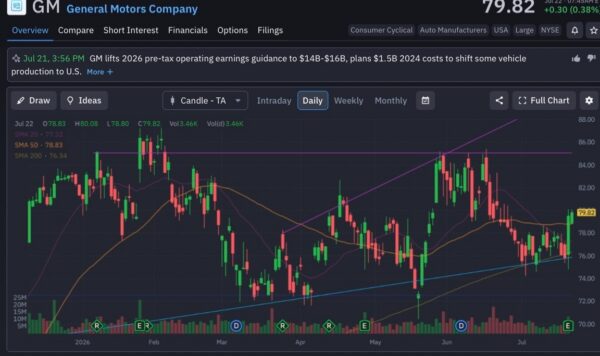
General Motors’ chart reflects a market that’s becoming more constructive but hasn’t fully committed to a re-rating. After rebounding from its June pullback, the stock reclaimed both its 50-day moving average ($78.83) and remains comfortably above its 200-day moving average ($76.34), preserving the longer-term uptrend. More importantly, each selloff since April has produced a higher low, suggesting institutional buyers continue stepping in on weakness. The remaining hurdle sits around $85, where multiple rallies have stalled this year. A decisive breakout above that level would signal investors are beginning to price GM’s improving earnings quality rather than continuing to value the company primarily as a cyclical automaker.
It’s Not An Accident
I’ve read a lot of automotive earnings releases. Most of them are variations of the same story: here’s how many cars we sold, here’s what we think macro does next quarter, here’s why our volume will recover. GM’s release this cycle reads differently, and that’s not an accident.
Now the company is asking investors to value a business that extracts more profit from fewer sales, compounds recurring revenue through software and insurance, and has enough manufacturing flexibility to protect margins when the world doesn’t cooperate. That’s a more interesting business than the one the $85 ceiling is currently pricing. If the next couple of quarters keep delivering the same message – margins expanding, cash flow strengthening, guidance moving higher without volume doing the heavy lifting – then the multiple has to follow eventually.
The old GM competed for the most sales. This one seems to be competing for the most profitable ones. I know which version I’d rather own.