ajax loader

Loading...


Ride-the-Wave Strategy – Best for Stock Traders

Ride-the-Wave targets multi-day price momentum following a company’s earnings announcement (EA). With this strategy:

  1. Buy a stock one day post-EA if a stock reacts positively post-earnings:
    1. Near the close of trading the EA-day for a pre-market-EA
    2. Near the close of the following day for a post-market-EA
  2. Sell-to-close after 7-10 days, or possibly earlier if a desired price target is reached

Similarly,

  1. short a stock one day post-EA if a stock reacts negatively post-earnings:
    1. near the close of trading the EA-day for a premarket-EA
    2. near the close of the following day for a post-market-EA
  2. then buy-to-close after 7-10 days, or possibly earlier if a desired price target is reached

Important: Ride-the-Wave is predicated on significant price momentum triggered by an EA. The 7-10 day scenario is the maximum trade hold-time. If you see post EA-momentum is halted or reversed by a significant opposite move, re-evaluate your presence in the trade.

This popular StockEarnings screen below will give you a list of stocks that historically exhibit significant price momentum following an EA for the next seven days:

  1. Stocks exhibiting positive post-EA price moves are buy-candidates
  2. Stocks exhibiting negative post-EA price moves are sell/short-candidates

The screen includes those stocks whose Earnings just came out in last two days.

Screen criteria:

  1. Earnings Date Start Date : Current Date + -1 Day
  2. Earnings Date End Date : Current Date + -2 Days
  3. Predicted Move (Next Day) Max : 7%
  4. Predicted Move (On 7th Day) Min : 7%

Strategy Guideline:

  1. Buy the stock if stock has reacted positively. Short the stock if stock has reacted negatively (see above).
  2. Close the position in 7-10 days, or possibly earlier based on price move.

Volatility Crush Strategy - Best for Options Traders

The Volatility Crush strategy is used with stocks that typically experience relatively low-to-moderate price moves (≤4%) following their Earnings Announcements (EA). The basic trade idea is to sell put or call options right before the EA, collecting a credit when options premium is very high due to elevated implied volatility (IV). You then close the position right after the EA by buying the option back much cheaper due to the significant drop in IV that occurs after the mystery of the EA disappears. In assessing this trade, you need to do your homework to ensure you collect sufficient premium to make the trade worthwhile.

This trade is practical due to the low-to-moderate price-move after the EA, which generally won’t significantly affect the options price, unlike an “action” stock, which experience great price moves post-EA. With these symbols, if you’re on the right side of the price move, that’s a great thing. But if you’re on the wrong side of the move, not so great. Consequently, by minimizing the effect of the post-EA price move, you have a much better chance to profit from the reduction in IV without it being ruined by a violent price move.

For this trade, open the position either (1) the night before the EA when the company announces earnings or (2) during the EA day when it announces post-market, generally capturing IV at or close to its peak.

For this trade, open the position either (1) the night before the EA when the company announces earnings or (2) during the EA day when it announces post-market, generally capturing IV at or close to its peak.

This popular stockearnings screen will give you a list of stocks which do not react more than 4% fpost-EA. It includes only those stocks whose earnings are releasing next day.

Screen criteria:

  1. Earnings Date Start Date : Current Date + 1
  2. Earnings Date End Date : Current Date + 1
  3. Predicted Move (Next Day) Max : 4%
  4. Options Type: Weekly

Strategy Guideline:

  1. Options Strategy: Sell Call and Put
  2. Options Strike Price: Current Stock Price – (% Predicated Move x 2)
  3. Expiration Date: It should generally be the closest expiry immediately after the EA.
  4. Buy Insurance: Buying back Call and Put at Strike price which 10% lower than Sell Strike Price is optional but recommended.

Watch Video for More Detail

Volatility Rush Strategy - Best for Options Traders

The Volatility Rush takes advantage of increasing options premiums into earnings announcements (EA) caused by an anticipated rise in Implied Volatility (IV). With this strategy, Buy a Call and Put at-the-money (a long straddle) 2-3 weeks before the EA when IV is lower. Sell the position either (1) the night before the EA when the company announces earnings pre-market, or (2) during the EA day when it announces post-market, generally capturing IV at or close to its peak.

This popular screen will give you a list of stocks whose Options premiums tend to rise into Earnings. It includes only those stocks whose Earnings are at least two weeks away from today.

Screen criteria:

  1. Earnings Date Start Date : Current Date + 15 Days
  2. Earnings Date End Date : Current Date + 30 Days
  3. Predicted Move (Next Day) Min : 5%
  4. Options Type: Weekly or Monthly if that lines up with the two to three-week lead-time for entering the trade

Strategy Guideline:

  1. Buy a Straddle at or close to the money two to three weeks pre-EA.
  2. Sell the position either the night before the EA when the company announces earnings pre-market, or during the EA day when it announces post-market.
  3. Expiration date should generally be the closest expiry immediately after the EA.
  4. Straddle price should not be more 60% of predicted move.

Predicted Move (Volatility)

Similar to Implied Volatility in Options. Expected volatility % based on our Proprietary Volatility Predication Model. We are expecting that stock price will likely to reach % in either direction by the end of next trading session after Earnings are released and not necessarily the closing volatility %.

Why is it important?

    This indicator helps

  1. Knowing expected volatility in stocks after Earnings helps to decide trading stocks before Earnings Announcement.
  2. Taking Advantage of volatility collapse following Earnings Results by using Advance Options strategies such as Spread and Straddles.

Since Last Earnings

Change in share price since last Earnings release.

Why is it Important?

When share has gained more than 10% since it's last Earning release, it tends to over react to minor bad news and give up some gains if not all. So, it contains more downside volatility than upside When share has dropped more than 10% since it's last Earning release, it tends to over react to minor good news and recover some drops if not all. So, it contains more upside volatility than downside.

EPS Surprise (%)

Occurs when a company's reported quarterly or annual profits are above or below analysts' expectations. Here is the formula to derive % EPS Surprice:

Actual EPS - Estimated EPS
------------------------------------- x 100
Estimated EPS

Why is it Important?

Earnings surprises can have a huge impact on a company's stock price. Several studies suggest that positive earnings surprises not only lead to an immediate hike in a stock's price, but also to a gradual increase over time. Hence, it's not surprising that some companies are known for routinely beating earning projections. A negative earnings surprise will usually result in a decline in share price.

Next Day Price Change (%)

Next Regular trading session Closing price following Earnings result.

For After Market Close Earnings, It is a next trading day closing price. For Before Market Open Earnings, It is the same trading day closing price.

Why is it Important?

Next Day price change is a reaction of Earnings result.

Charles Schwab Is Now Monetizing A $13 Trillion Client Base

Posted on Jul 21, 2026 by Grayson Cavern

Charles Schwab Is Now Monetizing A $13 Trillion Client Base

Charles Schwab Corp (NYSE: SCHW) Q2 earnings looked like another straightforward beat. Adjusted EPS came in at $1.62, revenue reached a record $7.1 billion, and client activity remained exceptionally strong. The easy conclusion, the one investors have reached for the past two years, is that higher interest rates continue to support Schwab’s earnings power.

I think that interpretation is becoming outdated, and this quarter gave me enough evidence to say so directly.

The Schwab investors worried about in 2023 was heavily dependent on net interest revenue, and the valuation reflected that single-variable risk. 

The Schwab that reported this quarter is monetizing something far more valuable than a rate environment: a $13.1 trillion client base with penetration levels across most product categories that are still a fraction of the industry average. 

No wonder Management spent little time arguing for a rate story in the Q2 earnings release and Summer Business Update. While they spent most of it talking about deeper client engagement, broader product adoption, and the significant runway remaining to increase wallet share from relationships that already exist on the platform.

The Market Is Still Pricing The Wrong Charles Schwab


For most of the past two years, Schwab’s valuation has been anchored to one question: what happens to earnings when interest rates fall? 

That framing made sense when net interest revenue appeared to be the primary driver of profitability. This quarter showed a business generating growth from multiple directions simultaneously, and the composition of that growth matters as much as its size.

Net interest revenue increased 19% year-over-year. Asset management and administration fees rose 16%. Trading revenue jumped 28% as daily average trades reached a record 11.9 million. Core net new assets totaled $118.7 billion, reflecting client engagement that remains exceptionally healthy well into the second year of a rate normalization cycle that was supposed to compress the earnings story significantly. None of those revenue streams depend on identical economic conditions, and that diversification deserves a different valuation treatment than concentrated revenue does. The more independent earnings engines a business develops, the less a single macro variable should determine its multiple, and I don’t think Schwab’s current multiple fully reflects how much that mix has changed.

Lending Penetration

The most revealing figure in Schwab’s presentation wasn’t revenue growth or EPS. It was lending penetration, and management’s framing of it deserves more attention than it received.

Bank lending balances have grown from roughly $50 billion to $67 billion over the past year, a 33% increase that most companies would headline aggressively. Charles Schwab Corp (NYSE:SCHW) highlighted it as evidence of how much opportunity still remains because lending penetration sits at approximately 1% of client assets against an industry average closer to 4%. 

A company sitting on $13.1 trillion in client assets and 48 million brokerage accounts, operating at one-quarter of the industry’s average lending penetration rate, doesn’t need to acquire millions of new customers to compound earnings meaningfully. It needs existing clients to do one more thing with their relationship, and then another, and the math on that compounding is considerably more powerful than customer acquisition at scale.

Lending is one example. Managed investing is another. The same logic applies to trust services, estate planning, alternatives, and the broader advisory capabilities highlighted throughout the Summer Business Update. Each additional service added to an existing relationship generates revenue without restarting the expensive process of customer acquisition, and the aggregate opportunity across $13.1 trillion in assets is the kind of number that justifies a structural re-rating rather than a cyclical one.

Platforms Compound Faster Than Brokers

One slide from management’s presentation captured Schwab’s strategy better than any quarterly metric. It wasn’t about revenue or earnings. It mapped the expanding range of services Schwab wants clients to use, from banking and lending to managed investing, trust services, alternatives, digital assets and AI-enabled advice. 

That’s platform thinking.

A brokerage earns more when clients trade. A platform earns more every time clients deepen the relationship. AI supports that strategy by improving servicing, automating workflows and increasing developer productivity by 15% to 20%, making the platform more efficient and harder to leave. 

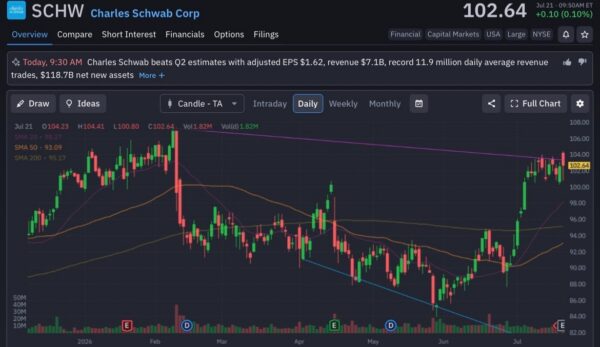
Now, since bottoming near $85 in June, Schwab has rallied about 20%, reclaiming both its 50-day moving average ($93.09) and 200-day moving average ($95.17). Shares are now pressing against the $104-$104.40 resistance zone that rejected buyers after February’s earnings report, with Monday’s intraday high reaching $104.41. 

Rather than reversing after a sharp advance, the stock is consolidating just beneath resistance while holding comfortably above both moving averages. 

That’s consistent with institutional accumulation, not speculative momentum, and supports the idea that investors are beginning to value Schwab less as a rate-sensitive broker and more as a financial platform.
Charles Schwab-StockEarnings

Why Schwab Deserves A Higher Multiple Than It Did Two Years Ago

Two years ago, investors valued Charles Schwab Corp (NYSE:SCHW) based on where they expected interest rates to go. That framework was appropriate for a business whose earnings were primarily rate-dependent. It no longer captures what this business is becoming.

Record trading activity, strong asset gathering, expanding managed investing, and a lending franchise operating at a fraction of its structural capacity all point toward a company whose earnings are increasingly supported by client monetization rather than a single macro tailwind. 

With all of these in mind, it’s logical to say this company doesn’t need the rate environment to cooperate in order to grow. 

It needs management to keep executing on the platform model they’ve been quietly building for the past two years – and after this quarter, I believe that’s exactly what’s happening.


Join over 1.2M+ investors/traders who receive daily and weekly notable earnings alerts with predicted move