ajax loader

Loading...


Ride-the-Wave Strategy – Best for Stock Traders

Ride-the-Wave targets multi-day price momentum following a company’s earnings announcement (EA). With this strategy:

  1. Buy a stock one day post-EA if a stock reacts positively post-earnings:
    1. Near the close of trading the EA-day for a pre-market-EA
    2. Near the close of the following day for a post-market-EA
  2. Sell-to-close after 7-10 days, or possibly earlier if a desired price target is reached

Similarly,

  1. short a stock one day post-EA if a stock reacts negatively post-earnings:
    1. near the close of trading the EA-day for a premarket-EA
    2. near the close of the following day for a post-market-EA
  2. then buy-to-close after 7-10 days, or possibly earlier if a desired price target is reached

Important: Ride-the-Wave is predicated on significant price momentum triggered by an EA. The 7-10 day scenario is the maximum trade hold-time. If you see post EA-momentum is halted or reversed by a significant opposite move, re-evaluate your presence in the trade.

This popular StockEarnings screen below will give you a list of stocks that historically exhibit significant price momentum following an EA for the next seven days:

  1. Stocks exhibiting positive post-EA price moves are buy-candidates
  2. Stocks exhibiting negative post-EA price moves are sell/short-candidates

The screen includes those stocks whose Earnings just came out in last two days.

Screen criteria:

  1. Earnings Date Start Date : Current Date + -1 Day
  2. Earnings Date End Date : Current Date + -2 Days
  3. Predicted Move (Next Day) Max : 7%
  4. Predicted Move (On 7th Day) Min : 7%

Strategy Guideline:

  1. Buy the stock if stock has reacted positively. Short the stock if stock has reacted negatively (see above).
  2. Close the position in 7-10 days, or possibly earlier based on price move.

Volatility Crush Strategy - Best for Options Traders

The Volatility Crush strategy is used with stocks that typically experience relatively low-to-moderate price moves (≤4%) following their Earnings Announcements (EA). The basic trade idea is to sell put or call options right before the EA, collecting a credit when options premium is very high due to elevated implied volatility (IV). You then close the position right after the EA by buying the option back much cheaper due to the significant drop in IV that occurs after the mystery of the EA disappears. In assessing this trade, you need to do your homework to ensure you collect sufficient premium to make the trade worthwhile.

This trade is practical due to the low-to-moderate price-move after the EA, which generally won’t significantly affect the options price, unlike an “action” stock, which experience great price moves post-EA. With these symbols, if you’re on the right side of the price move, that’s a great thing. But if you’re on the wrong side of the move, not so great. Consequently, by minimizing the effect of the post-EA price move, you have a much better chance to profit from the reduction in IV without it being ruined by a violent price move.

For this trade, open the position either (1) the night before the EA when the company announces earnings or (2) during the EA day when it announces post-market, generally capturing IV at or close to its peak.

For this trade, open the position either (1) the night before the EA when the company announces earnings or (2) during the EA day when it announces post-market, generally capturing IV at or close to its peak.

This popular stockearnings screen will give you a list of stocks which do not react more than 4% fpost-EA. It includes only those stocks whose earnings are releasing next day.

Screen criteria:

  1. Earnings Date Start Date : Current Date + 1
  2. Earnings Date End Date : Current Date + 1
  3. Predicted Move (Next Day) Max : 4%
  4. Options Type: Weekly

Strategy Guideline:

  1. Options Strategy: Sell Call and Put
  2. Options Strike Price: Current Stock Price – (% Predicated Move x 2)
  3. Expiration Date: It should generally be the closest expiry immediately after the EA.
  4. Buy Insurance: Buying back Call and Put at Strike price which 10% lower than Sell Strike Price is optional but recommended.

Watch Video for More Detail

Volatility Rush Strategy - Best for Options Traders

The Volatility Rush takes advantage of increasing options premiums into earnings announcements (EA) caused by an anticipated rise in Implied Volatility (IV). With this strategy, Buy a Call and Put at-the-money (a long straddle) 2-3 weeks before the EA when IV is lower. Sell the position either (1) the night before the EA when the company announces earnings pre-market, or (2) during the EA day when it announces post-market, generally capturing IV at or close to its peak.

This popular screen will give you a list of stocks whose Options premiums tend to rise into Earnings. It includes only those stocks whose Earnings are at least two weeks away from today.

Screen criteria:

  1. Earnings Date Start Date : Current Date + 15 Days
  2. Earnings Date End Date : Current Date + 30 Days
  3. Predicted Move (Next Day) Min : 5%
  4. Options Type: Weekly or Monthly if that lines up with the two to three-week lead-time for entering the trade

Strategy Guideline:

  1. Buy a Straddle at or close to the money two to three weeks pre-EA.
  2. Sell the position either the night before the EA when the company announces earnings pre-market, or during the EA day when it announces post-market.
  3. Expiration date should generally be the closest expiry immediately after the EA.
  4. Straddle price should not be more 60% of predicted move.

Predicted Move (Volatility)

Similar to Implied Volatility in Options. Expected volatility % based on our Proprietary Volatility Predication Model. We are expecting that stock price will likely to reach % in either direction by the end of next trading session after Earnings are released and not necessarily the closing volatility %.

Why is it important?

    This indicator helps

  1. Knowing expected volatility in stocks after Earnings helps to decide trading stocks before Earnings Announcement.
  2. Taking Advantage of volatility collapse following Earnings Results by using Advance Options strategies such as Spread and Straddles.

Since Last Earnings

Change in share price since last Earnings release.

Why is it Important?

When share has gained more than 10% since it's last Earning release, it tends to over react to minor bad news and give up some gains if not all. So, it contains more downside volatility than upside When share has dropped more than 10% since it's last Earning release, it tends to over react to minor good news and recover some drops if not all. So, it contains more upside volatility than downside.

EPS Surprise (%)

Occurs when a company's reported quarterly or annual profits are above or below analysts' expectations. Here is the formula to derive % EPS Surprice:

Actual EPS - Estimated EPS
------------------------------------- x 100
Estimated EPS

Why is it Important?

Earnings surprises can have a huge impact on a company's stock price. Several studies suggest that positive earnings surprises not only lead to an immediate hike in a stock's price, but also to a gradual increase over time. Hence, it's not surprising that some companies are known for routinely beating earning projections. A negative earnings surprise will usually result in a decline in share price.

Next Day Price Change (%)

Next Regular trading session Closing price following Earnings result.

For After Market Close Earnings, It is a next trading day closing price. For Before Market Open Earnings, It is the same trading day closing price.

Why is it Important?

Next Day price change is a reaction of Earnings result.

Dominos Pizza Just Changed The Way Investors Judge Franchise Restaurants

Posted on Jul 20, 2026 by Grayson Cavern

Dominos Pizza Just Changed The Way Investors Judge Franchise Restaurants

Dominos Pizza Inc (NASDAQ: DPZ) reported second-quarter earnings with revenue of $1.19 billion, narrowly beating expectations, while diluted EPS of $4.07 came in just below Wall Street’s forecast. Under normal circumstances, a quarter featuring an earnings miss, U.S. same-store sales growth of just 0.1%, and a slight decline in international comparable sales would have been enough to send investors looking elsewhere. Instead, the stock surged nearly 7% after earnings. 

Now one could argue that that’s simply reactionary and they’d be right, but if you paid attention last quarter, I told you Dominos wasn’t a fragile, traffic-dependent restaurant concept but a franchise system capable of compounding through weaker consumer demand, and that the market would eventually have to distinguish between those two very different things. This quarter may have been the first evidence that it finally did.

Wall Street Finally Looked Beyond Same-Store Sales


For decades, restaurant stocks have lived and died by the same three metrics: comparable sales, traffic, and average ticket. And Domino’s reported little to excite investors on any of those fronts. U.S. same-store sales rose just 0.1%, international same-store sales slipped 0.1%, and management openly acknowledged that the broader quick-service restaurant industry continues facing pressure from a consumer that has become more cautious about discretionary spending.

Yet CEO Russell Weiner spent little time defending those figures. Instead, he kept redirecting the conversation toward order count growth, framing it as the most important long-term driver of the business. The reasoning behind that framing is worth unpacking carefully, because it explains why the stock reacted the way it did. 

Every new customer that enters the Domino’s loyalty ecosystem strengthens supply-chain volume, supports new store economics, and expands market share in a way that compounds over years rather than quarters. 

Investors weren’t being asked to celebrate a period of stronger pizza sales, but to value a business whose customer acquisition engine keeps strengthening even when the consumer spending environment is working against it. That is a meaningfully different investment framework than the one most restaurant analysts are applying to this stock.

The Bears Are Still Looking At The Wrong Weakness

Skeptics haven’t disappeared, and their concerns aren’t entirely without foundation. Some continue arguing that GLP-1 weight-loss drugs will permanently reduce demand for calorie-dense foods at the category level. Others point to increasingly aggressive competition from Pizza Hut, third-party delivery platforms, and local operators eating into share. Some discussions around Domino’s franchisees add another layer of concern, with recurring suggestions that some operators are financially strained and struggling to manage their unit economics in a high-cost environment.

Individual franchisees may indeed face real pressure. Corporate itself acknowledged the softer backdrop. But a stressed franchisee base is not the same thing as a weakening franchise system, and conflating those two distinct problems is where the bear case loses its analytical precision. If Dominos Pizza Inc were genuinely losing competitive position at the system level, the operating engine would already be showing cracks in the numbers that actually matter. Well, it isn’t.

Global retail sales grew 3.0%, revenue increased 4.3% to $1.19 billion, income from operations rose 3.1%, net income increased 3.6%, diluted EPS climbed 6.8% year-over-year, and the company added a net 209 stores during the quarter. Franchise royalties kept growing, supply-chain revenue expanded, and leverage improved from 4.7x to 4.3x. 

Those characteristics don’t belong to a franchise system entering structural decline. That concern is better understood as an operator-level issue playing out beneath a corporate franchisor that continues collecting royalties regardless of which individual operator owns which store, and investors own the corporate economics, not the financial statements of every franchisee operating inside the system.

Institutions Already Repriced The Business

Heading into earnings, Domino’s had spent months trading beneath a descending trendline while sitting below its 200-day moving average, and expectations had compressed accordingly. The earnings reaction changed that picture almost immediately and with enough conviction to matter.

Rather than selling the EPS miss the way most restaurant investors would have, buyers drove the stock sharply higher on expanding volume, pushing price back above both the 20-day and 50-day moving averages while simultaneously breaking the downtrend that had contained the stock since January. Institutions rarely reward mediocre restaurant quarters with that kind of broad-based buying. They do it when they’ve concluded the market has been applying the wrong valuation framework to a business, and that’s what the price action here is communicating.

The 200-day moving average still sits overhead near $376, leaving meaningful work to do before the longer-term trend fully reasserts itself. But reclaiming the shorter-term averages while breaking trendline resistance on strong volume signals that the investor base is shifting from judging Domino’s on comp sales to judging it on franchise flywheel mechanics. Those are two very different conversations with very different valuation outcomes attached to them.
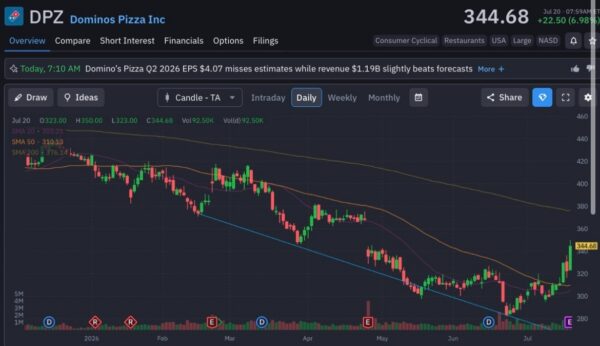
domino-StockEarnings

The Franchise Flywheel Keeps Spinning

The biggest takeaway from this quarter wasn’t the EPS miss or the modest comparable sales. It was the market’s willingness to look past both. Just as I highlighted last quarter that Domino’s shouldn’t be valued like a conventional restaurant chain because its franchise model compounds through royalties, supply-chain scale, loyalty depth, and disciplined store expansion in ways that are largely decoupled from any single quarter’s traffic trends.

True to that, this quarter suggests investors are finally arriving at the same conclusion. The consumer remains cautious, competition hasn’t softened, GLP-1 concerns haven’t gone away, and franchisee health at the operator level remains a legitimate variable worth watching. But as long as Domino’s keeps adding customers, expanding the loyalty ecosystem, and converting that growth into higher royalties and broader market share, the business deserves to be judged less by how many pizzas it sold this quarter and more by how durably its flywheel keeps spinning… and this quarter, it kept spinning.


Join over 1.2M+ investors/traders who receive daily and weekly notable earnings alerts with predicted move