ajax loader

Loading...


Ride-the-Wave Strategy – Best for Stock Traders

Ride-the-Wave targets multi-day price momentum following a company’s earnings announcement (EA). With this strategy:

  1. Buy a stock one day post-EA if a stock reacts positively post-earnings:
    1. Near the close of trading the EA-day for a pre-market-EA
    2. Near the close of the following day for a post-market-EA
  2. Sell-to-close after 7-10 days, or possibly earlier if a desired price target is reached

Similarly,

  1. short a stock one day post-EA if a stock reacts negatively post-earnings:
    1. near the close of trading the EA-day for a premarket-EA
    2. near the close of the following day for a post-market-EA
  2. then buy-to-close after 7-10 days, or possibly earlier if a desired price target is reached

Important: Ride-the-Wave is predicated on significant price momentum triggered by an EA. The 7-10 day scenario is the maximum trade hold-time. If you see post EA-momentum is halted or reversed by a significant opposite move, re-evaluate your presence in the trade.

This popular StockEarnings screen below will give you a list of stocks that historically exhibit significant price momentum following an EA for the next seven days:

  1. Stocks exhibiting positive post-EA price moves are buy-candidates
  2. Stocks exhibiting negative post-EA price moves are sell/short-candidates

The screen includes those stocks whose Earnings just came out in last two days.

Screen criteria:

  1. Earnings Date Start Date : Current Date + -1 Day
  2. Earnings Date End Date : Current Date + -2 Days
  3. Predicted Move (Next Day) Max : 7%
  4. Predicted Move (On 7th Day) Min : 7%

Strategy Guideline:

  1. Buy the stock if stock has reacted positively. Short the stock if stock has reacted negatively (see above).
  2. Close the position in 7-10 days, or possibly earlier based on price move.

Volatility Crush Strategy - Best for Options Traders

The Volatility Crush strategy is used with stocks that typically experience relatively low-to-moderate price moves (≤4%) following their Earnings Announcements (EA). The basic trade idea is to sell put or call options right before the EA, collecting a credit when options premium is very high due to elevated implied volatility (IV). You then close the position right after the EA by buying the option back much cheaper due to the significant drop in IV that occurs after the mystery of the EA disappears. In assessing this trade, you need to do your homework to ensure you collect sufficient premium to make the trade worthwhile.

This trade is practical due to the low-to-moderate price-move after the EA, which generally won’t significantly affect the options price, unlike an “action” stock, which experience great price moves post-EA. With these symbols, if you’re on the right side of the price move, that’s a great thing. But if you’re on the wrong side of the move, not so great. Consequently, by minimizing the effect of the post-EA price move, you have a much better chance to profit from the reduction in IV without it being ruined by a violent price move.

For this trade, open the position either (1) the night before the EA when the company announces earnings or (2) during the EA day when it announces post-market, generally capturing IV at or close to its peak.

For this trade, open the position either (1) the night before the EA when the company announces earnings or (2) during the EA day when it announces post-market, generally capturing IV at or close to its peak.

This popular stockearnings screen will give you a list of stocks which do not react more than 4% fpost-EA. It includes only those stocks whose earnings are releasing next day.

Screen criteria:

  1. Earnings Date Start Date : Current Date + 1
  2. Earnings Date End Date : Current Date + 1
  3. Predicted Move (Next Day) Max : 4%
  4. Options Type: Weekly

Strategy Guideline:

  1. Options Strategy: Sell Call and Put
  2. Options Strike Price: Current Stock Price – (% Predicated Move x 2)
  3. Expiration Date: It should generally be the closest expiry immediately after the EA.
  4. Buy Insurance: Buying back Call and Put at Strike price which 10% lower than Sell Strike Price is optional but recommended.

Watch Video for More Detail

Volatility Rush Strategy - Best for Options Traders

The Volatility Rush takes advantage of increasing options premiums into earnings announcements (EA) caused by an anticipated rise in Implied Volatility (IV). With this strategy, Buy a Call and Put at-the-money (a long straddle) 2-3 weeks before the EA when IV is lower. Sell the position either (1) the night before the EA when the company announces earnings pre-market, or (2) during the EA day when it announces post-market, generally capturing IV at or close to its peak.

This popular screen will give you a list of stocks whose Options premiums tend to rise into Earnings. It includes only those stocks whose Earnings are at least two weeks away from today.

Screen criteria:

  1. Earnings Date Start Date : Current Date + 15 Days
  2. Earnings Date End Date : Current Date + 30 Days
  3. Predicted Move (Next Day) Min : 5%
  4. Options Type: Weekly or Monthly if that lines up with the two to three-week lead-time for entering the trade

Strategy Guideline:

  1. Buy a Straddle at or close to the money two to three weeks pre-EA.
  2. Sell the position either the night before the EA when the company announces earnings pre-market, or during the EA day when it announces post-market.
  3. Expiration date should generally be the closest expiry immediately after the EA.
  4. Straddle price should not be more 60% of predicted move.

Predicted Move (Volatility)

Similar to Implied Volatility in Options. Expected volatility % based on our Proprietary Volatility Predication Model. We are expecting that stock price will likely to reach % in either direction by the end of next trading session after Earnings are released and not necessarily the closing volatility %.

Why is it important?

    This indicator helps

  1. Knowing expected volatility in stocks after Earnings helps to decide trading stocks before Earnings Announcement.
  2. Taking Advantage of volatility collapse following Earnings Results by using Advance Options strategies such as Spread and Straddles.

Since Last Earnings

Change in share price since last Earnings release.

Why is it Important?

When share has gained more than 10% since it's last Earning release, it tends to over react to minor bad news and give up some gains if not all. So, it contains more downside volatility than upside When share has dropped more than 10% since it's last Earning release, it tends to over react to minor good news and recover some drops if not all. So, it contains more upside volatility than downside.

EPS Surprise (%)

Occurs when a company's reported quarterly or annual profits are above or below analysts' expectations. Here is the formula to derive % EPS Surprice:

Actual EPS - Estimated EPS
------------------------------------- x 100
Estimated EPS

Why is it Important?

Earnings surprises can have a huge impact on a company's stock price. Several studies suggest that positive earnings surprises not only lead to an immediate hike in a stock's price, but also to a gradual increase over time. Hence, it's not surprising that some companies are known for routinely beating earning projections. A negative earnings surprise will usually result in a decline in share price.

Next Day Price Change (%)

Next Regular trading session Closing price following Earnings result.

For After Market Close Earnings, It is a next trading day closing price. For Before Market Open Earnings, It is the same trading day closing price.

Why is it Important?

Next Day price change is a reaction of Earnings result.

Netflix’s Premium Valuation Just Ran Into A New Problem.

Posted on Jul 17, 2026 by Grayson Cavern

Netflix’s Premium Valuation Just Ran Into A New Problem.

Netflix Inc (NASDAQ: NFLX) reported second-quarter revenue of $12.56 billion, up 13.4% year-over-year, with EPS of $0.80 against last year’s $0.72, and operating income of $4.19 billion on a 33.4% operating margin. Third-quarter guidance came in at $12.86 billion in revenue, implying 11.7% growth, with a 33.2% operating margins, numbers that left investors underwhelmed after another quarter of elevated anticipation.

The stock fell nearly 10%. Yet, the bigger problem is the fact that Netflix has quietly changed what it wants investors to measure, and the shift is deliberate enough to deserve direct attention. Subscriber additions disappeared from quarterly reporting months ago. Now the company is reducing engagement disclosures to once a year while redirecting attention toward revenue, operating income, margins, and advertising. That reframing only works if viewers remain as convinced by the product as management appears convinced by the business model, and this quarter exposed real tension between those two things.

Can AI Improve Margins Without Weakening The Product?


The shareholder letter mentions artificial intelligence far more confidently than in previous quarters, and the operating logic behind that confidence is straightforward. Management disclosed that generative AI has already been deployed across roughly 300 titles, enabling production workflows that create visual effects faster, reduce costs, and allow scenes that would have been difficult or impossible using traditional methods. AI is also expanding into advertising, personalization, and content discovery simultaneously.

From a business model perspective, the strategy makes sense; lower production costs, better margins, and more free cash flow compounding over time. Investors generally applaud those outcomes, and the numbers support the direction: advertising revenue is expected to generate roughly $3 billion this year, the full-year revenue outlook holds at $51.0–$51.4 billion at a 31.5% operating margin, and revenue per member keeps climbing through pricing and monetization improvements that don’t require subscriber volume to justify them. 

But viewers don’t judge operating leverage. They judge whether the next show is worth finishing. And the conversation that followed these earnings landed in a very different place than management’s margin narrative.

The Product Conversation That Followed Earnings

Stock-wise, weak Q3 guidance dominated the headlines after the earnings call. But business-wise, conversation centered around content. Complaints ranged from the growing volume of dubbed productions to perceptions that Netflix’s original programming has become inconsistent, with a recurring undercurrent that the company is now more focused on producing content efficiently than producing content that people actually remember. Others questioned whether the AI-assisted production pipeline is quietly diluting the creative output it’s meant to enhance.

Those comments don’t prove Netflix’s library has objectively deteriorated, and the data on engagement would need to support that claim before it becomes a thesis rather than a sentiment observation. But the pattern matters because perception influences engagement, engagement influences pricing power, and pricing power is the entire foundation the margin expansion story rests on. Management can’t optimize its way to a durable streaming business if viewers gradually conclude the product has become interchangeable with cheaper alternatives, and that’s precisely the risk the efficiency-first narrative introduces over a long enough time horizon.

Pricing The Uncertainty

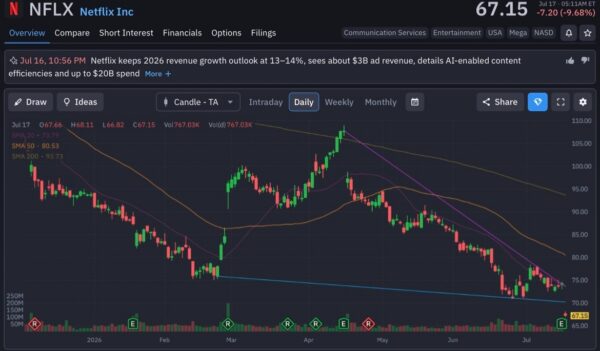
After earnings, Netflix closed at $67.15, extending a broader downtrend that has been in place since April. The stock traded between $66.82 and $68.11 on volume of roughly 767,000 shares, with price sitting below the 20-day moving average at $73.79, the 50-day at $80.53, and the 200-day at $93.73, while a descending trendline continues capping every meaningful rally attempt. Long-term support around $70–$71 is the level institutions need to defend if sentiment is going to stabilize rather than deteriorate further.

The chart isn’t pricing a collapsing business but a business in transition whose most important variable, content quality, is becoming harder to measure precisely as management reduces the frequency of the engagement data that would tell you how it’s actually trending.
netflix-StockEarnings

I Prefer Good Business Model Until It Changes

Streaming has never been won by the company with the highest operating margin. It has always been won by the company people keep coming back to watch, and the tension between those two things is what makes this a difficult stock to hold at current levels despite the financial architecture looking stronger than the selloff implies.

The bearish case here doesn’t rest on the numbers being bad, they aren’t. It rests on what’s being optimized for at the expense of what built the business in the first place. Netflix is reducing the visibility of engagement data at the exact moment viewer sentiment is becoming a meaningful question, deploying AI across production at the exact moment content consistency is being publicly challenged, and holding margin guidance steady at the exact moment the descending trendline on the chart is telling you that every rally attempt is still being sold into.

A business can optimize its way to impressive margins for several quarters before the product decline it masked shows up in subscriber behavior, and by the time it does, the stock has already done the damage. The chart below every major moving average, with a trendline capping rallies and support at $70–$71 being the last credible floor, is not a setup I want to be long into. I’m a seller at current levels, and I’ll be watching content sentiment and next year’s annual engagement disclosure as the two variables most likely to determine whether this bearish read eventually proves right or premature.


Join over 1.2M+ investors/traders who receive daily and weekly notable earnings alerts with predicted move