ajax loader

Loading...


Ride-the-Wave Strategy – Best for Stock Traders

Ride-the-Wave targets multi-day price momentum following a company’s earnings announcement (EA). With this strategy:

  1. Buy a stock one day post-EA if a stock reacts positively post-earnings:
    1. Near the close of trading the EA-day for a pre-market-EA
    2. Near the close of the following day for a post-market-EA
  2. Sell-to-close after 7-10 days, or possibly earlier if a desired price target is reached

Similarly,

  1. short a stock one day post-EA if a stock reacts negatively post-earnings:
    1. near the close of trading the EA-day for a premarket-EA
    2. near the close of the following day for a post-market-EA
  2. then buy-to-close after 7-10 days, or possibly earlier if a desired price target is reached

Important: Ride-the-Wave is predicated on significant price momentum triggered by an EA. The 7-10 day scenario is the maximum trade hold-time. If you see post EA-momentum is halted or reversed by a significant opposite move, re-evaluate your presence in the trade.

This popular StockEarnings screen below will give you a list of stocks that historically exhibit significant price momentum following an EA for the next seven days:

  1. Stocks exhibiting positive post-EA price moves are buy-candidates
  2. Stocks exhibiting negative post-EA price moves are sell/short-candidates

The screen includes those stocks whose Earnings just came out in last two days.

Screen criteria:

  1. Earnings Date Start Date : Current Date + -1 Day
  2. Earnings Date End Date : Current Date + -2 Days
  3. Predicted Move (Next Day) Max : 7%
  4. Predicted Move (On 7th Day) Min : 7%

Strategy Guideline:

  1. Buy the stock if stock has reacted positively. Short the stock if stock has reacted negatively (see above).
  2. Close the position in 7-10 days, or possibly earlier based on price move.

Volatility Crush Strategy - Best for Options Traders

The Volatility Crush strategy is used with stocks that typically experience relatively low-to-moderate price moves (≤4%) following their Earnings Announcements (EA). The basic trade idea is to sell put or call options right before the EA, collecting a credit when options premium is very high due to elevated implied volatility (IV). You then close the position right after the EA by buying the option back much cheaper due to the significant drop in IV that occurs after the mystery of the EA disappears. In assessing this trade, you need to do your homework to ensure you collect sufficient premium to make the trade worthwhile.

This trade is practical due to the low-to-moderate price-move after the EA, which generally won’t significantly affect the options price, unlike an “action” stock, which experience great price moves post-EA. With these symbols, if you’re on the right side of the price move, that’s a great thing. But if you’re on the wrong side of the move, not so great. Consequently, by minimizing the effect of the post-EA price move, you have a much better chance to profit from the reduction in IV without it being ruined by a violent price move.

For this trade, open the position either (1) the night before the EA when the company announces earnings or (2) during the EA day when it announces post-market, generally capturing IV at or close to its peak.

For this trade, open the position either (1) the night before the EA when the company announces earnings or (2) during the EA day when it announces post-market, generally capturing IV at or close to its peak.

This popular stockearnings screen will give you a list of stocks which do not react more than 4% fpost-EA. It includes only those stocks whose earnings are releasing next day.

Screen criteria:

  1. Earnings Date Start Date : Current Date + 1
  2. Earnings Date End Date : Current Date + 1
  3. Predicted Move (Next Day) Max : 4%
  4. Options Type: Weekly

Strategy Guideline:

  1. Options Strategy: Sell Call and Put
  2. Options Strike Price: Current Stock Price – (% Predicated Move x 2)
  3. Expiration Date: It should generally be the closest expiry immediately after the EA.
  4. Buy Insurance: Buying back Call and Put at Strike price which 10% lower than Sell Strike Price is optional but recommended.

Watch Video for More Detail

Volatility Rush Strategy - Best for Options Traders

The Volatility Rush takes advantage of increasing options premiums into earnings announcements (EA) caused by an anticipated rise in Implied Volatility (IV). With this strategy, Buy a Call and Put at-the-money (a long straddle) 2-3 weeks before the EA when IV is lower. Sell the position either (1) the night before the EA when the company announces earnings pre-market, or (2) during the EA day when it announces post-market, generally capturing IV at or close to its peak.

This popular screen will give you a list of stocks whose Options premiums tend to rise into Earnings. It includes only those stocks whose Earnings are at least two weeks away from today.

Screen criteria:

  1. Earnings Date Start Date : Current Date + 15 Days
  2. Earnings Date End Date : Current Date + 30 Days
  3. Predicted Move (Next Day) Min : 5%
  4. Options Type: Weekly or Monthly if that lines up with the two to three-week lead-time for entering the trade

Strategy Guideline:

  1. Buy a Straddle at or close to the money two to three weeks pre-EA.
  2. Sell the position either the night before the EA when the company announces earnings pre-market, or during the EA day when it announces post-market.
  3. Expiration date should generally be the closest expiry immediately after the EA.
  4. Straddle price should not be more 60% of predicted move.

Predicted Move (Volatility)

Similar to Implied Volatility in Options. Expected volatility % based on our Proprietary Volatility Predication Model. We are expecting that stock price will likely to reach % in either direction by the end of next trading session after Earnings are released and not necessarily the closing volatility %.

Why is it important?

    This indicator helps

  1. Knowing expected volatility in stocks after Earnings helps to decide trading stocks before Earnings Announcement.
  2. Taking Advantage of volatility collapse following Earnings Results by using Advance Options strategies such as Spread and Straddles.

Since Last Earnings

Change in share price since last Earnings release.

Why is it Important?

When share has gained more than 10% since it's last Earning release, it tends to over react to minor bad news and give up some gains if not all. So, it contains more downside volatility than upside When share has dropped more than 10% since it's last Earning release, it tends to over react to minor good news and recover some drops if not all. So, it contains more upside volatility than downside.

EPS Surprise (%)

Occurs when a company's reported quarterly or annual profits are above or below analysts' expectations. Here is the formula to derive % EPS Surprice:

Actual EPS - Estimated EPS
------------------------------------- x 100
Estimated EPS

Why is it Important?

Earnings surprises can have a huge impact on a company's stock price. Several studies suggest that positive earnings surprises not only lead to an immediate hike in a stock's price, but also to a gradual increase over time. Hence, it's not surprising that some companies are known for routinely beating earning projections. A negative earnings surprise will usually result in a decline in share price.

Next Day Price Change (%)

Next Regular trading session Closing price following Earnings result.

For After Market Close Earnings, It is a next trading day closing price. For Before Market Open Earnings, It is the same trading day closing price.

Why is it Important?

Next Day price change is a reaction of Earnings result.

Kroger vs. Walmart: Why KR May Be the Better Value Play Right Now

Posted on Jun 22, 2026 by Chris Markoch

Kroger vs. Walmart: Why KR May Be the Better Value Play Right Now

Walmart (NASDAQ: WMT) has spent the past few years winning the value war with shoppers. Lower prices, a sprawling footprint, and an e-commerce engine that finally rivals Amazon (NASDAQ: AMZN) have made it the default destination for budget-conscious households. But there’s a difference between being the better deal for consumers and being the better deal for investors, and right now those two things are pointing in opposite directions.

Kroger (NYSE: KR) CEO Greg Foran summed up the environment bluntly on the company’s first-quarter earnings call this month: shoppers are under pressure, and it’s changing how they buy groceries. High gas prices and reduced SNAP benefits are squeezing budgets, Foran told analysts, pushing customers toward smaller, promotion-driven trips instead of the traditional weekly stock-up. “We’re getting too many promotional trips and not enough of the full basket,” he said.

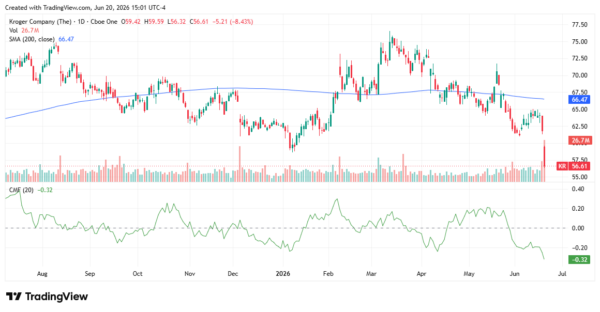
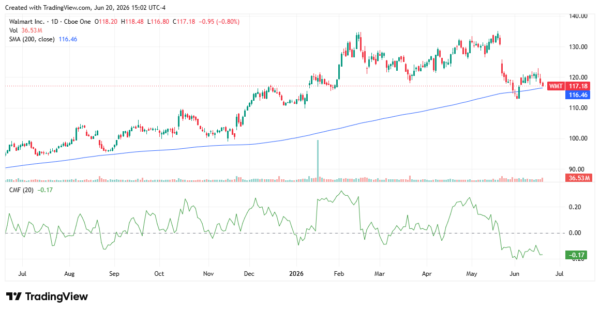
That’s a real headwind, and the market punished Kroger for it. KR shares fell more than 8% the day the company reported, landing near $56 and deep below its 200-day moving average. Walmart, by contrast, has held up far better, trading around $117, just below its own 200-day line after a more modest pullback from 2026 highs near $137.

On the surface, that makes Walmart look like the safer bet. Underneath it, the numbers tell a more interesting story for investors willing to look past the headline.

The Earnings Engine Is Still Running at Kroger


Despite the post-earnings selloff, Kroger’s underlying business hasn’t broken down. The company grew adjusted earnings per share by roughly 8% in fiscal 2025, and Wall Street expects a similar pace in fiscal 2026, with full-year adjusted EPS guidance reaffirmed at $5.10 to $5.30. Management didn’t cut that outlook after the first-quarter report, nor did it touch its free cash flow guidance of $2.7 billion to $2.9 billion, which still leaves room for buybacks, dividends, and reinvestment in price and digital.

The quarter itself was messier than the stock reaction suggested. Adjusted EPS of $1.58 came in only a penny short of estimates, and adjusted e-commerce sales jumped 19% year over year. The real issue was identical sales excluding fuel, which grew just 1%, down from 3.2% a year earlier, and gross margin, which slipped to 22.7% from 23.0% as Kroger absorbed higher transport costs and leaned into price cuts to win back share from Walmart, Costco, and Aldi.

In other words, Kroger is spending money today to defend its competitive position tomorrow. That’s a legitimate risk. It’s also precisely the kind of self-inflicted, sentiment-driven drawdown that contrarian investors look for, especially when the company’s own full-year guidance says the strategy is still on track.

Walmart’s Premium Is Already Priced In

Walmart’s chart tells the opposite story. Shares are still up sharply over the past year, trading at roughly 41 times trailing earnings and close to 39 times forward estimates, a premium multiple for a grocery and general merchandise retailer. That reflects a market that has already given Walmart enormous credit for its omnichannel execution, advertising business, and Sam’s Club momentum.

There’s nothing wrong with paying up for quality, but valuation matters for forward returns, and Walmart’s current setup leaves less room for error. The stock’s dividend yield sits below 1%. That’s a reflection of how far the share price has run relative to the payout rather than any weakness in the underlying business.

Kroger’s dividend tells a different story. The stock currently yields close to 2%, more than double Walmart’s, and that payout looks well covered. Kroger’s free cash flow guidance comfortably exceeds its dividend obligations, even after funding buybacks and store investments. For income-oriented investors, that combination of yield and coverage is hard to find in a name this size trading at a depressed valuation.

Analysts See More Room to Run in KR

Wall Street’s price targets reinforce the gap. Consensus estimates put Kroger’s 12-month target in the $68 to $76 range, while KR stock trades in the high $50s to low $60s, implying meaningful double-digit upside from current levels. Walmart’s consensus target sits in the $134 to $139 range against a stock already near $117 to $118, working out to upside in the high teens, but starting from a far richer valuation.

The reaction to Kroger’s first-quarter report split the analyst community in a way worth noting. JPMorgan trimmed its price target to $70 from $72 and stayed Neutral, citing margin pressure from the price investment strategy, and BMO cut its target to $60 from $70.

But Goldman Sachs raised its target to $82 from $72, and Telsey Advisory Group reiterated an Outperform rating with an $82 target, arguing the long-term payoff from Foran’s pricing push outweighs the near-term margin drag. Jefferies stayed at Buy. That kind of split, where some firms see a temporary cost of doing business and others see a structural problem, is a hallmark of a stock the market hasn’t fully repriced yet, not a unanimous red flag.

Reading the Charts

The technical picture adds another layer. Kroger’s Chaikin Money Flow has turned negative and is still falling, currently near -0.32, signaling sustained distribution as the stock trades well below its 200-day moving average of roughly $66. That’s not bullish in isolation, but for value-oriented investors, a beaten-down momentum reading on a stock with intact full-year guidance is often the entry point, not the exit sign.
kroger - StockEarnings

Walmart’s CMF has also turned negative, near -0.17, with the stock recently slipping below its own 200-day average around $116 before stabilizing. The difference is that Walmart’s pullback is happening from a much higher valuation base, while Kroger’s decline has pushed an already reasonably priced stock into statistically cheap territory relative to its own earnings power.
kroger - StockEarnings

The Bottom Line

Walmart has earned its premium through years of consistent execution, and nothing here argues it’s a bad business. But “better business” and “better stock to buy today” aren’t the same question.

At current prices, Walmart asks investors to pay nearly 40 times forward earnings for a sub-1% yield, while Kroger offers a covered 2% dividend, high-single-digit earnings growth management has reaffirmed even after a rough quarter, and a valuation that’s fallen far enough to catch fresh price-target raises from Goldman Sachs and Telsey.

Consumers chasing value right now are trading down to cheaper baskets and more selective trips. Investors looking for the same kind of value in their portfolios may want to take a similar approach: skip the name trading at a premium multiple and take a closer look at the one the market just put on sale.


A former marketing copywriter turned freelance financial writer and market analyst. I have a passion for delivering insights to investors. I write regularly about stocks for StockEarnings and MarketBeat. Posts are not advice.

Join over 1.2M+ investors/traders who receive daily and weekly notable earnings alerts with predicted move