ajax loader

Loading...


Ride-the-Wave Strategy – Best for Stock Traders

Ride-the-Wave targets multi-day price momentum following a company’s earnings announcement (EA). With this strategy:

  1. Buy a stock one day post-EA if a stock reacts positively post-earnings:
    1. Near the close of trading the EA-day for a pre-market-EA
    2. Near the close of the following day for a post-market-EA
  2. Sell-to-close after 7-10 days, or possibly earlier if a desired price target is reached

Similarly,

  1. short a stock one day post-EA if a stock reacts negatively post-earnings:
    1. near the close of trading the EA-day for a premarket-EA
    2. near the close of the following day for a post-market-EA
  2. then buy-to-close after 7-10 days, or possibly earlier if a desired price target is reached

Important: Ride-the-Wave is predicated on significant price momentum triggered by an EA. The 7-10 day scenario is the maximum trade hold-time. If you see post EA-momentum is halted or reversed by a significant opposite move, re-evaluate your presence in the trade.

This popular StockEarnings screen below will give you a list of stocks that historically exhibit significant price momentum following an EA for the next seven days:

  1. Stocks exhibiting positive post-EA price moves are buy-candidates
  2. Stocks exhibiting negative post-EA price moves are sell/short-candidates

The screen includes those stocks whose Earnings just came out in last two days.

Screen criteria:

  1. Earnings Date Start Date : Current Date + -1 Day
  2. Earnings Date End Date : Current Date + -2 Days
  3. Predicted Move (Next Day) Max : 7%
  4. Predicted Move (On 7th Day) Min : 7%

Strategy Guideline:

  1. Buy the stock if stock has reacted positively. Short the stock if stock has reacted negatively (see above).
  2. Close the position in 7-10 days, or possibly earlier based on price move.

Volatility Crush Strategy - Best for Options Traders

The Volatility Crush strategy is used with stocks that typically experience relatively low-to-moderate price moves (≤4%) following their Earnings Announcements (EA). The basic trade idea is to sell put or call options right before the EA, collecting a credit when options premium is very high due to elevated implied volatility (IV). You then close the position right after the EA by buying the option back much cheaper due to the significant drop in IV that occurs after the mystery of the EA disappears. In assessing this trade, you need to do your homework to ensure you collect sufficient premium to make the trade worthwhile.

This trade is practical due to the low-to-moderate price-move after the EA, which generally won’t significantly affect the options price, unlike an “action” stock, which experience great price moves post-EA. With these symbols, if you’re on the right side of the price move, that’s a great thing. But if you’re on the wrong side of the move, not so great. Consequently, by minimizing the effect of the post-EA price move, you have a much better chance to profit from the reduction in IV without it being ruined by a violent price move.

For this trade, open the position either (1) the night before the EA when the company announces earnings or (2) during the EA day when it announces post-market, generally capturing IV at or close to its peak.

For this trade, open the position either (1) the night before the EA when the company announces earnings or (2) during the EA day when it announces post-market, generally capturing IV at or close to its peak.

This popular stockearnings screen will give you a list of stocks which do not react more than 4% fpost-EA. It includes only those stocks whose earnings are releasing next day.

Screen criteria:

  1. Earnings Date Start Date : Current Date + 1
  2. Earnings Date End Date : Current Date + 1
  3. Predicted Move (Next Day) Max : 4%
  4. Options Type: Weekly

Strategy Guideline:

  1. Options Strategy: Sell Call and Put
  2. Options Strike Price: Current Stock Price – (% Predicated Move x 2)
  3. Expiration Date: It should generally be the closest expiry immediately after the EA.
  4. Buy Insurance: Buying back Call and Put at Strike price which 10% lower than Sell Strike Price is optional but recommended.

Watch Video for More Detail

Volatility Rush Strategy - Best for Options Traders

The Volatility Rush takes advantage of increasing options premiums into earnings announcements (EA) caused by an anticipated rise in Implied Volatility (IV). With this strategy, Buy a Call and Put at-the-money (a long straddle) 2-3 weeks before the EA when IV is lower. Sell the position either (1) the night before the EA when the company announces earnings pre-market, or (2) during the EA day when it announces post-market, generally capturing IV at or close to its peak.

This popular screen will give you a list of stocks whose Options premiums tend to rise into Earnings. It includes only those stocks whose Earnings are at least two weeks away from today.

Screen criteria:

  1. Earnings Date Start Date : Current Date + 15 Days
  2. Earnings Date End Date : Current Date + 30 Days
  3. Predicted Move (Next Day) Min : 5%
  4. Options Type: Weekly or Monthly if that lines up with the two to three-week lead-time for entering the trade

Strategy Guideline:

  1. Buy a Straddle at or close to the money two to three weeks pre-EA.
  2. Sell the position either the night before the EA when the company announces earnings pre-market, or during the EA day when it announces post-market.
  3. Expiration date should generally be the closest expiry immediately after the EA.
  4. Straddle price should not be more 60% of predicted move.

Predicted Move (Volatility)

Similar to Implied Volatility in Options. Expected volatility % based on our Proprietary Volatility Predication Model. We are expecting that stock price will likely to reach % in either direction by the end of next trading session after Earnings are released and not necessarily the closing volatility %.

Why is it important?

    This indicator helps

  1. Knowing expected volatility in stocks after Earnings helps to decide trading stocks before Earnings Announcement.
  2. Taking Advantage of volatility collapse following Earnings Results by using Advance Options strategies such as Spread and Straddles.

Since Last Earnings

Change in share price since last Earnings release.

Why is it Important?

When share has gained more than 10% since it's last Earning release, it tends to over react to minor bad news and give up some gains if not all. So, it contains more downside volatility than upside When share has dropped more than 10% since it's last Earning release, it tends to over react to minor good news and recover some drops if not all. So, it contains more upside volatility than downside.

EPS Surprise (%)

Occurs when a company's reported quarterly or annual profits are above or below analysts' expectations. Here is the formula to derive % EPS Surprice:

Actual EPS - Estimated EPS
------------------------------------- x 100
Estimated EPS

Why is it Important?

Earnings surprises can have a huge impact on a company's stock price. Several studies suggest that positive earnings surprises not only lead to an immediate hike in a stock's price, but also to a gradual increase over time. Hence, it's not surprising that some companies are known for routinely beating earning projections. A negative earnings surprise will usually result in a decline in share price.

Next Day Price Change (%)

Next Regular trading session Closing price following Earnings result.

For After Market Close Earnings, It is a next trading day closing price. For Before Market Open Earnings, It is the same trading day closing price.

Why is it Important?

Next Day price change is a reaction of Earnings result.

Why AI Companies Stocks Keep Falling Despite Earnings Beat

Posted on Jun 22, 2026 by Grayson Cavern

Why AI Companies Stocks Keep Falling Despite Earnings Beat

Corporate America has figured out something investors already knew: a company without an AI story trades like a company without a growth story. Earnings calls that once centered on customers, margins, and market expansion now spend most of their airtime on artificial intelligence roadmaps and infrastructure spending, as executives race to claim a seat at what they believe is the defining technological shift of this generation.

The results have been remarkable on paper. Earnings beats. Revenue growth. Higher guidance. New products landing on schedule. And yet investors checking their portfolios after these reports keep finding the same thing waiting for them – a lower stock price.

After working through earnings from Adobe, Salesforce, Broadcom, Ciena, and a handful of AI infrastructure names, the pattern became unmistakable. Since these companies delivered exactly what Wall Street asked for but still plummeted, let’s look into the reasons why this could be happening.

Adoption Is Old News, Revenue Decides What Happens Next.


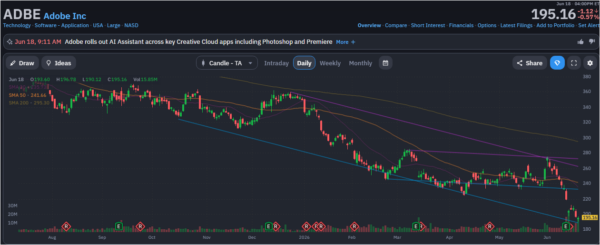
Let’s start with Adobe Inc (NASDAQ: ADBE). In what seemed to be a clapback to narratives about the company becoming obsolete in the new age world of AI, the company recorded a second quarter revenue of $5.87 billion. Record EPS of $5.06. Raised guidance across the board. A fresh $25 billion buyback. And Firefly crossed 190 million users, a number that would have dominated headlines two years ago.

Investors went straight past it to one question: how much revenue do those 190 million users actually generate? 

That single question didn’t just immediately deflate the company’s share price…
AI-StockEarnings

It marked the real shift happening across this entire sector. The market stopped asking whether AI works a couple of years ago.

Today, investors want to know whether AI pays and companies generating real dollars from artificial intelligence are starting to separate from companies generating excitement about it. Those are two different businesses wearing the same label, and the market is finally waking up to that shocking reality.

The Industry Has To Justify The Bill

AI has become one of the largest capital allocation exercises, surpassing the spending peak of the late 1990s Dotcom boom. Data centers are expanding. Chip orders keep climbing. Cooling and power infrastructure spending would have sounded absurd three years ago and now reads as routine.

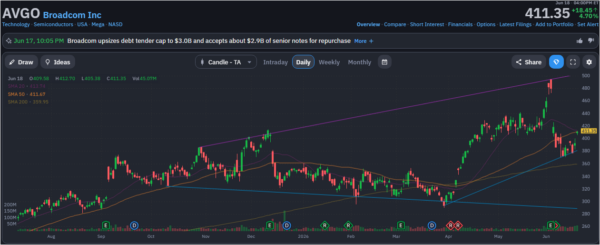
Broadcom Inc (NASDAQ: AVGO) sits directly inside that cycle as the companyrecorded a second quarter revenue of $15 billion. AI revenue up 46% year-over-year to $4.4 billion. Guidance pointing to $5.1 billion in AI semiconductor revenue next quarter. Numbers built to settle any lingering debate about demand. 

Those figures should have settled the debate. Instead, they created another one. Investors started evaluating whether AI revenue could continue expanding quickly enough to justify the billions being spent throughout the ecosystem. 
AI-StockEarnings

That question is now showing up on every call in this space. Executives talk about opportunity. Investors talk about efficiency. The conversation has moved from building AI infrastructure to extracting value from it, and that shift raises the bar every company in this sector has to clear, every single quarter, with no exceptions for size or track record.

The Next Three Years Are Important Than The Last Strong Quarter

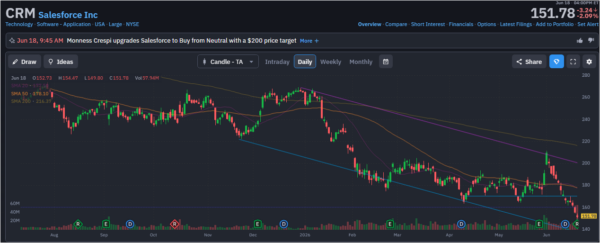
Take a gander at Salesforce Inc (NYSE: CRM) last strong quarter. The company generated a revenue of $9.83 billion. Adjusted EPS of $2.58. Raised guidance to about $41 billion – $41.3 billion, expanded margins, free cash flow around $6.3 billion, continued buybacks. By any traditional measure, an excellent quarter.
AI-StockEarnings

The conversation moved immediately to Agentforce  and whether it can become a growth engine large enough to push revenue past what investors already expect. That’s the part most reactions get wrong. Investors weren’t grading last quarter. They’re pricing what this quarter implies about the next three years, and the market had already assumed Salesforce would execute well. What it wanted was proof that future growth could exceed assumptions that were already optimistic going in. That’s a considerably higher standard than beating last quarter’s number, and it’s becoming the standard test across this entire category.

My point is, each win pushes investor expectations up another notch, forcing companies to deliver even more just to hold the same level of enthusiasm they had last quarter. 

That’s why strong numbers keep producing falling stocks because the market has moved past AI adoption to AI profits.

The Boom Is Real And The Winners Are Still Emerging

I remain bullish on artificial intelligence, and corporate America’s spending pattern says the conviction is shared broadly. Companies keep reorganizing around AI because customers want it, competitors are building it, and capital keeps flowing toward whoever looks best positioned to benefit. The infrastructure buildout shows no sign of slowing, and very few management teams seem interested in being the ones who hesitate.

But conviction in the trend has never meant conviction in every name riding it. The internet reshaped the global economy yet most internet stocks from that era no longer exist. AI will follow the same arc: genuine productivity gains, new markets, extraordinary winners, and right alongside them, plenty of overinvestment, weak business models, and companies that mistake spending for strategy.


Join over 1.2M+ investors/traders who receive daily and weekly notable earnings alerts with predicted move