ajax loader

Loading...


Ride-the-Wave Strategy – Best for Stock Traders

Ride-the-Wave targets multi-day price momentum following a company’s earnings announcement (EA). With this strategy:

  1. Buy a stock one day post-EA if a stock reacts positively post-earnings:
    1. Near the close of trading the EA-day for a pre-market-EA
    2. Near the close of the following day for a post-market-EA
  2. Sell-to-close after 7-10 days, or possibly earlier if a desired price target is reached

Similarly,

  1. short a stock one day post-EA if a stock reacts negatively post-earnings:
    1. near the close of trading the EA-day for a premarket-EA
    2. near the close of the following day for a post-market-EA
  2. then buy-to-close after 7-10 days, or possibly earlier if a desired price target is reached

Important: Ride-the-Wave is predicated on significant price momentum triggered by an EA. The 7-10 day scenario is the maximum trade hold-time. If you see post EA-momentum is halted or reversed by a significant opposite move, re-evaluate your presence in the trade.

This popular StockEarnings screen below will give you a list of stocks that historically exhibit significant price momentum following an EA for the next seven days:

  1. Stocks exhibiting positive post-EA price moves are buy-candidates
  2. Stocks exhibiting negative post-EA price moves are sell/short-candidates

The screen includes those stocks whose Earnings just came out in last two days.

Screen criteria:

  1. Earnings Date Start Date : Current Date + -1 Day
  2. Earnings Date End Date : Current Date + -2 Days
  3. Predicted Move (Next Day) Max : 7%
  4. Predicted Move (On 7th Day) Min : 7%

Strategy Guideline:

  1. Buy the stock if stock has reacted positively. Short the stock if stock has reacted negatively (see above).
  2. Close the position in 7-10 days, or possibly earlier based on price move.

Volatility Crush Strategy - Best for Options Traders

The Volatility Crush strategy is used with stocks that typically experience relatively low-to-moderate price moves (≤4%) following their Earnings Announcements (EA). The basic trade idea is to sell put or call options right before the EA, collecting a credit when options premium is very high due to elevated implied volatility (IV). You then close the position right after the EA by buying the option back much cheaper due to the significant drop in IV that occurs after the mystery of the EA disappears. In assessing this trade, you need to do your homework to ensure you collect sufficient premium to make the trade worthwhile.

This trade is practical due to the low-to-moderate price-move after the EA, which generally won’t significantly affect the options price, unlike an “action” stock, which experience great price moves post-EA. With these symbols, if you’re on the right side of the price move, that’s a great thing. But if you’re on the wrong side of the move, not so great. Consequently, by minimizing the effect of the post-EA price move, you have a much better chance to profit from the reduction in IV without it being ruined by a violent price move.

For this trade, open the position either (1) the night before the EA when the company announces earnings or (2) during the EA day when it announces post-market, generally capturing IV at or close to its peak.

For this trade, open the position either (1) the night before the EA when the company announces earnings or (2) during the EA day when it announces post-market, generally capturing IV at or close to its peak.

This popular stockearnings screen will give you a list of stocks which do not react more than 4% fpost-EA. It includes only those stocks whose earnings are releasing next day.

Screen criteria:

  1. Earnings Date Start Date : Current Date + 1
  2. Earnings Date End Date : Current Date + 1
  3. Predicted Move (Next Day) Max : 4%
  4. Options Type: Weekly

Strategy Guideline:

  1. Options Strategy: Sell Call and Put
  2. Options Strike Price: Current Stock Price – (% Predicated Move x 2)
  3. Expiration Date: It should generally be the closest expiry immediately after the EA.
  4. Buy Insurance: Buying back Call and Put at Strike price which 10% lower than Sell Strike Price is optional but recommended.

Watch Video for More Detail

Volatility Rush Strategy - Best for Options Traders

The Volatility Rush takes advantage of increasing options premiums into earnings announcements (EA) caused by an anticipated rise in Implied Volatility (IV). With this strategy, Buy a Call and Put at-the-money (a long straddle) 2-3 weeks before the EA when IV is lower. Sell the position either (1) the night before the EA when the company announces earnings pre-market, or (2) during the EA day when it announces post-market, generally capturing IV at or close to its peak.

This popular screen will give you a list of stocks whose Options premiums tend to rise into Earnings. It includes only those stocks whose Earnings are at least two weeks away from today.

Screen criteria:

  1. Earnings Date Start Date : Current Date + 15 Days
  2. Earnings Date End Date : Current Date + 30 Days
  3. Predicted Move (Next Day) Min : 5%
  4. Options Type: Weekly or Monthly if that lines up with the two to three-week lead-time for entering the trade

Strategy Guideline:

  1. Buy a Straddle at or close to the money two to three weeks pre-EA.
  2. Sell the position either the night before the EA when the company announces earnings pre-market, or during the EA day when it announces post-market.
  3. Expiration date should generally be the closest expiry immediately after the EA.
  4. Straddle price should not be more 60% of predicted move.

Predicted Move (Volatility)

Similar to Implied Volatility in Options. Expected volatility % based on our Proprietary Volatility Predication Model. We are expecting that stock price will likely to reach % in either direction by the end of next trading session after Earnings are released and not necessarily the closing volatility %.

Why is it important?

    This indicator helps

  1. Knowing expected volatility in stocks after Earnings helps to decide trading stocks before Earnings Announcement.
  2. Taking Advantage of volatility collapse following Earnings Results by using Advance Options strategies such as Spread and Straddles.

Since Last Earnings

Change in share price since last Earnings release.

Why is it Important?

When share has gained more than 10% since it's last Earning release, it tends to over react to minor bad news and give up some gains if not all. So, it contains more downside volatility than upside When share has dropped more than 10% since it's last Earning release, it tends to over react to minor good news and recover some drops if not all. So, it contains more upside volatility than downside.

EPS Surprise (%)

Occurs when a company's reported quarterly or annual profits are above or below analysts' expectations. Here is the formula to derive % EPS Surprice:

Actual EPS - Estimated EPS
------------------------------------- x 100
Estimated EPS

Why is it Important?

Earnings surprises can have a huge impact on a company's stock price. Several studies suggest that positive earnings surprises not only lead to an immediate hike in a stock's price, but also to a gradual increase over time. Hence, it's not surprising that some companies are known for routinely beating earning projections. A negative earnings surprise will usually result in a decline in share price.

Next Day Price Change (%)

Next Regular trading session Closing price following Earnings result.

For After Market Close Earnings, It is a next trading day closing price. For Before Market Open Earnings, It is the same trading day closing price.

Why is it Important?

Next Day price change is a reaction of Earnings result.

Tesla Earnings Preview: Investors Torn Over Tesla-SpaceX Merger

Posted on Apr 14, 2026 by Grayson Cavern

Tesla Earnings Preview: Investors Torn Over Tesla-SpaceX Merger

There’s a reason the conversation around Tesla (NASDAQ: TSLA) has begun to drift away from the usual pillars of analysis – deliveries, margins, and quarterly earnings – and toward something far less tangible, something that, on the surface, should not even be part of the discussion.

A potential merger with SpaceX.

It remains unconfirmed, but the truth is, markets do not generate narratives of this scale without cause; they reach for them when the existing story begins to feel insufficient or when it changes to a grim one.

That is the position Tesla is moving into ahead of its next earnings report – not weak, not broken, but no longer beyond question.

When The Numbers Withdrew Their Support


Viewed in isolation, Tesla’s latest financials still reflect a company operating at scale, with full-year 2025 revenue landing in the $94.8–$96.8 billion range, yet declining roughly 2%–3% year-over-year (YOY), marking a second consecutive period of stalled or negative top-line growth.

Growth has not disappeared, but it has shifted away from the areas that once defined Tesla’s trajectory. Nowhere is that more evident than in margins, where gross margin has declined from 25.6% in 2022 to approximately 18% in 2024–2025, while operating margin compressed from 16.8% to roughly 7% over the same period. 

A structural change driven by pricing, as the company increasingly relies on price adjustments to sustain demand in a more competitive environment. In effect, demand is no longer doing the heavy lifting on its own.

Is This The Fall Of An Electric Empire?

There was a time when Tesla’s growth trajectory absorbed these pressures, with expanding deliveries and strong pricing power reinforcing one another.

Vehicle deliveries reached approximately 1.8 million units in 2025, a figure that would have once signaled dominance but now exists within a more competitive landscape. BYD delivered roughly 2.26 million vehicles over the same period, becoming the world’s largest EV manufacturer and forcing a structural change in how Tesla competes.

Price action is now reflecting that same shift.
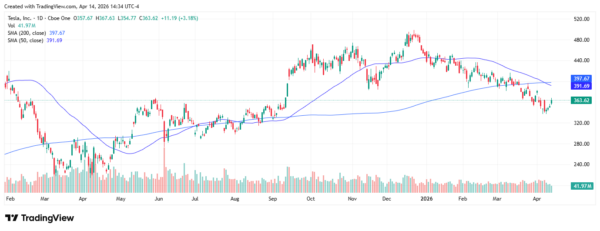
Tesla - StockEarnings

After peaking near $480 in late 2025, Tesla has formed a clear downtrend, with successive lower highs and lower lows. The breakdown below $400 – previously a major support level – shifted momentum decisively, pushing the stock toward the $330–$360 range, where it now trades near its 200-day moving average

RSI remains in the low-40s, signaling weak conviction rather than capitulation. While the recent bounce from $330 suggests buyers are still present, failure to reclaim $380–$400 keeps the broader structure under pressure.

It’s not rocket science; Tesla is no longer being priced as an unstoppable leader but as a company in transition.

A Tesla-SpaceX Narrative Wouldn’t Have Existed In “This” Era

If Tesla were still expanding at a pace sufficient to sustain its narrative independently, the emergence of a sudden merger would be unnecessary. Yet those conversations are becoming increasingly difficult to ignore.

Reports indicate that SpaceX has explored deeper integration with Tesla and Musk’s broader ecosystem, including xAI. Meanwhile, the company is undergoing a quieter internal shift, consolidating its product lineup and reducing emphasis on legacy premium models such as the Model S and Model X, as focus narrows toward higher-volume offerings like the Model 3 and Model Y. Taken together, these developments point less to expansion and more to adjustment.

This is not to say Tesla has a demand problem. After all, the company still sells vehicles at scale, and its broader ecosystem, from energy to AI, remains active and evolving. 

However, the nature of that demand has changed in ways that directly affect how the business is perceived and the narrative that once sustained its dominance.

The Supporters, The Critics And Why Everyone Is Dead Wrong

This is where the SpaceX discussion shifts from a question of feasibility to one of context.

Through a supportive lens, this story becomes one of expansion – an opportunity to integrate Tesla’s ambitions across AI, space, and infrastructure into a broader, more powerful ecosystem. 

Through a critical lens, it transforms into a distraction, highlighting governance risks, Musk’s compensation packages, and structural incompatibilities between a public automaker and a private aerospace company.

Both perspectives are valid reactions to the story, but they are quite off the mark. As they are both missing the only relevant question: why is this conversation gaining traction now? 

Truth is, if growth, margins, and competitive positioning were still accelerating in line with prior expectations, the need for an additional narrative would not arise. 

The fact that it has suggests something has shifted – not in the business’s viability, but in the confidence surrounding its future – making the next earnings report a critical lever in how the company shapes out.

The Next “Historical” Earnings Report

Tesla’s next earnings report won’t just be about numbers. It will serve as a test of alignment between performance and expectation. Margins will be closely scrutinized. Deliveries will matter not only in absolute terms but relative to competitive positioning. Revenue trends will be evaluated for signs of reacceleration rather than stabilization. Above all, guidance will carry weight.

But do not get it wrong, the company doesn’t need to demonstrate performance as much as it must reinforce belief about its future.

Still Strong – But No Longer Unquestioned

All told, it would be a mistake to interpret Tesla’s position as fundamentally weak. The company exited 2025 with approximately $29–$30 billion in cash, supported by modest debt levels, providing flexibility across pricing strategy, capacity expansion, and capital allocation. 

Indicating that Tesla remains formidable, however, it is no longer operating without credible challenge. As the market adjusts, the questions will evolve – from how fast it can grow, to what it is ultimately becoming.

Unfortunately, the upcoming earnings report will not resolve that question. 

It will, however, indicate whether the current company’s trajectory is sufficient to sustain convictions, or whether investors have already begun to look beyond it (as evident in the Tesla-SpaceX story)


Join over 1.2M+ investors/traders who receive daily and weekly notable earnings alerts with predicted move