When the stock market becomes volatile, investors often look for ways to make their portfolios a little more defensive. Dividend-paying investments can help because they provide income even when share prices are moving sideways or lower. This can mean buying individual stocks, but it can also mean looking at income ETFs.
Owning individual dividend-paying stocks can be a successful strategy for buy-and-hold investors who reinvest their dividends. The compounding effect can significantly increase an investor’s total return over time.
However, investing in single stocks comes with a couple of risks. One of those comes from a change to a dividend payout. Ideally, investors want to own stocks of companies that are increasing their dividends. At the very least, they want the assurance that the dividend won’t be suspended or cut.
The latter was the case with AT&T (NYSE: T) when it cut its dividend from $2.04 to $1.11 in 2022. The company’s strategy has proven to be correct. But for income investors, it was an alarming event.
That’s because many investors rely on a company’s dividends for regular income. And a payout cut of nearly 50% has a real impact.
Another option is to invest in dividend ETFs. These funds buy a basket of dividend-paying companies, removing the single stock risk while still providing a source of regular income.
Here are four dividend ETFs investors may want to consider.
Amplify CWP Enhanced Dividend Income ETF
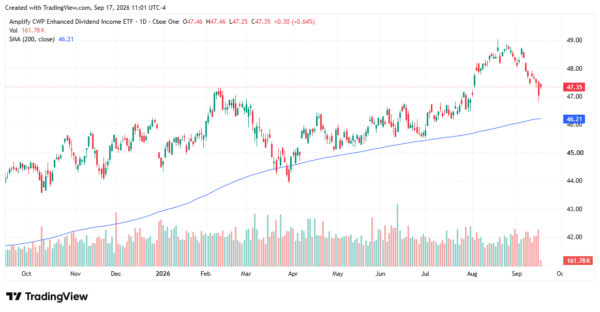
The Amplify CWP Enhanced Dividend Income ETF (NYSEARCA: DIVO) offers investors a combination of dividend stocks and covered-call income.
DIVO owns a relatively concentrated portfolio of established, large-cap U.S. companies with histories of earnings and dividend growth. The fund’s managers then selectively sell covered calls on individual holdings to generate additional income.
A covered call involves selling call options against stocks the fund already owns. The premiums collected from those options can support the ETF’s monthly distributions. The tradeoff is that the strategy may limit some of the fund’s upside when one of its stocks rallies sharply.
As of August, DIVO had a 4.84% distribution rate and a 1.35% yield. Its total expense ratio was 0.56%. DIVO may appeal to investors who want monthly cash flow but still want exposure to high-quality blue-chip companies.
JPMorgan Nasdaq Equity Premium Income ETF
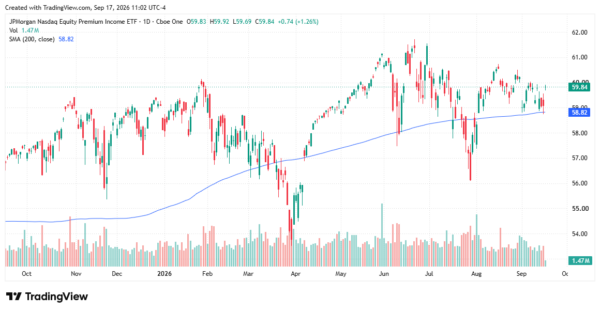
The JPMorgan Nasdaq Equity Premium Income ETF (NASDAQ: JEPQ) is another interesting ETF.
JEPQ invests in large-cap companies associated with the Nasdaq-100 while using options to generate income. That gives investors exposure to many of the market’s leading growth businesses, along with monthly distributions supported by stock dividends and options premiums. As of June, JEPQ had a 12-month rolling dividend yield of 10.69% and a 30-day SEC yield of 12.87%. Its expense ratio was 0.35%.
JPMorgan Equity Premium Income ETF
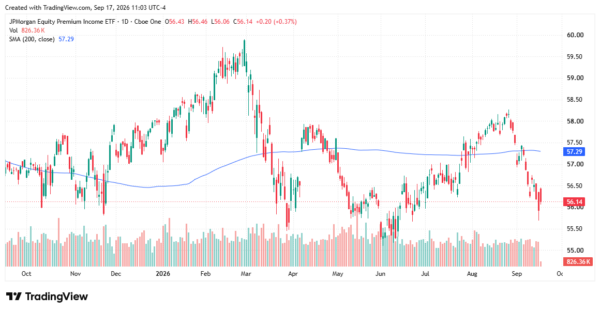
The JPMorgan Equity Premium Income ETF (NYSEARCA: JEPI) is also interesting.
JEPI owns a diversified portfolio of large-cap U.S. companies while using an options strategy to produce monthly income. Recent holdings have included Amazon (NASDAQ: AMZN), Microsoft (NASDAQ: MSFT), Alphabet (NASDAQ: GOOGL), Mastercard (NYSE: MA), NVIDIA (NASDAQ: NVDA), Johnson & Johnson (NYSE: JNJ), AbbVie (NYSE: ABBV) and Trane Technologies (NYSE: TT).
JEPI spreads its exposure across more areas of the economy.
That may make it more attractive to investors looking for income with less dependence on the technology sector. As of July, JEPI’s dividend yield was 8.05%, while its yield was 7.88%. The fund carried an expense ratio of 0.35%.
iShares Core High Dividend ETF
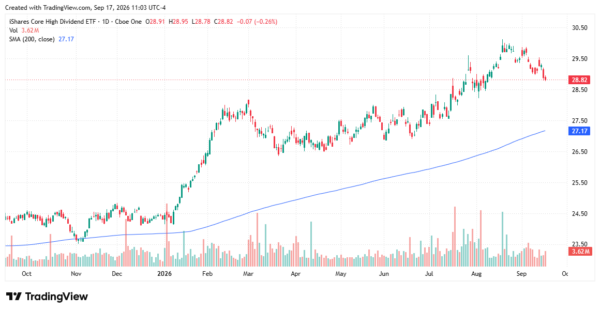
Investors who prefer a simpler dividend strategy can also consider the iShares Core High Dividend ETF (NYSEARCA: HDV). Rather than relying on options trading to help it generate income along the way for ETF holders, HDV tracks an index of high-yielding U.S. stocks. The portfolio has substantial exposure to healthcare, consumer staples and energy—sectors that can sometimes hold up better than speculative growth stocks during uncertain markets.
As of August, HDV had a 3.34% yield. Its expense ratio was just 0.08%, making it the least expensive fund on this list. HDV may not deliver the eye-catching yields of JEPQ or JEPI, but it offers a low-cost way to own established dividend-paying companies.
Which Income Strategy Fits Your Portfolio?
Each of these ETFs approaches income differently. DIVO blends dividend growth with selective covered calls. JEPQ offers higher income and more technology exposure. JEPI provides a broader, more defensive equity portfolio, while HDV offers a traditional high-dividend strategy at a very low cost. As we said above, when the stock market becomes volatile, as it is now, investors often look for ways to make their portfolios a little more defensive.
Dividend-paying investments can help because they provide income even when share prices are moving sideways or lower. Consider these four income ETFs moving forward to help diversify and safeguard your portfolio from the chaos.