ajax loader

Loading...


Ride-the-Wave Strategy – Best for Stock Traders

Ride-the-Wave targets multi-day price momentum following a company’s earnings announcement (EA). With this strategy:

  1. Buy a stock one day post-EA if a stock reacts positively post-earnings:
    1. Near the close of trading the EA-day for a pre-market-EA
    2. Near the close of the following day for a post-market-EA
  2. Sell-to-close after 7-10 days, or possibly earlier if a desired price target is reached

Similarly,

  1. short a stock one day post-EA if a stock reacts negatively post-earnings:
    1. near the close of trading the EA-day for a premarket-EA
    2. near the close of the following day for a post-market-EA
  2. then buy-to-close after 7-10 days, or possibly earlier if a desired price target is reached

Important: Ride-the-Wave is predicated on significant price momentum triggered by an EA. The 7-10 day scenario is the maximum trade hold-time. If you see post EA-momentum is halted or reversed by a significant opposite move, re-evaluate your presence in the trade.

This popular StockEarnings screen below will give you a list of stocks that historically exhibit significant price momentum following an EA for the next seven days:

  1. Stocks exhibiting positive post-EA price moves are buy-candidates
  2. Stocks exhibiting negative post-EA price moves are sell/short-candidates

The screen includes those stocks whose Earnings just came out in last two days.

Screen criteria:

  1. Earnings Date Start Date : Current Date + -1 Day
  2. Earnings Date End Date : Current Date + -2 Days
  3. Predicted Move (Next Day) Max : 7%
  4. Predicted Move (On 7th Day) Min : 7%

Strategy Guideline:

  1. Buy the stock if stock has reacted positively. Short the stock if stock has reacted negatively (see above).
  2. Close the position in 7-10 days, or possibly earlier based on price move.

Volatility Crush Strategy - Best for Options Traders

The Volatility Crush strategy is used with stocks that typically experience relatively low-to-moderate price moves (≤4%) following their Earnings Announcements (EA). The basic trade idea is to sell put or call options right before the EA, collecting a credit when options premium is very high due to elevated implied volatility (IV). You then close the position right after the EA by buying the option back much cheaper due to the significant drop in IV that occurs after the mystery of the EA disappears. In assessing this trade, you need to do your homework to ensure you collect sufficient premium to make the trade worthwhile.

This trade is practical due to the low-to-moderate price-move after the EA, which generally won’t significantly affect the options price, unlike an “action” stock, which experience great price moves post-EA. With these symbols, if you’re on the right side of the price move, that’s a great thing. But if you’re on the wrong side of the move, not so great. Consequently, by minimizing the effect of the post-EA price move, you have a much better chance to profit from the reduction in IV without it being ruined by a violent price move.

For this trade, open the position either (1) the night before the EA when the company announces earnings or (2) during the EA day when it announces post-market, generally capturing IV at or close to its peak.

For this trade, open the position either (1) the night before the EA when the company announces earnings or (2) during the EA day when it announces post-market, generally capturing IV at or close to its peak.

This popular stockearnings screen will give you a list of stocks which do not react more than 4% fpost-EA. It includes only those stocks whose earnings are releasing next day.

Screen criteria:

  1. Earnings Date Start Date : Current Date + 1
  2. Earnings Date End Date : Current Date + 1
  3. Predicted Move (Next Day) Max : 4%
  4. Options Type: Weekly

Strategy Guideline:

  1. Options Strategy: Sell Call and Put
  2. Options Strike Price: Current Stock Price – (% Predicated Move x 2)
  3. Expiration Date: It should generally be the closest expiry immediately after the EA.
  4. Buy Insurance: Buying back Call and Put at Strike price which 10% lower than Sell Strike Price is optional but recommended.

Watch Video for More Detail

Volatility Rush Strategy - Best for Options Traders

The Volatility Rush takes advantage of increasing options premiums into earnings announcements (EA) caused by an anticipated rise in Implied Volatility (IV). With this strategy, Buy a Call and Put at-the-money (a long straddle) 2-3 weeks before the EA when IV is lower. Sell the position either (1) the night before the EA when the company announces earnings pre-market, or (2) during the EA day when it announces post-market, generally capturing IV at or close to its peak.

This popular screen will give you a list of stocks whose Options premiums tend to rise into Earnings. It includes only those stocks whose Earnings are at least two weeks away from today.

Screen criteria:

  1. Earnings Date Start Date : Current Date + 15 Days
  2. Earnings Date End Date : Current Date + 30 Days
  3. Predicted Move (Next Day) Min : 5%
  4. Options Type: Weekly or Monthly if that lines up with the two to three-week lead-time for entering the trade

Strategy Guideline:

  1. Buy a Straddle at or close to the money two to three weeks pre-EA.
  2. Sell the position either the night before the EA when the company announces earnings pre-market, or during the EA day when it announces post-market.
  3. Expiration date should generally be the closest expiry immediately after the EA.
  4. Straddle price should not be more 60% of predicted move.

Predicted Move (Volatility)

Similar to Implied Volatility in Options. Expected volatility % based on our Proprietary Volatility Predication Model. We are expecting that stock price will likely to reach % in either direction by the end of next trading session after Earnings are released and not necessarily the closing volatility %.

Why is it important?

    This indicator helps

  1. Knowing expected volatility in stocks after Earnings helps to decide trading stocks before Earnings Announcement.
  2. Taking Advantage of volatility collapse following Earnings Results by using Advance Options strategies such as Spread and Straddles.

Since Last Earnings

Change in share price since last Earnings release.

Why is it Important?

When share has gained more than 10% since it's last Earning release, it tends to over react to minor bad news and give up some gains if not all. So, it contains more downside volatility than upside When share has dropped more than 10% since it's last Earning release, it tends to over react to minor good news and recover some drops if not all. So, it contains more upside volatility than downside.

EPS Surprise (%)

Occurs when a company's reported quarterly or annual profits are above or below analysts' expectations. Here is the formula to derive % EPS Surprice:

Actual EPS - Estimated EPS
------------------------------------- x 100
Estimated EPS

Why is it Important?

Earnings surprises can have a huge impact on a company's stock price. Several studies suggest that positive earnings surprises not only lead to an immediate hike in a stock's price, but also to a gradual increase over time. Hence, it's not surprising that some companies are known for routinely beating earning projections. A negative earnings surprise will usually result in a decline in share price.

Next Day Price Change (%)

Next Regular trading session Closing price following Earnings result.

For After Market Close Earnings, It is a next trading day closing price. For Before Market Open Earnings, It is the same trading day closing price.

Why is it Important?

Next Day price change is a reaction of Earnings result.

Boeing: When Good News Requires More News 

Posted on Oct 01, 2026 by Chris Markoch

Boeing: When Good News Requires More News 

It’s been a good month for Boeing (NYSE: BA). On Sept. 14, the company was awarded a $562 million contract from the U.S. Navy. The contract will allow Boeing to move the Navy’s MQ-25A Stingray refueling drone into low-rate initial production. This was a significant milestone for a program that has been marred by delays.  

Then on Sept. 29, the Navy selected Boeing to develop its F/A-XX sixth-generation fighter. This will replace the F/A-18 Super Hornet. The $20 billion contract has the potential to position Boeing for decades of future production and sustainable revenue. 

In both cases, investors sold the news. In fact, they didn’t even buy the rumor. BA is down 11.2% for the month, and it’s down over 14% for the year. The stock closed Sept. 30 at $186.27, near its lowest level since the spring. That’s an unusual reaction to defense wins of this size. 

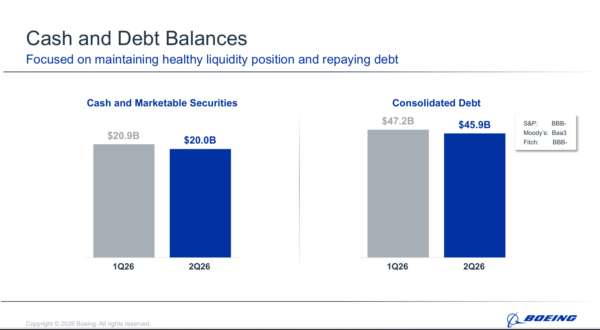
Investors are dealing with an expensive stock from a company that is still managing a significant debt load, is facing potential labor strife, and just got a setback for the program that started causing problems for the company in November 2024. 
boeing - StockEarnings

In other words, the market isn’t ignoring the good news. It’s weighing that news against a longer list of open questions. Right now, investors want more proof before they pay up. That gap between perception and fundamentals is the Boeing story today. 

Why Investors Shouldn’t Dismiss the Navy Contracts 


Start with the MQ-25. Low-rate initial production is the step that turns a development program into a production program. The Stingray will take aerial refueling duty off Super Hornets. That frees fighters for combat missions and extends the reach of the carrier air wing. 

Production matters financially, too. The MQ-25 was one of several fixed-price development contracts that saddled Boeing’s defense unit with billions in charges in recent years. Moving into production gives the company a chance to start earning back that investment. 

The F/A-XX is the bigger prize. Fighter jet programs run for decades. The Super Hornet first flew in the 1990s and remains a frontline aircraft today. Winning its replacement means design, production, upgrade, and sustainment revenue that could stretch deep into the century. 

It also builds on existing momentum. In March 2025, the Air Force selected Boeing for its F-47 sixth-generation fighter. Boeing now holds both of the U.S. military’s next-generation fighter programs. That’s a rare position, and it supports the case that its defense business is turning a corner. 

The catch is timing. These are long-dated revenue streams. They won’t fix near-term cash flow. Investors buying BA today are still mostly buying a commercial aircraft recovery story. 

Not All the News Has Been Good 

On Sept. 28, the U.S. Federal Aviation Administration (FAA) announced it was delaying certification of Boeing’s 737 Max 10 variant due to a newly flagged software issue. The timing couldn’t have been worse. Boeing appeared close to being approved to start delivering the jet.  

The Max 10 is Boeing’s largest jet in its single-aisle family. The program has struggled through years of delays. However, flight testing finished in July, and the company was optimistic that it would receive approval.  

Even more concerning is that the software glitch, which is tied to the company’s flight-management software versions 14 and 14.1, could impact the initial deliveries of Boeing’s Max 7 if regulators treat the software as a safety issue.  

That’s why the Max 10 delay hit harder than the Navy wins helped. Commercial airplanes drive most of Boeing’s revenue and nearly all of its recovery narrative. Every certification delay pushes deliveries, and the cash that comes with them further down the road. 

Labor Trouble May Be Abating 

The company’s largest white-collar union, the Society of Professional Engineering Employees in Aerospace (SPEEA) will decide on Oct. 1 whether its members will ratify Boeing’s latest contract offer, which was proposed on Sept. 11. If the offer is rejected, it would clear a path for a walkout as soon as Oct. 7.  

That would be the worst possible timing for Boeing. Engineers play a central role in certification work. A strike could slow the very programs investors are waiting on. However, as of this writing, there was genuine optimism that the sweetened proposal would be ratified. That means by the time you read this, it may be a moot point. Or, it may be a bigger headwind and headache for the company.  

What the Chart Is Saying 

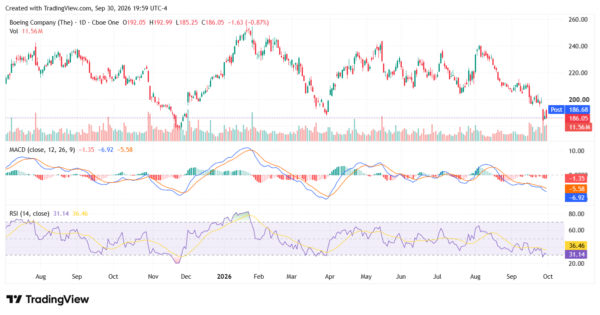
BA’s chart reflects investor frustration. The stock has fallen from around $240 in mid-August to $186.05. It’s now testing the zone near its March and April lows. A break below that area could open the door to the late-2025 lows near $180. 

Momentum is stretched. The relative strength index (RSI) sits at 31, just above the 30 level that signals oversold conditions. The MACD remains below its signal line and below zero, a sign sellers are still in control. Volume also spiked on the late-September gap lower, showing conviction behind the selling. 

Oversold doesn’t mean a bottom. But it does suggest much of the bad news may already be priced in. 
boeing - StockEarnings

Good News Needs Company 

Boeing’s problem isn’t a lack of good news. It’s that the good news is long-term and the bad news is immediate. The Navy contracts make the next two decades look stronger. The Max 10 delay and labor uncertainty make the next two quarters look shakier. 

Investors appear to want more news before they act: a clean SPEEA vote, a clear Max 10 timeline, and steady delivery numbers. Until then, defense wins alone may not lift the stock. For patient investors, though, an oversold stock with a growing defense backlog may be a setup where perception eventually catches up with fundamentals. 

A former marketing copywriter turned freelance financial writer and market analyst. I have a passion for delivering insights to investors. I write regularly about stocks for StockEarnings and MarketBeat. Posts are not advice.

Join over 1.2M+ investors/traders who receive daily and weekly notable earnings alerts with predicted move