ajax loader

Loading...


Ride-the-Wave Strategy – Best for Stock Traders

Ride-the-Wave targets multi-day price momentum following a company’s earnings announcement (EA). With this strategy:

  1. Buy a stock one day post-EA if a stock reacts positively post-earnings:
    1. Near the close of trading the EA-day for a pre-market-EA
    2. Near the close of the following day for a post-market-EA
  2. Sell-to-close after 7-10 days, or possibly earlier if a desired price target is reached

Similarly,

  1. short a stock one day post-EA if a stock reacts negatively post-earnings:
    1. near the close of trading the EA-day for a premarket-EA
    2. near the close of the following day for a post-market-EA
  2. then buy-to-close after 7-10 days, or possibly earlier if a desired price target is reached

Important: Ride-the-Wave is predicated on significant price momentum triggered by an EA. The 7-10 day scenario is the maximum trade hold-time. If you see post EA-momentum is halted or reversed by a significant opposite move, re-evaluate your presence in the trade.

This popular StockEarnings screen below will give you a list of stocks that historically exhibit significant price momentum following an EA for the next seven days:

  1. Stocks exhibiting positive post-EA price moves are buy-candidates
  2. Stocks exhibiting negative post-EA price moves are sell/short-candidates

The screen includes those stocks whose Earnings just came out in last two days.

Screen criteria:

  1. Earnings Date Start Date : Current Date + -1 Day
  2. Earnings Date End Date : Current Date + -2 Days
  3. Predicted Move (Next Day) Max : 7%
  4. Predicted Move (On 7th Day) Min : 7%

Strategy Guideline:

  1. Buy the stock if stock has reacted positively. Short the stock if stock has reacted negatively (see above).
  2. Close the position in 7-10 days, or possibly earlier based on price move.

Volatility Crush Strategy - Best for Options Traders

The Volatility Crush strategy is used with stocks that typically experience relatively low-to-moderate price moves (≤4%) following their Earnings Announcements (EA). The basic trade idea is to sell put or call options right before the EA, collecting a credit when options premium is very high due to elevated implied volatility (IV). You then close the position right after the EA by buying the option back much cheaper due to the significant drop in IV that occurs after the mystery of the EA disappears. In assessing this trade, you need to do your homework to ensure you collect sufficient premium to make the trade worthwhile.

This trade is practical due to the low-to-moderate price-move after the EA, which generally won’t significantly affect the options price, unlike an “action” stock, which experience great price moves post-EA. With these symbols, if you’re on the right side of the price move, that’s a great thing. But if you’re on the wrong side of the move, not so great. Consequently, by minimizing the effect of the post-EA price move, you have a much better chance to profit from the reduction in IV without it being ruined by a violent price move.

For this trade, open the position either (1) the night before the EA when the company announces earnings or (2) during the EA day when it announces post-market, generally capturing IV at or close to its peak.

For this trade, open the position either (1) the night before the EA when the company announces earnings or (2) during the EA day when it announces post-market, generally capturing IV at or close to its peak.

This popular stockearnings screen will give you a list of stocks which do not react more than 4% fpost-EA. It includes only those stocks whose earnings are releasing next day.

Screen criteria:

  1. Earnings Date Start Date : Current Date + 1
  2. Earnings Date End Date : Current Date + 1
  3. Predicted Move (Next Day) Max : 4%
  4. Options Type: Weekly

Strategy Guideline:

  1. Options Strategy: Sell Call and Put
  2. Options Strike Price: Current Stock Price – (% Predicated Move x 2)
  3. Expiration Date: It should generally be the closest expiry immediately after the EA.
  4. Buy Insurance: Buying back Call and Put at Strike price which 10% lower than Sell Strike Price is optional but recommended.

Watch Video for More Detail

Volatility Rush Strategy - Best for Options Traders

The Volatility Rush takes advantage of increasing options premiums into earnings announcements (EA) caused by an anticipated rise in Implied Volatility (IV). With this strategy, Buy a Call and Put at-the-money (a long straddle) 2-3 weeks before the EA when IV is lower. Sell the position either (1) the night before the EA when the company announces earnings pre-market, or (2) during the EA day when it announces post-market, generally capturing IV at or close to its peak.

This popular screen will give you a list of stocks whose Options premiums tend to rise into Earnings. It includes only those stocks whose Earnings are at least two weeks away from today.

Screen criteria:

  1. Earnings Date Start Date : Current Date + 15 Days
  2. Earnings Date End Date : Current Date + 30 Days
  3. Predicted Move (Next Day) Min : 5%
  4. Options Type: Weekly or Monthly if that lines up with the two to three-week lead-time for entering the trade

Strategy Guideline:

  1. Buy a Straddle at or close to the money two to three weeks pre-EA.
  2. Sell the position either the night before the EA when the company announces earnings pre-market, or during the EA day when it announces post-market.
  3. Expiration date should generally be the closest expiry immediately after the EA.
  4. Straddle price should not be more 60% of predicted move.

Predicted Move (Volatility)

Similar to Implied Volatility in Options. Expected volatility % based on our Proprietary Volatility Predication Model. We are expecting that stock price will likely to reach % in either direction by the end of next trading session after Earnings are released and not necessarily the closing volatility %.

Why is it important?

    This indicator helps

  1. Knowing expected volatility in stocks after Earnings helps to decide trading stocks before Earnings Announcement.
  2. Taking Advantage of volatility collapse following Earnings Results by using Advance Options strategies such as Spread and Straddles.

Since Last Earnings

Change in share price since last Earnings release.

Why is it Important?

When share has gained more than 10% since it's last Earning release, it tends to over react to minor bad news and give up some gains if not all. So, it contains more downside volatility than upside When share has dropped more than 10% since it's last Earning release, it tends to over react to minor good news and recover some drops if not all. So, it contains more upside volatility than downside.

EPS Surprise (%)

Occurs when a company's reported quarterly or annual profits are above or below analysts' expectations. Here is the formula to derive % EPS Surprice:

Actual EPS - Estimated EPS
------------------------------------- x 100
Estimated EPS

Why is it Important?

Earnings surprises can have a huge impact on a company's stock price. Several studies suggest that positive earnings surprises not only lead to an immediate hike in a stock's price, but also to a gradual increase over time. Hence, it's not surprising that some companies are known for routinely beating earning projections. A negative earnings surprise will usually result in a decline in share price.

Next Day Price Change (%)

Next Regular trading session Closing price following Earnings result.

For After Market Close Earnings, It is a next trading day closing price. For Before Market Open Earnings, It is the same trading day closing price.

Why is it Important?

Next Day price change is a reaction of Earnings result.

Quantum Computing Could Revolutionize Technology, But…

Posted on Jul 15, 2026 by Ian Cooper

Quantum Computing Could Revolutionize Technology, But…

Quantum computing is widely viewed as one of the most transformative technologies of the coming decade. Its ability to solve extraordinarily complex problems at speeds unimaginable for today’s computers could reshape industries ranging from healthcare and finance to artificial intelligence and scientific research.

According to AI Magazine, quantum computers could solve certain computational problems up to 100 million times faster than conventional computers. In one widely cited demonstration, a quantum computer completed a specialized calculation in roughly 200 seconds—a task researchers estimated would have required one of the world’s fastest supercomputers approximately 10,000 years to complete.

Artificial intelligence models could become significantly more sophisticated. Financial institutions could improve risk analysis and portfolio optimization. Manufacturers could develop next-generation batteries and advanced materials far more quickly than current technology allows. Pharmaceutical companies could accelerate drug discovery. Artificial intelligence models could become significantly more sophisticated. Financial institutions could improve risk analysis and portfolio optimization. Manufacturers could develop next-generation batteries and advanced materials far more quickly than current technology allows.

The Dark Side of Quantum Computing


The same things that make quantum computers revolutionary also threaten many of today’s encryption methods.

Unfortunately, quantum computing also has the potential to undermine the digital security systems that protect everything from online banking and government networks to cryptocurrencies and personal data.

One of the biggest cybersecurity risks associated with quantum computing is a strategy known as “harvest now, decrypt later.” Rather than immediately attempting to crack encrypted information, cybercriminals and nation-state actors can collect and store encrypted data today with the expectation that future quantum computers will eventually become powerful enough to decrypt it.

For organizations handling sensitive information—including financial institutions, healthcare providers, defense contractors, and cryptocurrency exchanges—this creates a long-term security challenge. Data stolen today could remain unreadable for years before suddenly becoming accessible.

What Is Q-Day?

Within the cybersecurity industry, this future milestone has earned a name: “Q-Day.”

Q-Day refers to the point at which quantum computers become capable of breaking today’s widely used public-key encryption standards. While experts continue to debate exactly when that moment will arrive, many believe organizations cannot afford to wait until it happens before upgrading their security infrastructure.

In response, governments and technology companies are already moving toward post-quantum cryptographya new generation of encryption algorithms specifically designed to withstand attacks from both classical and quantum computers. Organizations that delay implementation could face increased exposure to harvest-now, decrypt-later attacks, particularly if they store highly sensitive data intended to remain confidential for decades.

Cybersecurity ETFs That Could Benefit

This transition is expected to create substantial investment opportunities across the cybersecurity industry. All of which could be beneficial for cybersecurity ETFs such as:

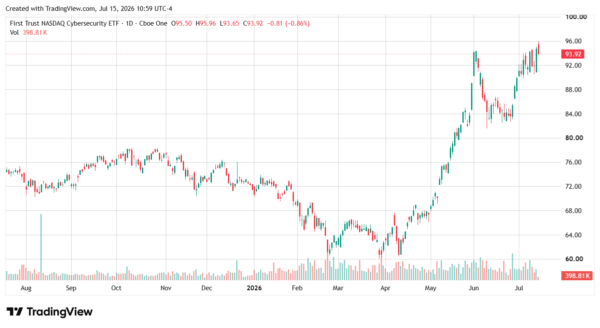
First Trust NASDAQ Cybersecurity ETF (NASDAQ: CIBR) is one of the largest and most established cybersecurity ETFs. It holds a diversified portfolio of leading cybersecurity companies involved in endpoint protection, cloud security, identity management, and network defense. As organizations invest in quantum-resistant security technologies, many of these firms could benefit from increased enterprise spending.
quantum computing-StockEarnings

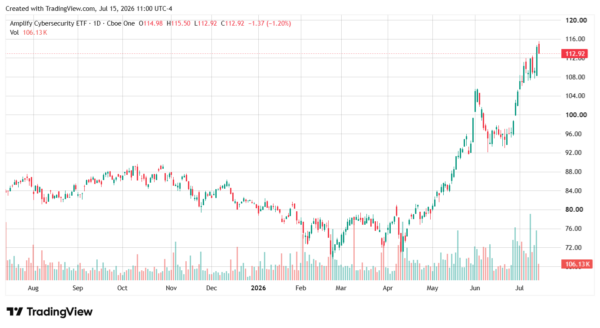
ETFMG Prime Cyber Security ETF (NYSEARCA: HACK) provides another diversified approach to the sector. The fund includes companies specializing in cybersecurity software, infrastructure protection, hardware security, and managed security services. With cybersecurity spending already growing due to ransomware, AI-driven threats, and geopolitical tensions, the arrival of quantum computing could represent another major catalyst for long-term industry demand.
quantum computing-StockEarnings

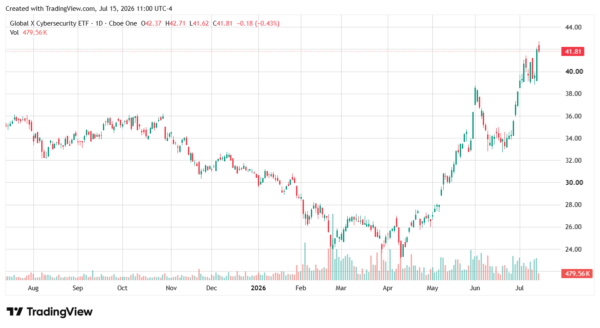
Global X Cybersecurity ETF (NASDAQ: BUG) offers concentrated exposure to companies developing advanced cybersecurity technologies, including cloud security, threat detection, identity verification, and network protection. Many of its holdings are positioned to help organizations transition toward more sophisticated security architectures capable of defending against emerging quantum-era risks.
quantum computing-StockEarnings

The Bottom Line

Governments and corporations are already preparing for a post-quantum world. That preparation is likely to require billions of dollars in investment as companies replace vulnerable encryption standards with quantum-resistant alternatives.


Over the last 26 years, he’s taught thousands of investors how to trade news flow and herd mentality using a unique blend of technical and fundamental analysis. Cooper was among the few analysts to spot the financial crisis of 2008, the top of subprime and Alt-A, the death of Lehman Brothers, Bear Stearns, and New Century Financial, and even the Dow’s collapse to 6,500, as well as its recovery. He even called for gold to rally well above $1.500 when it traded under $600. At the moment, Cooper makes use of technical, fundamental and news analysis, to help individual investors grow their wealth. He’s a firm believer that hard work and thorough research will lead to investment success.

Join over 1.2M+ investors/traders who receive daily and weekly notable earnings alerts with predicted move