Personalized medicine is back in the headlines. Merck & Co. (NYSE: MRK) and Moderna (NASDAQ: MRNA) announced this week that their experimental melanoma vaccine, intismeran, hit its main goals in a large Phase 3 trial. Combined with Merck’s Keytruda, the mRNA-based shot slowed cancer recurrence and reduced the risk of the disease spreading. Moderna’s stock jumped, and Merck shares climbed too.
The news reignited investor interest in a theme that’s been building for years: using genetic and molecular data to design treatments tailored to individual patients. Moderna supplied the mRNA technology. Merck brought commercial muscle and its blockbuster immunotherapy. Together, they may have proven that personalized cancer vaccines may actually work.
Pfizer (NYSE: PFE) wasn’t part of this week’s announcement. But it’s been quietly building its own case in personalized and precision medicine for years, particularly in oncology. The company has adopted a formal precision-medicine framework for drug development, invested heavily in genomic data, and spent $43 billion acquiring Seagen’s antibody-drug conjugate platform.
For investors looking to play the broader personalized medicine theme, Pfizer offers something Moderna and Merck don’t: a deep, diversified pipeline, a well-established oncology franchise, and a dividend yield near 6%. That combination makes PFE worth a closer look, even if it isn’t the company making this week’s splashy headlines.
The stock has also quietly turned higher. Shares are up nearly 4% over the past week and have climbed off their summer lows. That move, paired with this week’s industry news, makes now a good time to revisit Pfizer’s personalized medicine story.
How AI Is Powering the Personalized Medicine Shift
Biotech has become attractive to investors looking for an alternative to the frothy AI infrastructure trade. But that framing misses something. Biotech isn’t really an alternative to AI. It may be one of the best ways to invest in AI for the next decade.
AI’s strengths line up well with biotech’s biggest bottleneck. Drugs take years to reach the market. Even before that, they must survive clinical trials, where most candidates fail. That slow, expensive process is exactly where AI can help most.
Personalized medicine depends on data. Lots of it. Genomic sequencing, proteomics, and real-world patient outcomes all need to be analyzed at a massive scale to identify what makes one patient’s cancer different from another’s. That’s where artificial intelligence comes in.
AI models can now scan genetic and molecular data far faster than traditional methods. This lets researchers spot patterns tied to specific mutations. It also speeds up early drug discovery, helping companies match compounds to the patients most likely to benefit from them.
The result is a shift in how trials are designed. Instead of testing one drug on a broad population, companies increasingly use AI to enroll patients whose tumors carry a specific genetic signature. That improves the odds a trial succeeds, and it’s part of why intismeran’s melanoma results mattered so much this week. It signals that AI-assisted precision approaches are starting to deliver.
AI also plays a growing role after a drug reaches the market. Companies now use predictive analytics to match approved therapies to the patients most likely to respond. For a pharmaceutical company, that kind of AI infrastructure isn’t a side project. It’s becoming the backbone of how new medicines get discovered, tested, and delivered to the right patients.
Pfizer’s Deep Bench in Precision Oncology
Pfizer has pursued personalized medicine through a different route than Moderna. Rather than betting big on a single mRNA vaccine platform, Pfizer has built a broad, multi-modality oncology pipeline. It includes small molecules, biologics, and antibody-drug conjugates gained through its 2023 Seagen acquisition.
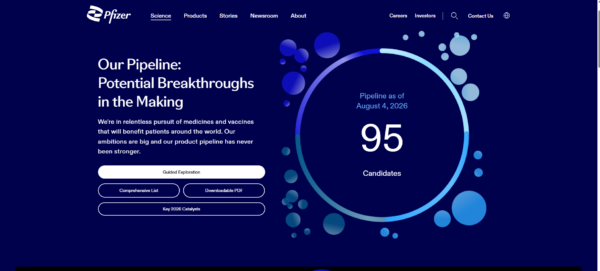
That deal added four approved ADCs, including Padcev, which grew 13% last quarter on strong demand in bladder cancer. Oncology now makes up roughly 27% of Pfizer’s total revenue. As of early August, the company had 31 oncology, immunology, vaccine, and internal medicine candidates in Phase 3 trials, out of 95 total pipeline projects.
Pfizer has also leaned into AI-driven drug discovery, using tools to analyze genomic and proteomic data at scale. The company has used AI in pharmacovigilance since 2014, well before it became an industry buzzword. Management has said it expects eight or more blockbuster oncology medicines in its portfolio by 2030, a target that leans heavily on precision approaches.
Pfizer isn’t chasing the mRNA cancer vaccine race directly. But its BioNTech (NASDAQ: BNTX) partnership on Covid-19 gave it firsthand experience scaling mRNA manufacturing. That know-how, paired with Seagen’s targeted ADC science, gives Pfizer multiple paths into personalized oncology. Investors get diversification that single platform biotech’s like Moderna can’t offer.
What the Charts Say About PFE Right Now
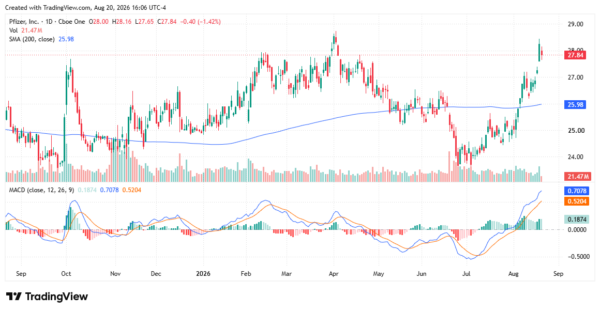
Pfizer’s daily chart shows a stock in recovery mode. Shares have climbed from roughly $23 in July to nearly $28, breaking above the 200-day moving average. The MACD indicator has turned solidly bullish, suggesting momentum is building.
The longer-term picture tells a different story. Pfizer’s all-time high was $61.71, set in December 2021 during the peak of Covid-19 vaccine demand. Even after this year’s rally, PFE trades more than 50% below that level. The company hasn’t found a replacement blockbuster since Comirnaty and Paxlovid sales faded.
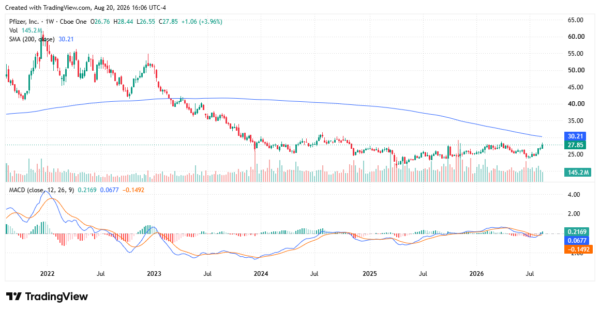
That gap is exactly why some investors see opportunity. A successful oncology pipeline, paired with the Metsera obesity assets acquired this year, could give Pfizer the growth catalyst it’s been missing since 2021.
A Dividend That Rewards Investors Who Wait
Pfizer pays a $1.72 annual dividend per share, good for a yield of approximately 6%. That’s roughly double the yield on most large pharmaceutical stocks. The company has now paid 351 consecutive quarterly dividends, a streak dating back decades.
The payout isn’t without risk. Pfizer’s free cash flow payout ratio has exceeded 100% in recent years, and the company faces a patent cliff for products like Eliquis later this decade. Still, management has repeatedly emphasized dividend stability as a core part of its capital allocation strategy.
For investors willing to wait on Pfizer’s oncology pipeline to mature, that dividend offers a reason to stay patient. Personalized medicine may take years to fully reshape Pfizer’s growth story. In the meantime, the yield pays investors to hold on.