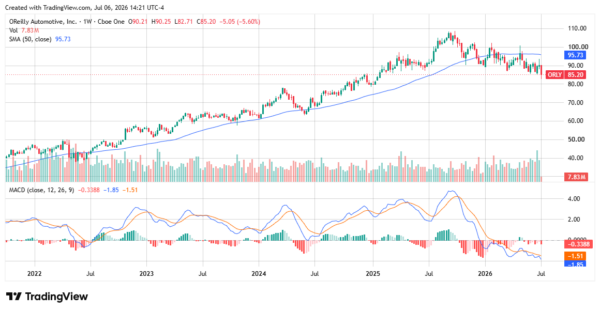
O’Reilly Automotive (NASDAQ: ORLY) has put in an offer of up to $10 billion for Genuine Parts Company’s (NYSE: GPC) NAPA division. The bid has done exactly what earnings season needed: given the auto parts retail sector a reason to matter beyond the usual comp-sales scorecard. NAPA has been a laggard tucked inside GPC’s Automotive segment for years, and the idea that O’Reilly might want to absorb it has sent the stock down by over 5% since the announcement.
But before anyone starts penciling in a done deal, it’s worth noting that O’Reilly reportedly isn’t the only name circling NAPA. And Genuine Parts management has given no indication it’s eager to sell.
If anything, the timing is awkward: GPC is already mid-stride on a separation of its Global Automotive and Global Industrial businesses, targeted for completion in the first quarter of 2027. Layering an entirely different corporate action — divesting NAPA out of Automotive — on top of that plan would be a lot to ask of a management team that just told investors it’s focused on executing one transformation at a time.
Multiple Suitors Change the Calculus for GPC Shareholders
The most underappreciated detail in this whole story is that O’Reilly is reportedly not the lone bidder. That matters more than the headline number. A single-suitor situation gives the target little leverage and often signals a company eager to exit a struggling asset. A multi-bidder situation is a different animal. In that scenario, investors have to presume that NAPA has real strategic value to more than one buyer.
That strengthens Genuine Parts’ negotiating position and raises the price other suitors would need to pay to win. It also means GPC’s board has optionality it didn’t have a month ago. Selling to the highest bidder is one path, but retaining NAPA and letting it ride inside (or alongside) the automotive separation is very much still on the table.
GPC’s Q1 2026 earnings report didn’t break out NAPA’s standalone financials. However, analysts have noted that the NAPA business has been a laggard to Genuine Parts due to its franchisee structure and supply chain underinvestment
That could make NAPA harder to value.
A Supply Chain Case, With Skepticism Attached
The weakness of NAPA, however, is a strength of O’Reilly. Analysts covering the alleged bid have been quick to point out the obvious upside case: O’Reilly’s distribution network and inventory management have consistently outperformed peers, and folding NAPA’s store footprint into that system could meaningfully improve fill rates and reduce redundant warehousing.
That’s the bull case in a sentence. But the skepticism is just as loud. Integrating a chain built on an independent owner model (many NAPA stores aren’t even company-owned) into O’Reilly’s centralized operating structure is fundamentally different from a typical bolt-on acquisition. Analysts are questioning whether the execution risk and price tag make sense compared to O’Reilly simply continuing to open new stores and take share organically. That’s exactly what its Q1 results (comp sales up 8.1%, operating income up 14%) show it’s already doing well.
Technical Picture: ORLY Testing Support After a Steep Pullback
O’Reilly’s weekly chart has turned notably weaker since topping out near the $108 level late last year. Shares now sit around $85, down more than 5.5% in the most recent week and trading below the 50-week simple moving average near $95.73 — a level that had acted as support through most of the stock’s multiyear uptrend and has now flipped to resistance.
The MACD (12, 26, 9) is negative and below its signal line, with the histogram showing sustained downside momentum rather than an early reversal. That combination suggests sellers remain in control for now, and any NAPA-related headlines are likely to be traded quickly rather than sustained until the technical setup stabilizes.
The Overlap and Dividend Problem Bears Shouldn’t Ignore
Even if a deal gets done, the messier questions start after signing. O’Reilly and NAPA compete in many of the same ZIP codes, and a combined entity would almost certainly need to close a meaningful number of overlapping locations — either legacy ORLY stores or NAPA stores — to avoid cannibalizing its own footprint. That kind of store rationalization tends to draw regulatory attention, and a $10 billion transaction between the two largest scale players in domestic auto parts retail is the kind of deal that invites a long look from antitrust regulators, not a rubber stamp.
There’s also a shareholder-base mismatch worth flagging: Genuine Parts is a Dividend King with 70 consecutive years of dividend increases and a current yield near 4%, while O’Reilly pays no dividend at all, preferring buybacks instead. That means many investors may simply prefer GPC to retain the income-generating asset rather than trade it for O’Reilly’s growth-and-buyback model.
None of this means the NAPA story fades quietly. It’s already done its job of putting auto parts retail back in investors’ line of sight this earnings season. But the presence of competing bidders, GPC’s ongoing separation timeline, the store-overlap and regulatory questions and the dividend mismatch all argue for treating this as a multi-quarter storyline rather than a signed, sealed and delivered transaction. Investors should watch for confirmation of the bid’s terms and any GPC commentary on strategic alternatives before assuming NAPA changes hands.