For the better part of three years, PepsiCo (NASDAQ: PEP) has done something most consumer companies would envy. It has continued growing revenue despite consumers pushing back against higher grocery bills, proving its brands carry enough pricing power to protect profits even as household budgets tighten.
Wall Street expects the company to report earnings of about $2.19-$2.21 per share on roughly $23.9 billion in revenue when it reports Thursday morning, modest improvements from the same quarter last year.
I don’t think those headline figures will decide where the stock goes next. Investors already know the company can charge more for a bag of chips or a bottle of soda. The question now is whether consumers are finally buying more products again, because protecting growth with higher prices and creating growth through stronger demand are two very different investment stories.
The Strategy That Worked Is Now Under Scrutiny
Pepsi’s previous quarter explains why this earnings report feels more important than usual.
Revenue increased 2.6%, while organic revenue grew 1.3%, respectable figures on the surface until you look beneath them. Organic volume declined another 3%, North America Foods volumes fell 4%, and North America Beverages slipped 3%. Those numbers weren’t telling investors Pepsi had lost its pricing power. They were telling them pricing was still carrying most of the business.
For several years, markets rewarded companies capable of offsetting inflation through higher prices because preserving margins was the priority. Pepsi executed that strategy exceptionally well. Consumers complained about paying more, yet they continued reaching for Lay’s, Doritos, Gatorade and Pepsi often enough to keep revenue moving higher.
Wall Street’s expectations have quietly changed since then. Pricing no longer feels like a competitive advantage on its own because every additional increase raises the same question. At what point do higher prices begin reflecting weakening demand rather than brand strength? Thursday’s report offers another opportunity to answer that question, particularly if management shows volume trends stabilizing after several quarters of decline.
How Pepsi Beats Matters More Than Whether It Beats
This is why I think investors often misread consumer staples earnings.
Imagine Pepsi delivers another earnings beat. That’d be good news. But the market’s reaction depends entirely on how the company reached those numbers.
Consensus estimates call for earnings of roughly $2.20 per share on nearly $24 billion in revenue. Ironically, Pepsi could hit both numbers and still disappoint investors. Another quarter driven by pricing would reinforce the view that management is extending a strategy that has become progressively harder to repeat. There are only so many price increases consumers tolerate before shopping habits begin changing in more meaningful ways
Now, suppose pricing moderates but volumes begin recovering across beverages and snacks. Suddenly, Pepsi isn’t just protecting profitability. It’s demonstrating consumers are becoming comfortable purchasing branded products again despite several years of inflation pressure.
Those two outcomes could produce similar earnings per share. Only one changes the long-term investment case.
That’s why Thursday’s conference call may prove more valuable than Thursday’s headline numbers. I’ll be listening closely to management’s comments on promotional activity, consumer spending patterns, North American demand and whether shoppers are beginning to refill baskets instead of simply absorbing higher prices.
Institutions Haven’t Made Up Their Minds
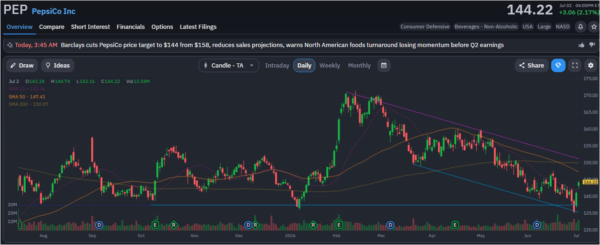
Since peaking near $170 earlier this year, the stock has built a pattern of lower highs while repeatedly failing to sustain rallies beneath a declining 50-day moving average. The 200-day average continues trending lower near $150, confirming institutions have steadily reduced exposure rather than aggressively accumulating shares.
More recently, something changed. Buyers defended the $136-$138 area, a level that previously attracted demand, before pushing shares back toward $144 with noticeably stronger trading volume. The stock has also reclaimed its 20-day moving average, an encouraging development after weeks of persistent weakness.
I wouldn’t call that a breakout, rather, a market willing to reconsider its opinion.
That amplifies the tension about Thursday’s earnings because the chart reflects investors waiting for confirmation rather than conviction. Strong evidence that volume trends are improving could provide the catalyst needed to challenge the 50-day average. Another quarter showing price increases doing most of the heavy lifting would probably leave the stock trapped inside the same downtrend that’s defined much of 2026.
All Eyes On Thursday
By Thursday afternoon, Wall Street will know whether Pepsi exceeded consensus estimates. I’m far more interested in understanding what sits beneath those estimates.
I’ll be watching whether volume finally begins contributing alongside pricing instead of depending on it, whether management sounds more confident discussing consumer demand than promotional activity, and whether the conversation shifts from defending margins to expanding the business again.
Because that’s ultimately what determines where Pepsi goes next.
Companies can protect earnings with pricing for a surprisingly long time. Premium valuations usually require something more durable. They require investors believing tomorrow’s growth will come from customers buying more products rather than paying more for the same ones.
That’s the signal I’ll be looking for when Pepsi reports. If it finally appears, Wall Street won’t simply have a better earnings report to digest. It’ll have a reason to believe one of the market’s most dependable consumer businesses has found its next phase of growth instead of squeezing a little more life out of the last one.