ajax loader

Loading...


Ride-the-Wave Strategy – Best for Stock Traders

Ride-the-Wave targets multi-day price momentum following a company’s earnings announcement (EA). With this strategy:

  1. Buy a stock one day post-EA if a stock reacts positively post-earnings:
    1. Near the close of trading the EA-day for a pre-market-EA
    2. Near the close of the following day for a post-market-EA
  2. Sell-to-close after 7-10 days, or possibly earlier if a desired price target is reached

Similarly,

  1. short a stock one day post-EA if a stock reacts negatively post-earnings:
    1. near the close of trading the EA-day for a premarket-EA
    2. near the close of the following day for a post-market-EA
  2. then buy-to-close after 7-10 days, or possibly earlier if a desired price target is reached

Important: Ride-the-Wave is predicated on significant price momentum triggered by an EA. The 7-10 day scenario is the maximum trade hold-time. If you see post EA-momentum is halted or reversed by a significant opposite move, re-evaluate your presence in the trade.

This popular StockEarnings screen below will give you a list of stocks that historically exhibit significant price momentum following an EA for the next seven days:

  1. Stocks exhibiting positive post-EA price moves are buy-candidates
  2. Stocks exhibiting negative post-EA price moves are sell/short-candidates

The screen includes those stocks whose Earnings just came out in last two days.

Screen criteria:

  1. Earnings Date Start Date : Current Date + -1 Day
  2. Earnings Date End Date : Current Date + -2 Days
  3. Predicted Move (Next Day) Max : 7%
  4. Predicted Move (On 7th Day) Min : 7%

Strategy Guideline:

  1. Buy the stock if stock has reacted positively. Short the stock if stock has reacted negatively (see above).
  2. Close the position in 7-10 days, or possibly earlier based on price move.

Volatility Crush Strategy - Best for Options Traders

The Volatility Crush strategy is used with stocks that typically experience relatively low-to-moderate price moves (≤4%) following their Earnings Announcements (EA). The basic trade idea is to sell put or call options right before the EA, collecting a credit when options premium is very high due to elevated implied volatility (IV). You then close the position right after the EA by buying the option back much cheaper due to the significant drop in IV that occurs after the mystery of the EA disappears. In assessing this trade, you need to do your homework to ensure you collect sufficient premium to make the trade worthwhile.

This trade is practical due to the low-to-moderate price-move after the EA, which generally won’t significantly affect the options price, unlike an “action” stock, which experience great price moves post-EA. With these symbols, if you’re on the right side of the price move, that’s a great thing. But if you’re on the wrong side of the move, not so great. Consequently, by minimizing the effect of the post-EA price move, you have a much better chance to profit from the reduction in IV without it being ruined by a violent price move.

For this trade, open the position either (1) the night before the EA when the company announces earnings or (2) during the EA day when it announces post-market, generally capturing IV at or close to its peak.

For this trade, open the position either (1) the night before the EA when the company announces earnings or (2) during the EA day when it announces post-market, generally capturing IV at or close to its peak.

This popular stockearnings screen will give you a list of stocks which do not react more than 4% fpost-EA. It includes only those stocks whose earnings are releasing next day.

Screen criteria:

  1. Earnings Date Start Date : Current Date + 1
  2. Earnings Date End Date : Current Date + 1
  3. Predicted Move (Next Day) Max : 4%
  4. Options Type: Weekly

Strategy Guideline:

  1. Options Strategy: Sell Call and Put
  2. Options Strike Price: Current Stock Price – (% Predicated Move x 2)
  3. Expiration Date: It should generally be the closest expiry immediately after the EA.
  4. Buy Insurance: Buying back Call and Put at Strike price which 10% lower than Sell Strike Price is optional but recommended.

Watch Video for More Detail

Volatility Rush Strategy - Best for Options Traders

The Volatility Rush takes advantage of increasing options premiums into earnings announcements (EA) caused by an anticipated rise in Implied Volatility (IV). With this strategy, Buy a Call and Put at-the-money (a long straddle) 2-3 weeks before the EA when IV is lower. Sell the position either (1) the night before the EA when the company announces earnings pre-market, or (2) during the EA day when it announces post-market, generally capturing IV at or close to its peak.

This popular screen will give you a list of stocks whose Options premiums tend to rise into Earnings. It includes only those stocks whose Earnings are at least two weeks away from today.

Screen criteria:

  1. Earnings Date Start Date : Current Date + 15 Days
  2. Earnings Date End Date : Current Date + 30 Days
  3. Predicted Move (Next Day) Min : 5%
  4. Options Type: Weekly or Monthly if that lines up with the two to three-week lead-time for entering the trade

Strategy Guideline:

  1. Buy a Straddle at or close to the money two to three weeks pre-EA.
  2. Sell the position either the night before the EA when the company announces earnings pre-market, or during the EA day when it announces post-market.
  3. Expiration date should generally be the closest expiry immediately after the EA.
  4. Straddle price should not be more 60% of predicted move.

Predicted Move (Volatility)

Similar to Implied Volatility in Options. Expected volatility % based on our Proprietary Volatility Predication Model. We are expecting that stock price will likely to reach % in either direction by the end of next trading session after Earnings are released and not necessarily the closing volatility %.

Why is it important?

    This indicator helps

  1. Knowing expected volatility in stocks after Earnings helps to decide trading stocks before Earnings Announcement.
  2. Taking Advantage of volatility collapse following Earnings Results by using Advance Options strategies such as Spread and Straddles.

Since Last Earnings

Change in share price since last Earnings release.

Why is it Important?

When share has gained more than 10% since it's last Earning release, it tends to over react to minor bad news and give up some gains if not all. So, it contains more downside volatility than upside When share has dropped more than 10% since it's last Earning release, it tends to over react to minor good news and recover some drops if not all. So, it contains more upside volatility than downside.

EPS Surprise (%)

Occurs when a company's reported quarterly or annual profits are above or below analysts' expectations. Here is the formula to derive % EPS Surprice:

Actual EPS - Estimated EPS
------------------------------------- x 100
Estimated EPS

Why is it Important?

Earnings surprises can have a huge impact on a company's stock price. Several studies suggest that positive earnings surprises not only lead to an immediate hike in a stock's price, but also to a gradual increase over time. Hence, it's not surprising that some companies are known for routinely beating earning projections. A negative earnings surprise will usually result in a decline in share price.

Next Day Price Change (%)

Next Regular trading session Closing price following Earnings result.

For After Market Close Earnings, It is a next trading day closing price. For Before Market Open Earnings, It is the same trading day closing price.

Why is it Important?

Next Day price change is a reaction of Earnings result.

The Smart Money’s Hesitation Toward Palantir (PLTR) Creates a Buy-Op

Posted on May 19, 2026 by Joshua Enomoto

The Smart Money’s Hesitation Toward Palantir (PLTR) Creates a Buy-Op

Palantir Technologies (NASDAQ: PLTR) arguably ranks among the most difficult tech names to figure out. Sure, there’s the whole big data narrative, along with artificial intelligence, which has driven PLTR stock to incredible heights. However, the problem is that investors are clearly looking for more substance out of the name, leading to skepticism about whether it can maintain its lofty premium.

Just look at what happened in Palantir’s latest earnings disclosure. For the first quarter, the company posted earnings per share of 33 cents on revenue of $1.63 billion. These figures easily beat out analysts’ expectations for EPS of 27 cents against a top-line expected view of $1.54 billion. However, it’s also fair to point out that robust earnings performances have been par for the course.

Subsequently, on the day of the disclosure, PLTR stock popped higher. Unfortunately, the day after saw a sizable decline in market value. Overall, the results have been unimpressive. In the past month, PLTR incurred an 8.47% loss. On a year-to-date basis, the security is down roughly 25%.

In part, what appears to be happening is a broader sense of diminishing returns. For example, the upcoming Q2 report should show continued financial expansion, with EPS targeted at 33 cents and revenue at $1.81 billion. However, the market is signaling that it’s not enough to ink robust growth metrics. The improvements need to be that much more substantial to satisfy investors, who again are increasingly uncomfortable with the hot premium.

Under this environment, traders need to be more tactical with PLTR stock. You often see these fluff pieces on PLTR stock talking about AI and other narratives — as if this stuff hadn’t already been priced into the security!

It likely has, and the volatility skew is evidence of this.

Hesitation Among the Smart Money Presents an Interesting Case for PLTR Stock


By definition, the volatility skew identifies implied volatility (IV) across the strike price spectrum of a given options chain. Since IV reflects the expected kinetic range of a security at the affected strike price, a higher volatility reading effectively represents greater demand for hedging the implied movement.

Yes, this sounds like a complicated definition — and it is complicated, which is part of the reason why I’m not a big fan of the (deliberately) opaque nature of options education. Basically, the skew represents an insurance market. On any given day, a heavily traded stock would be expected to move either in a net positive or negative direction.

With options, smart money traders can either protect themselves from the risk of a catastrophic loss or they can lever up a speculative bullish position — essentially covering upside risk. In hesitant markets, sophisticated players may end up hedging both sides.

That’s about the situation that’s happening with PLTR stock. For the June 5 expiration date, the dominant expression is geared toward downside protection. You’ll notice that for the lowest out-the-money strike prices, put IV swings sharply northward. This dynamic implies protection against unexpected volatility.

However, the right-side tail is longer, implying careful exposure to upside convexity. Generally, the shape of the skew — especially it being flat for strikes near the spot price — indicates that the smart money doesn’t believe in wild drama for Palantir stock. Still, if something should happen positively, traders don’t want to be caught flat-footed.

An important caveat that needs to be declared is that the smart money isn’t necessarily prescient. Yes, these sophisticated players are buying insurance — but that doesn’t always mean that a car crash is more likely to occur. Right now, even the most seasoned traders don’t know what to exactly make of PLTR stock.

That’s where we can use induction and triangulate a potentially successful transaction.

Playing the Numbers Game with Palantir Stock

One of the tempting reasons why people trade PLTR stock is its high 60-month beta of 1.52. Essentially, this metric tells us that Palantir is considerably more volatile than the benchmark S&P 500. However, this stat is also an aggregate datapoint, meaning that PLTR isn’t always guaranteed to be as volatile as the beta implies. On some days, the volatility could be worse, or it could be muted.

In other words, we’re not interested in trading Palantir stock randomly; instead, we want to trade it deliberately. More to the point, we only want to trade it under conditions and time periods that are favorable to us. Based on the numbers, I believe we are in such a scenario.
PLTR - StockEarnings

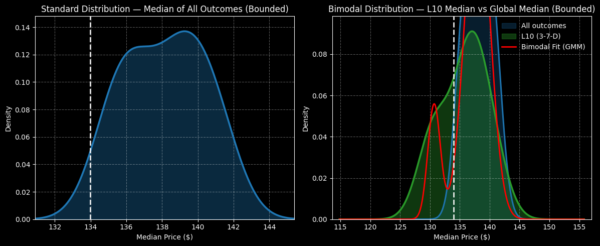
In the past 10 weeks, PLTR stock has printed only three up weeks, thereby leading to an overall negative slope. Under this 3-7-D sequence, we would expect the next 10 weeks to create a forward distribution ranging between $120 and $150 (assuming a starting point of $133.99).

Where did this distribution come from? Since PLTR’s public market debut, there have been 17 instances of the 3-7-D signal on a rolling basis. Using an inductive algorithm, we can plot an expected median pathway based on prior observations of this signal.

However, from a sequential week-to-week basis, we would anticipate PLTR stock to be incredibly choppy. Statistically, it’s only within the first three weeks that Palantir has demonstrated a tendency of rising. With prices expected to cluster around $140 at the third week (if the inductive observation is to repeat itself), this price level represents a logical target.

With that in mind, I’m looking at the 138/140 bull call spread expiring June 5. If Palantir stock rises through the $140 strike at expiration, the maximum payout would be roughly 111%. While it’s not the greatest payout by magnitude, you would only be putting a net debit of $95 per spread at risk.

Some might question the near-term expiry, which is understandable. However, having a long expiration date isn’t necessarily safe for a debit-based trade. That’s because the stock in question could easily fall out of the money while you wait for the spread to expire.

No, the inductive methodology used to calculate the trade above isn’t foolproof. But in a non-deterministic system, it’s probably the best tool that we have.


Joshua Enomoto is a seasoned financial writer with a strong track record of in-depth stock analysis, offering clear, insightful commentary for retail investors across all levels of expertise. Renowned for his ability to blend analytical rigor with engaging wit, Joshua's work has been featured on leading investment platforms, including TipRanks, InvestorPlace, Barchart, Benzinga, and Fintel. He was also handpicked to spearhead high-impact initiatives such as InvestorPlace's "Trade of the Day" and Benzinga’s ETF coverage. As a frequent guest expert for CGTN America, Joshua discusses a wide range of economic, societal, and consumer market trends. A graduate of U.C. San Diego, Joshua brings a thoughtful and fresh perspective to complex financial narratives, helping enterprise clients connect with their audiences. He also composes music in his spare time.

Join over 1.2M+ investors/traders who receive daily and weekly notable earnings alerts with predicted move