ajax loader

Loading...


Ride-the-Wave Strategy – Best for Stock Traders

Ride-the-Wave targets multi-day price momentum following a company’s earnings announcement (EA). With this strategy:

  1. Buy a stock one day post-EA if a stock reacts positively post-earnings:
    1. Near the close of trading the EA-day for a pre-market-EA
    2. Near the close of the following day for a post-market-EA
  2. Sell-to-close after 7-10 days, or possibly earlier if a desired price target is reached

Similarly,

  1. short a stock one day post-EA if a stock reacts negatively post-earnings:
    1. near the close of trading the EA-day for a premarket-EA
    2. near the close of the following day for a post-market-EA
  2. then buy-to-close after 7-10 days, or possibly earlier if a desired price target is reached

Important: Ride-the-Wave is predicated on significant price momentum triggered by an EA. The 7-10 day scenario is the maximum trade hold-time. If you see post EA-momentum is halted or reversed by a significant opposite move, re-evaluate your presence in the trade.

This popular StockEarnings screen below will give you a list of stocks that historically exhibit significant price momentum following an EA for the next seven days:

  1. Stocks exhibiting positive post-EA price moves are buy-candidates
  2. Stocks exhibiting negative post-EA price moves are sell/short-candidates

The screen includes those stocks whose Earnings just came out in last two days.

Screen criteria:

  1. Earnings Date Start Date : Current Date + -1 Day
  2. Earnings Date End Date : Current Date + -2 Days
  3. Predicted Move (Next Day) Max : 7%
  4. Predicted Move (On 7th Day) Min : 7%

Strategy Guideline:

  1. Buy the stock if stock has reacted positively. Short the stock if stock has reacted negatively (see above).
  2. Close the position in 7-10 days, or possibly earlier based on price move.

Volatility Crush Strategy - Best for Options Traders

The Volatility Crush strategy is used with stocks that typically experience relatively low-to-moderate price moves (≤4%) following their Earnings Announcements (EA). The basic trade idea is to sell put or call options right before the EA, collecting a credit when options premium is very high due to elevated implied volatility (IV). You then close the position right after the EA by buying the option back much cheaper due to the significant drop in IV that occurs after the mystery of the EA disappears. In assessing this trade, you need to do your homework to ensure you collect sufficient premium to make the trade worthwhile.

This trade is practical due to the low-to-moderate price-move after the EA, which generally won’t significantly affect the options price, unlike an “action” stock, which experience great price moves post-EA. With these symbols, if you’re on the right side of the price move, that’s a great thing. But if you’re on the wrong side of the move, not so great. Consequently, by minimizing the effect of the post-EA price move, you have a much better chance to profit from the reduction in IV without it being ruined by a violent price move.

For this trade, open the position either (1) the night before the EA when the company announces earnings or (2) during the EA day when it announces post-market, generally capturing IV at or close to its peak.

For this trade, open the position either (1) the night before the EA when the company announces earnings or (2) during the EA day when it announces post-market, generally capturing IV at or close to its peak.

This popular stockearnings screen will give you a list of stocks which do not react more than 4% fpost-EA. It includes only those stocks whose earnings are releasing next day.

Screen criteria:

  1. Earnings Date Start Date : Current Date + 1
  2. Earnings Date End Date : Current Date + 1
  3. Predicted Move (Next Day) Max : 4%
  4. Options Type: Weekly

Strategy Guideline:

  1. Options Strategy: Sell Call and Put
  2. Options Strike Price: Current Stock Price – (% Predicated Move x 2)
  3. Expiration Date: It should generally be the closest expiry immediately after the EA.
  4. Buy Insurance: Buying back Call and Put at Strike price which 10% lower than Sell Strike Price is optional but recommended.

Watch Video for More Detail

Volatility Rush Strategy - Best for Options Traders

The Volatility Rush takes advantage of increasing options premiums into earnings announcements (EA) caused by an anticipated rise in Implied Volatility (IV). With this strategy, Buy a Call and Put at-the-money (a long straddle) 2-3 weeks before the EA when IV is lower. Sell the position either (1) the night before the EA when the company announces earnings pre-market, or (2) during the EA day when it announces post-market, generally capturing IV at or close to its peak.

This popular screen will give you a list of stocks whose Options premiums tend to rise into Earnings. It includes only those stocks whose Earnings are at least two weeks away from today.

Screen criteria:

  1. Earnings Date Start Date : Current Date + 15 Days
  2. Earnings Date End Date : Current Date + 30 Days
  3. Predicted Move (Next Day) Min : 5%
  4. Options Type: Weekly or Monthly if that lines up with the two to three-week lead-time for entering the trade

Strategy Guideline:

  1. Buy a Straddle at or close to the money two to three weeks pre-EA.
  2. Sell the position either the night before the EA when the company announces earnings pre-market, or during the EA day when it announces post-market.
  3. Expiration date should generally be the closest expiry immediately after the EA.
  4. Straddle price should not be more 60% of predicted move.

Predicted Move (Volatility)

Similar to Implied Volatility in Options. Expected volatility % based on our Proprietary Volatility Predication Model. We are expecting that stock price will likely to reach % in either direction by the end of next trading session after Earnings are released and not necessarily the closing volatility %.

Why is it important?

    This indicator helps

  1. Knowing expected volatility in stocks after Earnings helps to decide trading stocks before Earnings Announcement.
  2. Taking Advantage of volatility collapse following Earnings Results by using Advance Options strategies such as Spread and Straddles.

Since Last Earnings

Change in share price since last Earnings release.

Why is it Important?

When share has gained more than 10% since it's last Earning release, it tends to over react to minor bad news and give up some gains if not all. So, it contains more downside volatility than upside When share has dropped more than 10% since it's last Earning release, it tends to over react to minor good news and recover some drops if not all. So, it contains more upside volatility than downside.

EPS Surprise (%)

Occurs when a company's reported quarterly or annual profits are above or below analysts' expectations. Here is the formula to derive % EPS Surprice:

Actual EPS - Estimated EPS
------------------------------------- x 100
Estimated EPS

Why is it Important?

Earnings surprises can have a huge impact on a company's stock price. Several studies suggest that positive earnings surprises not only lead to an immediate hike in a stock's price, but also to a gradual increase over time. Hence, it's not surprising that some companies are known for routinely beating earning projections. A negative earnings surprise will usually result in a decline in share price.

Next Day Price Change (%)

Next Regular trading session Closing price following Earnings result.

For After Market Close Earnings, It is a next trading day closing price. For Before Market Open Earnings, It is the same trading day closing price.

Why is it Important?

Next Day price change is a reaction of Earnings result.

How NVIDIA Lost Billions In China And Still Posted Absurd Numbers

Posted on May 21, 2026 by Grayson Cavern

How NVIDIA Lost Billions In China And Still Posted Absurd Numbers

In recent months, NVIDIA has lost access to billions of dollars of Chinese AI business. Most companies would spend the next earnings call explaining the damage.

Yet, NVIDIA Corporation (NYSE: NVDA) reported Q1 earnings for FY27 with a revenue of $81.6 billion and diluted EPS of $0.76 instead. That contradiction was the most fascinating part of the quarter because Nvidia did not merely overcome a headwind that could have crippled most companies; it produced numbers so large they almost buried China’s story.

And the deeper I went, the harder it became to view NVIDIA as “just” a semiconductor company going forward.

China Has Crippled Growth Stories Before


Apple Inc. (NASDAQ: AAPL) regularly faces scrutiny whenever Chinese sales slow. Nike Inc. (NYSE: NKE) spent years treating China as a critical growth engine before slowing demand became a recurring concern. Starbucks Corporation (NASDAQ: SBUX) spent decades building China into its most important international growth engine. Yet, increasing local competition has pressured the company to explore strategic alternatives for its China business as growth slowed

That’s how global markets normally work. When a major market weakens, growth slows, and investors reassess expectations.

NVIDIA faced something far worse than slowing demand.

The company disclosed that H20 export restrictions resulted in a $4.5 billion charge during the quarter. It also disclosed an additional $2.5 billion in H20 revenue it could not ship due to those restrictions.

That is $7 billion of impact connected to a single product line. For most companies, a disruption of that magnitude would dominate the quarter. For NVIDIA, it became background noise.

NVIDIA Showed How Little China Matters

The quality of numbers NVIDIA released this quarter is disturbing, but in a good way.

Revenue reached $81.6 billion. Gross profit reached $58.8 billion. Operating income reached $44.1 billion. Operating cash flow reached $48.8 billion. Free cash flow reached $26 billion.

The board also approved an additional $80 billion share repurchase authorization.

When you compare this to the $7 billion connected to China again, NVIDIA still generated enough cash in one quarter to fund entire industries.

But make no mistake, this story isn’t about how NVIDIA survived China’s restrictions. In fact, focusing on that alone could cause a fatal misinterpretation of these earnings, which could lead you to a false conclusion about the AI boom and where it’s headed.

What I’m trying to tell you is that the global AI spending has expanded so rapidly it absorbed the restrictions that broke down the internet a couple of months ago.

And nowhere was that reality more visible than inside the Data Center business. Let me explain.

What Selling The Capacity Behind An Infrastructure Race Looks Like

A step further in this report, you’d bump into Data Center revenue climbing to $75.2 billion, up 92% year-over-year.

Not only that, Gaming also generated $3.8 billion. Professional Visualization generated $509 million. Automotive generated $567 million.

Place those figures next to each other, and the transformation becomes impossible to ignore.

The old NVIDIA still exists, which is where most investors’ theses are stuck.

But the new NVIDIA completely dominates it. The company no longer looks like a chipmaker benefiting from AI demand. It looks like the company supplying the computational backbone behind one of the largest infrastructure buildouts in modern history.

The quarter repeatedly pointed toward the same destination; Blackwell systems ramped. AI factories expanded. Sovereign AI projects accelerated. Inference demand continued climbing.

The world’s largest technology companies, the government and enterprises… Everyone is still spending because, before an AI model can reason, before a robot can navigate a warehouse, before an autonomous vehicle can interpret its surroundings, someone must build the computing infrastructure first. And NVIDIA is sitting at the center of it all.

A Powerful Uptrend

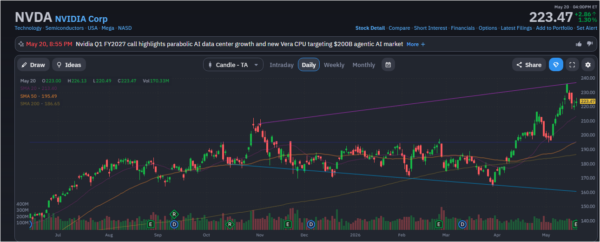
NVDA exploded higher following earnings, confirming what had already become one of the strongest charts in the market. The stock recently broke above the key $200 resistance zone, turning a level that capped rallies for months into potential support.

Technically, NVDA remains firmly above its 20-, 50-, and 200-day moving averages, signaling a strong momentum across multiple timeframes.

The earnings-driven surge also pushed the stock toward the upper boundary of its rising channel near $235-$240. While some short-term consolidation would be normal after such a sharp run, the trend remains firmly in the bulls’ favor as long as NVDA holds above the $200 breakout area.

At the moment, buyers continue treating every pullback as an opportunity to gain exposure to the AI infrastructure buildout.
nvidia - StockEarnings

The Spending Still Hasn’t Hit The Wall

Of course, Wall Street keeps searching for signs that AI spending will cool.

NVIDIA’s guidance told a different story.

The company guided for approximately $91 billion in Q2 revenue despite the continued impact from export restrictions.

That may be the most important figure in the entire report.

Because guidance arrives after management has already seen customer orders, deployment schedules, capacity plans, and infrastructure demand.

And yet the company still expects another leap higher. This is why NVIDIA is losing billions of dollars tied to China, while still producing revenue, profits, cash flow, and guidance that most corporations could not generate under ideal conditions…could go down as the most critical AI story in decades.

And if this infrastructure race keeps accelerating faster than global tension, the company’s biggest challenge may no longer be finding customers. It may be keeping up with them.


Join over 1.2M+ investors/traders who receive daily and weekly notable earnings alerts with predicted move