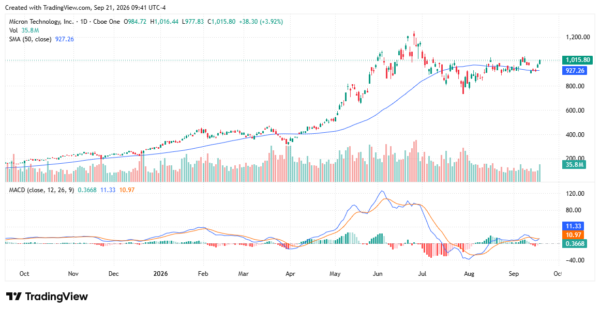
Micron Technology (NASDAQ: MU) is scheduled to report its fiscal fourth-quarter earnings after the market closes on September 30. While revenue and earnings will attract plenty of attention, Wall Street’s biggest question is straightforward: Can Micron keep benefiting from extraordinary demand for the memory chips powering artificial intelligence?
Expectations are already exceptionally high.
Micron’s previous quarterly results showed explosive growth in sales, profits and margins. The company then issued a strong outlook for the fourth quarter. This time around, Wall Street will want results that exceed the company’s guidance and an outlook suggesting the momentum can continue into fiscal 2027.
Micron Earnings Could Deliver Another Record Quarter
Micron guided for fiscal fourth-quarter revenue of about $50 billion, plus or minus $1 billion. At the midpoint, that would represent a considerable increase from the $41.46 billion generated during the third quarter. The company also expects adjusted earnings of about $31 per share, plus or minus $1, along with an adjusted gross margin of about 86%.
Those are big numbers for a company that has historically operated in one of the semiconductor industry’s most cyclical markets. Memory prices can rise rapidly when supply is tight, only to collapse when manufacturers add too much capacity.
This time, however, Micron argues that the AI revolution is creating a more durable period of demand. Investors will want to hear evidence supporting that claim when the company reports.
HBM Growth Could Be the Key Earnings Catalyst
The most important part of Micron’s earnings report may be its update on high-bandwidth memory, better known as HBM.
HBM is critical for advanced AI accelerators because it allows enormous amounts of data to move quickly between memory and processors. As companies such as Microsoft (NASDAQ: MSFT), Amazon (NASDAQ: AMZN), Alphabet (NASDAQ: GOOGL) and Meta Platforms (NASDAQ: META) continue spending billions of dollars on AI infrastructure, demand for specialized memory has surged.
Micron said during its previous report that HBM4 was already in high-volume shipments for a lead customer’s platform. It had also sent qualification samples to multiple other customers. Meanwhile, development of its next-generation HBM4E product was progressing, with volume production expected in calendar 2027.
Pricing and Margins Must Remain Strong
HBM demand is only part of the story. Micron also sells DRAM and NAND memory used in servers, personal computers, smartphones, vehicles and storage systems.
Strong AI demand has tightened the supply of advanced memory products. In addition, manufacturers are dedicating more production capacity to HBM, which can require considerably more manufacturing resources than conventional DRAM. That shift can limit the supply of traditional memory and support higher prices throughout the market.
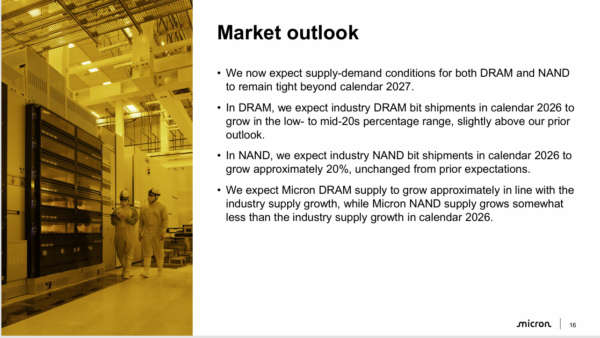
This favorable pricing environment helped Micron produce a non-GAAP gross margin of 84.9% in its fiscal third quarter. The company expects that figure to reach approximately 86% in the fourth quarter. Investors will want to know whether those margins are sustainable.
The outlook for the new fiscal year could move the stock more than the headline results. Wall Street will want to hear whether cloud companies are maintaining their AI spending plans. Investors will also look for guidance on HBM demand, conventional DRAM pricing, NAND conditions and planned capital expenditures.
Fiscal 2027 Outlook Could Drive MU Stock
Wall Street expects Micron to deliver another strong quarter on September 30. But with revenue, earnings and margins already projected at record levels, the company faces a much higher bar than it did earlier in the AI cycle.
The report will ultimately come down to three questions: Is AI-memory demand still accelerating? Can the company maintain its exceptional margins? And does management expect the momentum to continue into fiscal 2027?
If the answers are convincing, Micron could reinforce its position as one of the biggest beneficiaries of the AI infrastructure boom. If guidance shows that growth is beginning to level off, investors may decide that too much optimism is already reflected in the stock.