ajax loader

Loading...


Ride-the-Wave Strategy – Best for Stock Traders

Ride-the-Wave targets multi-day price momentum following a company’s earnings announcement (EA). With this strategy:

  1. Buy a stock one day post-EA if a stock reacts positively post-earnings:
    1. Near the close of trading the EA-day for a pre-market-EA
    2. Near the close of the following day for a post-market-EA
  2. Sell-to-close after 7-10 days, or possibly earlier if a desired price target is reached

Similarly,

  1. short a stock one day post-EA if a stock reacts negatively post-earnings:
    1. near the close of trading the EA-day for a premarket-EA
    2. near the close of the following day for a post-market-EA
  2. then buy-to-close after 7-10 days, or possibly earlier if a desired price target is reached

Important: Ride-the-Wave is predicated on significant price momentum triggered by an EA. The 7-10 day scenario is the maximum trade hold-time. If you see post EA-momentum is halted or reversed by a significant opposite move, re-evaluate your presence in the trade.

This popular StockEarnings screen below will give you a list of stocks that historically exhibit significant price momentum following an EA for the next seven days:

  1. Stocks exhibiting positive post-EA price moves are buy-candidates
  2. Stocks exhibiting negative post-EA price moves are sell/short-candidates

The screen includes those stocks whose Earnings just came out in last two days.

Screen criteria:

  1. Earnings Date Start Date : Current Date + -1 Day
  2. Earnings Date End Date : Current Date + -2 Days
  3. Predicted Move (Next Day) Max : 7%
  4. Predicted Move (On 7th Day) Min : 7%

Strategy Guideline:

  1. Buy the stock if stock has reacted positively. Short the stock if stock has reacted negatively (see above).
  2. Close the position in 7-10 days, or possibly earlier based on price move.

Volatility Crush Strategy - Best for Options Traders

The Volatility Crush strategy is used with stocks that typically experience relatively low-to-moderate price moves (≤4%) following their Earnings Announcements (EA). The basic trade idea is to sell put or call options right before the EA, collecting a credit when options premium is very high due to elevated implied volatility (IV). You then close the position right after the EA by buying the option back much cheaper due to the significant drop in IV that occurs after the mystery of the EA disappears. In assessing this trade, you need to do your homework to ensure you collect sufficient premium to make the trade worthwhile.

This trade is practical due to the low-to-moderate price-move after the EA, which generally won’t significantly affect the options price, unlike an “action” stock, which experience great price moves post-EA. With these symbols, if you’re on the right side of the price move, that’s a great thing. But if you’re on the wrong side of the move, not so great. Consequently, by minimizing the effect of the post-EA price move, you have a much better chance to profit from the reduction in IV without it being ruined by a violent price move.

For this trade, open the position either (1) the night before the EA when the company announces earnings or (2) during the EA day when it announces post-market, generally capturing IV at or close to its peak.

For this trade, open the position either (1) the night before the EA when the company announces earnings or (2) during the EA day when it announces post-market, generally capturing IV at or close to its peak.

This popular stockearnings screen will give you a list of stocks which do not react more than 4% fpost-EA. It includes only those stocks whose earnings are releasing next day.

Screen criteria:

  1. Earnings Date Start Date : Current Date + 1
  2. Earnings Date End Date : Current Date + 1
  3. Predicted Move (Next Day) Max : 4%
  4. Options Type: Weekly

Strategy Guideline:

  1. Options Strategy: Sell Call and Put
  2. Options Strike Price: Current Stock Price – (% Predicated Move x 2)
  3. Expiration Date: It should generally be the closest expiry immediately after the EA.
  4. Buy Insurance: Buying back Call and Put at Strike price which 10% lower than Sell Strike Price is optional but recommended.

Watch Video for More Detail

Volatility Rush Strategy - Best for Options Traders

The Volatility Rush takes advantage of increasing options premiums into earnings announcements (EA) caused by an anticipated rise in Implied Volatility (IV). With this strategy, Buy a Call and Put at-the-money (a long straddle) 2-3 weeks before the EA when IV is lower. Sell the position either (1) the night before the EA when the company announces earnings pre-market, or (2) during the EA day when it announces post-market, generally capturing IV at or close to its peak.

This popular screen will give you a list of stocks whose Options premiums tend to rise into Earnings. It includes only those stocks whose Earnings are at least two weeks away from today.

Screen criteria:

  1. Earnings Date Start Date : Current Date + 15 Days
  2. Earnings Date End Date : Current Date + 30 Days
  3. Predicted Move (Next Day) Min : 5%
  4. Options Type: Weekly or Monthly if that lines up with the two to three-week lead-time for entering the trade

Strategy Guideline:

  1. Buy a Straddle at or close to the money two to three weeks pre-EA.
  2. Sell the position either the night before the EA when the company announces earnings pre-market, or during the EA day when it announces post-market.
  3. Expiration date should generally be the closest expiry immediately after the EA.
  4. Straddle price should not be more 60% of predicted move.

Predicted Move (Volatility)

Similar to Implied Volatility in Options. Expected volatility % based on our Proprietary Volatility Predication Model. We are expecting that stock price will likely to reach % in either direction by the end of next trading session after Earnings are released and not necessarily the closing volatility %.

Why is it important?

    This indicator helps

  1. Knowing expected volatility in stocks after Earnings helps to decide trading stocks before Earnings Announcement.
  2. Taking Advantage of volatility collapse following Earnings Results by using Advance Options strategies such as Spread and Straddles.

Since Last Earnings

Change in share price since last Earnings release.

Why is it Important?

When share has gained more than 10% since it's last Earning release, it tends to over react to minor bad news and give up some gains if not all. So, it contains more downside volatility than upside When share has dropped more than 10% since it's last Earning release, it tends to over react to minor good news and recover some drops if not all. So, it contains more upside volatility than downside.

EPS Surprise (%)

Occurs when a company's reported quarterly or annual profits are above or below analysts' expectations. Here is the formula to derive % EPS Surprice:

Actual EPS - Estimated EPS
------------------------------------- x 100
Estimated EPS

Why is it Important?

Earnings surprises can have a huge impact on a company's stock price. Several studies suggest that positive earnings surprises not only lead to an immediate hike in a stock's price, but also to a gradual increase over time. Hence, it's not surprising that some companies are known for routinely beating earning projections. A negative earnings surprise will usually result in a decline in share price.

Next Day Price Change (%)

Next Regular trading session Closing price following Earnings result.

For After Market Close Earnings, It is a next trading day closing price. For Before Market Open Earnings, It is the same trading day closing price.

Why is it Important?

Next Day price change is a reaction of Earnings result.

CrowdStrike Stock: Strong AI Demand Meets a Sobering Valuation

Posted on Sep 21, 2026 by Chris Markoch

CrowdStrike Stock: Strong AI Demand Meets a Sobering Valuation

Is CrowdStrike (NASDAQ: CRWD) stock overvalued? The numbers say yes, but for the time being, the market doesn’t care. On Sept. 18, CRWD closed at $237.65, within reach of a 52-week high of $250.32. The stock is up about 118% over 52 weeks, and its market value is about $244 billion, with a forward P/E of approximately 147. Divide that value by roughly $6 billion in expected revenue, and price-to-sales tops 40. That’s a steep price for any software company.

Yet the business behind the ticker is hard to dismiss. CrowdStrike is widely viewed as a best-in-class cybersecurity platform. Its latest quarter showed accelerating growth, rising margins, and strong cash generation. Investors are also buying the stock as a hedge against AI risk. As artificial intelligence spreads, the attack surface expands. Security spending follows. Wall Street noticed: Stephens & Co. raised its price target to $280 on Friday.

Investors have to wrestle with this contradiction. On one side sits a premium company with a compelling AI narrative. On the other sits a valuation that demands near-flawless execution for a decade. We test both with a discounted cash flow (DCF) model, a look at passive 401(k) money, and the technical chart.

The short version: the fundamentals are excellent, the DCF is sobering, and the flows and momentum are real. Perception and fundamentals have rarely been further apart. This article walks through each piece so you can decide how much of the premium you’re willing to pay.

Why CrowdStrike’s AI Security Growth Still Looks Strong


Start with what makes this company special. Second-quarter revenue rose 26% to $1.47 billion, and annual recurring revenue reached $5.84 billion, up 25%. Net new ARR hit a record $332.8 million, a 51% jump. New-logo net new ARR also set a record, and management raised its full-year net new ARR growth outlook to 34%. Accelerating growth on a base this large is uncommon.

Profitability is improving alongside growth. Free cash flow set a second-quarter record at $377.4 million. Management expects a free cash flow margin of at least 30% this year, and cash stood at $5.01 billion. Non-GAAP subscription gross margin reached 81%, and about 51% of customers use six or more modules.

The AI angle is the catalyst. CEO George Kurtz argues that every enterprise will run on AI, and that securing it is the company’s largest opportunity. Accounts on Falcon Flex now represent over $2.29 billion in ARR, growing 101%. Shares jumped on Sept. 14 as worries about AI risk lifted cybersecurity names broadly.

For investors, the takeaway is simple. This is a real business with real momentum. The debate is about price, not quality.

How Passive Investing Supports CrowdStrike Stock

Here’s something that many investors overlook. CrowdStrike is a component of both the S&P 500 and the Nasdaq-100. More than 500 ETFs hold it. Vanguard, BlackRock, and State Street rank among its largest shareholders.

Now consider your paycheck. Roughly 60% of 401(k) participants held target-date funds by 2023, and index funds are often the default option in 401 (k) plans. With automatic enrollment, contributions flow into them unless the employee chooses otherwise. So each contribution buys a slice of CrowdStrike, weighted by market value.

That creates a steady, price-insensitive bid. An index doesn’t care whether a stock is expensive. As CrowdStrike’s market value grows, its index weight grows too, and so does the automatic buying.

It is not evidence of value, though. And the same mechanism works in reverse during heavy withdrawals or selloffs. The thing to remember is that passive flows can’t justify a premium, but they can prolong it.

CrowdStrike Stock Valuation: What the DCF Says

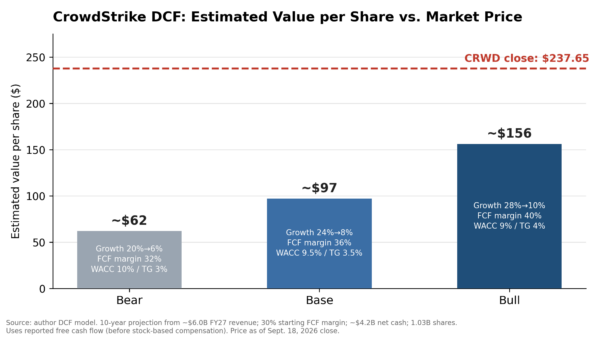
A DCF estimates what future cash flows are worth today. I built three scenarios. Each uses about $6 billion in fiscal 2027 revenue, a 30% starting free cash flow margin, and roughly $4.2 billion in net cash. Furthermore, I projected ten years, then applied a terminal growth rate.
crowdstrike - StockEarnings

Even the bull case lands about a third below Friday’s close. Working backward, today’s price requires roughly 28% annual revenue growth for a decade. That would push sales to about $70 billion by fiscal 2037.

This chart is based on my estimates and requires two important caveats. First, these figures use reported free cash flow, which excludes stock-based compensation. That expense, with related payroll taxes, totaled $399.0 million last quarter. Treating it as a real cost drops the base case to about $66. Second, DCFs are highly sensitive to inputs. At an 8.5% discount rate and 4% terminal growth, the base case still reaches only about $128.

All of which is to say the market is pricing in a long runway of exceptional growth. If it arrives, CRWD stock can work at its current multiple. If it stalls, the multiple has far to fall.

Reading the Chart: Where Momentum Helps and Where Risk Hides

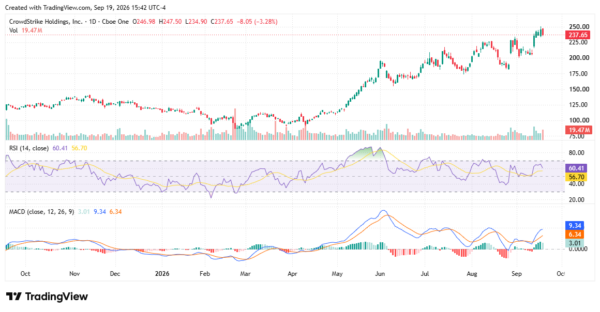
The CRWD chart tells a constructive story, but it comes with yet another caution flag. CrowdStrike climbed from the mid-$80s earlier this year to near $250, printing higher highs and higher lows. The stock’s 3.3% drop on Sept. 18, on 19.47 million shares, pulled it back to $237.65.

The 14-day RSI reads 60.41, comfortably below the overbought 70 line. MACD sits at 9.34, above its 6.34 signal line, with a positive histogram. Resistance sits near $250. Support appears near $205, where early-September buyers stepped in, then near $180. A close above $250 would confirm the breakout. A drop below $205 would weaken it.
crowdstirke - StockEarnings

Know What You Own, And At What Price

CrowdStrike is a high-quality company priced beyond conventional valuation support. Our DCF range of $62 to $156 sits well below the market price. GuruFocus’s fair-value estimate of $137.22 points the same way. But passive inflows, AI enthusiasm, and positive momentum can keep premium stocks elevated longer than fundamentals suggest.

For investors, the key is knowing what you’re paying for. Watch third-quarter net new ARR guidance of $343 million to $347 million, free cash flow margins, and stock-based compensation. Position size matters more when a stock needs near-perfect execution. The story behind the stock is strong. The price behind the story leaves little room for error.


A former marketing copywriter turned freelance financial writer and market analyst. I have a passion for delivering insights to investors. I write regularly about stocks for StockEarnings and MarketBeat. Posts are not advice.

Join over 1.2M+ investors/traders who receive daily and weekly notable earnings alerts with predicted move