ajax loader

Loading...


Ride-the-Wave Strategy – Best for Stock Traders

Ride-the-Wave targets multi-day price momentum following a company’s earnings announcement (EA). With this strategy:

  1. Buy a stock one day post-EA if a stock reacts positively post-earnings:
    1. Near the close of trading the EA-day for a pre-market-EA
    2. Near the close of the following day for a post-market-EA
  2. Sell-to-close after 7-10 days, or possibly earlier if a desired price target is reached

Similarly,

  1. short a stock one day post-EA if a stock reacts negatively post-earnings:
    1. near the close of trading the EA-day for a premarket-EA
    2. near the close of the following day for a post-market-EA
  2. then buy-to-close after 7-10 days, or possibly earlier if a desired price target is reached

Important: Ride-the-Wave is predicated on significant price momentum triggered by an EA. The 7-10 day scenario is the maximum trade hold-time. If you see post EA-momentum is halted or reversed by a significant opposite move, re-evaluate your presence in the trade.

This popular StockEarnings screen below will give you a list of stocks that historically exhibit significant price momentum following an EA for the next seven days:

  1. Stocks exhibiting positive post-EA price moves are buy-candidates
  2. Stocks exhibiting negative post-EA price moves are sell/short-candidates

The screen includes those stocks whose Earnings just came out in last two days.

Screen criteria:

  1. Earnings Date Start Date : Current Date + -1 Day
  2. Earnings Date End Date : Current Date + -2 Days
  3. Predicted Move (Next Day) Max : 7%
  4. Predicted Move (On 7th Day) Min : 7%

Strategy Guideline:

  1. Buy the stock if stock has reacted positively. Short the stock if stock has reacted negatively (see above).
  2. Close the position in 7-10 days, or possibly earlier based on price move.

Volatility Crush Strategy - Best for Options Traders

The Volatility Crush strategy is used with stocks that typically experience relatively low-to-moderate price moves (≤4%) following their Earnings Announcements (EA). The basic trade idea is to sell put or call options right before the EA, collecting a credit when options premium is very high due to elevated implied volatility (IV). You then close the position right after the EA by buying the option back much cheaper due to the significant drop in IV that occurs after the mystery of the EA disappears. In assessing this trade, you need to do your homework to ensure you collect sufficient premium to make the trade worthwhile.

This trade is practical due to the low-to-moderate price-move after the EA, which generally won’t significantly affect the options price, unlike an “action” stock, which experience great price moves post-EA. With these symbols, if you’re on the right side of the price move, that’s a great thing. But if you’re on the wrong side of the move, not so great. Consequently, by minimizing the effect of the post-EA price move, you have a much better chance to profit from the reduction in IV without it being ruined by a violent price move.

For this trade, open the position either (1) the night before the EA when the company announces earnings or (2) during the EA day when it announces post-market, generally capturing IV at or close to its peak.

For this trade, open the position either (1) the night before the EA when the company announces earnings or (2) during the EA day when it announces post-market, generally capturing IV at or close to its peak.

This popular stockearnings screen will give you a list of stocks which do not react more than 4% fpost-EA. It includes only those stocks whose earnings are releasing next day.

Screen criteria:

  1. Earnings Date Start Date : Current Date + 1
  2. Earnings Date End Date : Current Date + 1
  3. Predicted Move (Next Day) Max : 4%
  4. Options Type: Weekly

Strategy Guideline:

  1. Options Strategy: Sell Call and Put
  2. Options Strike Price: Current Stock Price – (% Predicated Move x 2)
  3. Expiration Date: It should generally be the closest expiry immediately after the EA.
  4. Buy Insurance: Buying back Call and Put at Strike price which 10% lower than Sell Strike Price is optional but recommended.

Watch Video for More Detail

Volatility Rush Strategy - Best for Options Traders

The Volatility Rush takes advantage of increasing options premiums into earnings announcements (EA) caused by an anticipated rise in Implied Volatility (IV). With this strategy, Buy a Call and Put at-the-money (a long straddle) 2-3 weeks before the EA when IV is lower. Sell the position either (1) the night before the EA when the company announces earnings pre-market, or (2) during the EA day when it announces post-market, generally capturing IV at or close to its peak.

This popular screen will give you a list of stocks whose Options premiums tend to rise into Earnings. It includes only those stocks whose Earnings are at least two weeks away from today.

Screen criteria:

  1. Earnings Date Start Date : Current Date + 15 Days
  2. Earnings Date End Date : Current Date + 30 Days
  3. Predicted Move (Next Day) Min : 5%
  4. Options Type: Weekly or Monthly if that lines up with the two to three-week lead-time for entering the trade

Strategy Guideline:

  1. Buy a Straddle at or close to the money two to three weeks pre-EA.
  2. Sell the position either the night before the EA when the company announces earnings pre-market, or during the EA day when it announces post-market.
  3. Expiration date should generally be the closest expiry immediately after the EA.
  4. Straddle price should not be more 60% of predicted move.

Predicted Move (Volatility)

Similar to Implied Volatility in Options. Expected volatility % based on our Proprietary Volatility Predication Model. We are expecting that stock price will likely to reach % in either direction by the end of next trading session after Earnings are released and not necessarily the closing volatility %.

Why is it important?

    This indicator helps

  1. Knowing expected volatility in stocks after Earnings helps to decide trading stocks before Earnings Announcement.
  2. Taking Advantage of volatility collapse following Earnings Results by using Advance Options strategies such as Spread and Straddles.

Since Last Earnings

Change in share price since last Earnings release.

Why is it Important?

When share has gained more than 10% since it's last Earning release, it tends to over react to minor bad news and give up some gains if not all. So, it contains more downside volatility than upside When share has dropped more than 10% since it's last Earning release, it tends to over react to minor good news and recover some drops if not all. So, it contains more upside volatility than downside.

EPS Surprise (%)

Occurs when a company's reported quarterly or annual profits are above or below analysts' expectations. Here is the formula to derive % EPS Surprice:

Actual EPS - Estimated EPS
------------------------------------- x 100
Estimated EPS

Why is it Important?

Earnings surprises can have a huge impact on a company's stock price. Several studies suggest that positive earnings surprises not only lead to an immediate hike in a stock's price, but also to a gradual increase over time. Hence, it's not surprising that some companies are known for routinely beating earning projections. A negative earnings surprise will usually result in a decline in share price.

Next Day Price Change (%)

Next Regular trading session Closing price following Earnings result.

For After Market Close Earnings, It is a next trading day closing price. For Before Market Open Earnings, It is the same trading day closing price.

Why is it Important?

Next Day price change is a reaction of Earnings result.

Micron’s AI Windfall Is Becoming Apple’s Problem

Posted on Jun 30, 2026 by Grayson Cavern

Micron’s AI Windfall Is Becoming Apple’s Problem

Apple (NASDAQ: AAPL) rarely raises prices without a reason. This month it raised them anyway, pushing several MacBook and iPad configurations with higher memory up by as much as $100. Yeah, that reads like routine premium pricing. Look one layer deeper and you’ll find the actual reason sitting on the other side of the transaction, and it isn’t Apple’s decision to make alone anymore.

Micron (NASDAQ: MU) just delivered the strongest quarter in its history. Revenue surged 346% year-over-year to a record $41.5 billion, non-GAAP EPS hit $25.11, gross margin expanded to 84.9%, and management guided to another record quarter at roughly $50 billion in revenue. Blockbuster numbers showing that their pricing power has migrated up the semiconductor supply chain, away from device makers and into the hands of whoever controls the memory itself. If Micron keeps dictating those economics while AI demand keeps accelerating, Apple’s price hike isn’t the end of this story. It’s the first visible symptom of it.

Micron Stopped Selling Memory. It Started Selling Scarcity.


Memory has always been one of the most punishing, cyclical businesses in semiconductors – oversupply crushes prices, margins collapse, and manufacturers wait years for the next recovery to arrive. AI just rewrote that entire script.

Micron reported that data center revenue surpassed a $25 billion annualized run rate this quarter, with data center SSD revenue more than doubling sequentially to over $5 billion. DRAM revenue climbed 343% to $31.3 billion, NAND jumped 361% to $9.9 billion, and critically, both businesses grew far more from pricing than from shipment volume. Average selling prices rose in the low-60% range for DRAM and the mid-80% range for NAND in a single quarter. 

More importantly, management believes this isn’t another temporary memory cycle. The company expects DRAM and NAND demand to exceed supply beyond 2027 because AI infrastructure requires exponentially more high-performance memory while new manufacturing capacity takes years to build. So to lock in supply, customers have already signed 16 strategic customer agreements covering roughly one-fifth of Micon’s DRAM volume and one-third of its NAND volume, with 14 agreements representing approximately $100 billion of minimum contracted revenue over their remaining lives.

That completely changes Micron’s business model. For years, customers dictated prices because memory was abundant. Today, customers are locking themselves into multi-year contracts because memory has become strategic infrastructure they can’t lose access to.

Apple Just Showed You What Losing Leverage Looks Like

For the sake of this thesis, Apple didn’t cause Micron’s rally. Apple is simply the first company that made the consequences of that rally visible to ordinary consumers, and that should inform how you read and react to this going forward.

The company recently increased prices on several higher-memory MacBook and iPad configurations by up to $100, citing higher component costs tied to advanced memory. While Apple still commands one of the strongest ecosystems and balance sheets in corporate America, even it isn’t immune when the economics of critical components change.

Now that’s exactly what Micron has been describing. The company expects future memory products to become more expensive as newer generations such as LP6, DDR6 and HBM carry higher manufacturing costs, while long-term supply agreements explicitly allow future products to command pricing premiums. Management even stated that memory has become a “strategic asset” in the AI era rather than another commodity component.  

In other words, Apple isn’t absorbing higher costs because Micron suddenly became greedy. It’s paying more because AI has fundamentally changed the value of advanced memory. Apple happens to be one of the first companies consumers can actually see passing that cost forward. Tomorrow, it could be everyone else building premium AI hardware.

The Chart Is Already Pricing Years, Not Quarters

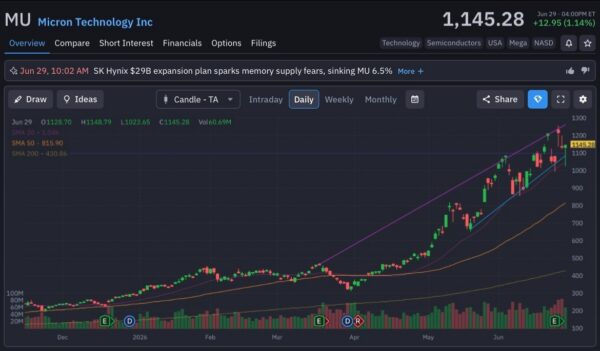
Micron’s stock doesn’t trade like a cyclical memory name anymore, and the chart confirms it. Shares ran from roughly $500 in April to above $1,200 before the recent pullback, with institutions accumulating throughout the move rather than fading it. Even after profit-taking, the stock holds comfortably above its 20-day moving average near $1,040, the 50-day near $816, and the 200-day near $431… a long-term uptrend that hasn’t been seriously challenged despite the volatility.

That kind of price action shows up when Wall Street stops pricing next quarter and starts pricing several years of structurally higher earnings. The market is now rewarding a forward setup that includes supply shortages persisting beyond 2027, another $50 billion quarter on deck, gross margins approaching 86%, and an AI memory market where demand keeps outrunning what the industry can physically produce. That’s a different business than the one investors spent two decades training themselves to discount.
micron-StockEarnings

My Take

I’ll keep buying Micron while the market is still pricing it at roughly 22x forward earnings for a business that increasingly looks like AI infrastructure rather than a traditional memory cycle play. That multiple doesn’t reflect what management is actually guiding toward.

But Micron is the opening chapter here, not the whole story. Apple’s price increase is the first visible proof that AI isn’t just minting new winners at the top of the stack. It’s redistributing pricing power across the entire semiconductor supply chain underneath them. The ripple reached Apple first because Apple is the name consumers actually see. Every other company building premium AI hardware on top of advanced memory is next in line, whether they’ve announced it yet or not.


Join over 1.2M+ investors/traders who receive daily and weekly notable earnings alerts with predicted move