Gold has come under pressure recently, weighed down by a stronger U.S. dollar, rising bond yields, ongoing turmoil in the Middle East, and significantly reduced expectations for aggressive interest rate cuts from the Federal Reserve.
However, there are still plenty of reasons for investors to remain bullish on the metal.
Central Banks Continue to Drive Gold Demand
For one, central banks are still adding gold to their reserves. In fact, central banks are still aggressively accumulating gold, providing another strong tailwind for the precious metal. Plus, according to Kitco.com, the latest World Gold Council survey shows that official-sector demand is still strong. In fact, according to the survey, 89% of reserve managers expect global central bank gold holdings to increase over the next 12 months. About 45% of respondents said their own institutions plan to increase gold reserves, up from 43% in 2025.
Meanwhile, central banks now hold more gold than at any point since 1975, with reserves totaling more than 36,000 metric tonnes, according to TheConversation.com.
Wall Street Still Sees Higher Gold Prices Ahead
Wall Street is also bullish on gold’s long-term outlook.
JPMorgan Chase believes the precious metal could climb as high as $6,000 this year, while Goldman Sachs sees gold reaching $5,400. UBS has set a target of $5,500, and Morgan Stanley expects prices to reach $5,200 by year-end.
In addition, according to GoldSilver.com, “Every major bank that has revised its forecast since the correction began has maintained or raised its year-end target, treating the pullback as a consolidation within an intact structural bull market.”
While investors can buy gold stocks, such as Barrick, Newmont, or Franco-Nevada, those looking for safe diversification may want to consider gold exchange-traded funds (ETFs).
Here are a few you may want to consider.
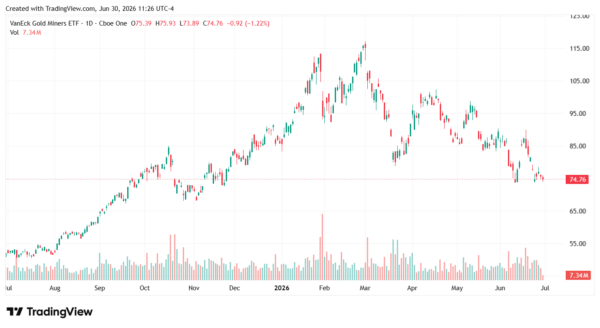
VanEck Gold Miners ETF: Exposure to Industry Leaders
One of the best ways to diversify at less cost is with an ETF, such as the VanEck Vectors Gold Miners ETF (NYSEARCA: GDX). Not only can you gain access to some of the biggest gold stocks in the world, you can do so at less cost. Better, the ETF pays a yearly dividend. It last paid out just over 63 cents per share on December 22, 2025. Before that, it paid out just over 40 cents per share on December 23, 2024.
With an expense ratio of 0.51%, the ETF holds positions in Newmont Corp., Barrick Gold, Franco-Nevada, Agnico Eagle Mines, Gold Fields, and Wheaton Precious Metals to name a few.
Even better, shares of mining stocks often outperform the price of gold. That’s because higher gold prices can result in increased profit margins and free cash flow for gold miners. In addition, top gold miners often have limited exposure to riskier mining projects.
Sprott Junior Gold Miners ETF: Targeting Emerging Producers
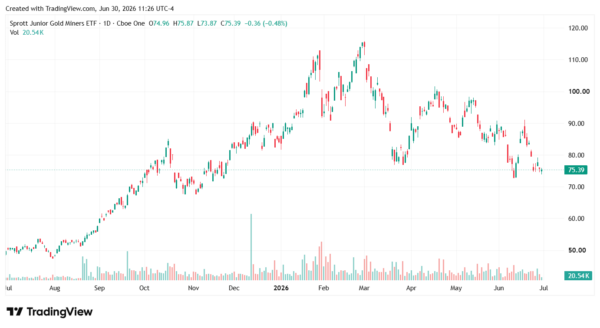
With an expense ratio of 0.5%, the Sprott Junior Gold Miners ETF (NYSEARCA: SGDJ) seeks investment results that correspond to the performance of its underlying index, the Solactive Junior Gold Miners Custom Factors Index. The Index tracks the performance of small-cap gold companies whose stocks are listed on regulated exchanges.
Some of its top holdings include Lundin Gold Inc., Seabridge Gold, Equinox Gold, Victoria Gold, Westgold Resources, Osisko Mining, K92 Mining Inc., Novagold Resources, Regis Resources, New Gold Inc., Sabina Gold & Silver, Argonaut Gold, Centerra Gold, Coeur Mining, Skeena Resources, and K92 Mining to name a few.
Global X Gold Explorers ETF: Investing in Future Discoveries
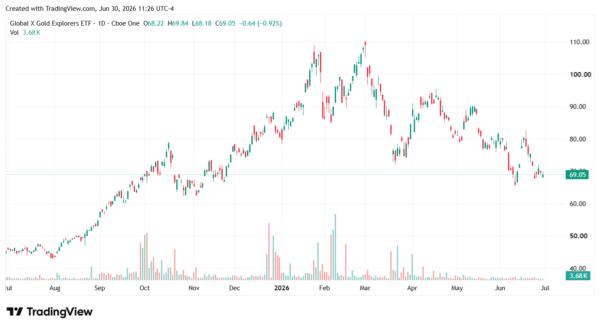
With an expense ratio of 0.65%, the Global X Gold Explorers ETF (NYSEARCA: GOEX) invests in companies involved with gold deposit exploration.
Some of its top 50 holdings include Coeur Mining, Lundin Gold, Hecla Mining, New Gold Inc., SSR Mining, and Alamos Gold. GOEX also pays a semi-annual dividend. Its last dividend of just over nine cents per share will be paid on July 7 to shareholders of record as of June 29.
Why Gold ETFs Can Still Make Sense Today
At the end of the day, gold’s story hasn’t really changed—it just goes through cycles of excitement and hesitation. Whether this turns into the next big move higher or just more sideways action will depend on how things like interest rates and global tensions actually play out—not just what analysts predict.