ajax loader

Loading...


Ride-the-Wave Strategy – Best for Stock Traders

Ride-the-Wave targets multi-day price momentum following a company’s earnings announcement (EA). With this strategy:

  1. Buy a stock one day post-EA if a stock reacts positively post-earnings:
    1. Near the close of trading the EA-day for a pre-market-EA
    2. Near the close of the following day for a post-market-EA
  2. Sell-to-close after 7-10 days, or possibly earlier if a desired price target is reached

Similarly,

  1. short a stock one day post-EA if a stock reacts negatively post-earnings:
    1. near the close of trading the EA-day for a premarket-EA
    2. near the close of the following day for a post-market-EA
  2. then buy-to-close after 7-10 days, or possibly earlier if a desired price target is reached

Important: Ride-the-Wave is predicated on significant price momentum triggered by an EA. The 7-10 day scenario is the maximum trade hold-time. If you see post EA-momentum is halted or reversed by a significant opposite move, re-evaluate your presence in the trade.

This popular StockEarnings screen below will give you a list of stocks that historically exhibit significant price momentum following an EA for the next seven days:

  1. Stocks exhibiting positive post-EA price moves are buy-candidates
  2. Stocks exhibiting negative post-EA price moves are sell/short-candidates

The screen includes those stocks whose Earnings just came out in last two days.

Screen criteria:

  1. Earnings Date Start Date : Current Date + -1 Day
  2. Earnings Date End Date : Current Date + -2 Days
  3. Predicted Move (Next Day) Max : 7%
  4. Predicted Move (On 7th Day) Min : 7%

Strategy Guideline:

  1. Buy the stock if stock has reacted positively. Short the stock if stock has reacted negatively (see above).
  2. Close the position in 7-10 days, or possibly earlier based on price move.

Volatility Crush Strategy - Best for Options Traders

The Volatility Crush strategy is used with stocks that typically experience relatively low-to-moderate price moves (≤4%) following their Earnings Announcements (EA). The basic trade idea is to sell put or call options right before the EA, collecting a credit when options premium is very high due to elevated implied volatility (IV). You then close the position right after the EA by buying the option back much cheaper due to the significant drop in IV that occurs after the mystery of the EA disappears. In assessing this trade, you need to do your homework to ensure you collect sufficient premium to make the trade worthwhile.

This trade is practical due to the low-to-moderate price-move after the EA, which generally won’t significantly affect the options price, unlike an “action” stock, which experience great price moves post-EA. With these symbols, if you’re on the right side of the price move, that’s a great thing. But if you’re on the wrong side of the move, not so great. Consequently, by minimizing the effect of the post-EA price move, you have a much better chance to profit from the reduction in IV without it being ruined by a violent price move.

For this trade, open the position either (1) the night before the EA when the company announces earnings or (2) during the EA day when it announces post-market, generally capturing IV at or close to its peak.

For this trade, open the position either (1) the night before the EA when the company announces earnings or (2) during the EA day when it announces post-market, generally capturing IV at or close to its peak.

This popular stockearnings screen will give you a list of stocks which do not react more than 4% fpost-EA. It includes only those stocks whose earnings are releasing next day.

Screen criteria:

  1. Earnings Date Start Date : Current Date + 1
  2. Earnings Date End Date : Current Date + 1
  3. Predicted Move (Next Day) Max : 4%
  4. Options Type: Weekly

Strategy Guideline:

  1. Options Strategy: Sell Call and Put
  2. Options Strike Price: Current Stock Price – (% Predicated Move x 2)
  3. Expiration Date: It should generally be the closest expiry immediately after the EA.
  4. Buy Insurance: Buying back Call and Put at Strike price which 10% lower than Sell Strike Price is optional but recommended.

Watch Video for More Detail

Volatility Rush Strategy - Best for Options Traders

The Volatility Rush takes advantage of increasing options premiums into earnings announcements (EA) caused by an anticipated rise in Implied Volatility (IV). With this strategy, Buy a Call and Put at-the-money (a long straddle) 2-3 weeks before the EA when IV is lower. Sell the position either (1) the night before the EA when the company announces earnings pre-market, or (2) during the EA day when it announces post-market, generally capturing IV at or close to its peak.

This popular screen will give you a list of stocks whose Options premiums tend to rise into Earnings. It includes only those stocks whose Earnings are at least two weeks away from today.

Screen criteria:

  1. Earnings Date Start Date : Current Date + 15 Days
  2. Earnings Date End Date : Current Date + 30 Days
  3. Predicted Move (Next Day) Min : 5%
  4. Options Type: Weekly or Monthly if that lines up with the two to three-week lead-time for entering the trade

Strategy Guideline:

  1. Buy a Straddle at or close to the money two to three weeks pre-EA.
  2. Sell the position either the night before the EA when the company announces earnings pre-market, or during the EA day when it announces post-market.
  3. Expiration date should generally be the closest expiry immediately after the EA.
  4. Straddle price should not be more 60% of predicted move.

Predicted Move (Volatility)

Similar to Implied Volatility in Options. Expected volatility % based on our Proprietary Volatility Predication Model. We are expecting that stock price will likely to reach % in either direction by the end of next trading session after Earnings are released and not necessarily the closing volatility %.

Why is it important?

    This indicator helps

  1. Knowing expected volatility in stocks after Earnings helps to decide trading stocks before Earnings Announcement.
  2. Taking Advantage of volatility collapse following Earnings Results by using Advance Options strategies such as Spread and Straddles.

Since Last Earnings

Change in share price since last Earnings release.

Why is it Important?

When share has gained more than 10% since it's last Earning release, it tends to over react to minor bad news and give up some gains if not all. So, it contains more downside volatility than upside When share has dropped more than 10% since it's last Earning release, it tends to over react to minor good news and recover some drops if not all. So, it contains more upside volatility than downside.

EPS Surprise (%)

Occurs when a company's reported quarterly or annual profits are above or below analysts' expectations. Here is the formula to derive % EPS Surprice:

Actual EPS - Estimated EPS
------------------------------------- x 100
Estimated EPS

Why is it Important?

Earnings surprises can have a huge impact on a company's stock price. Several studies suggest that positive earnings surprises not only lead to an immediate hike in a stock's price, but also to a gradual increase over time. Hence, it's not surprising that some companies are known for routinely beating earning projections. A negative earnings surprise will usually result in a decline in share price.

Next Day Price Change (%)

Next Regular trading session Closing price following Earnings result.

For After Market Close Earnings, It is a next trading day closing price. For Before Market Open Earnings, It is the same trading day closing price.

Why is it Important?

Next Day price change is a reaction of Earnings result.

Down 10% in the Trailing Month, Can ConocoPhillips Stock Bounce Back?

Posted on Jul 02, 2026 by Joshua Enomoto

Down 10% in the Trailing Month, Can ConocoPhillips Stock Bounce Back?

Upstream energy giant ConocoPhillips (NYSE: COP) may be down sharply in recent sessions, a victim of an aggressive beta compression from a collapsing crude tape. However, COP stock could elicit a quick scalp for intrepid debit-side speculators. Primarily, the reason for my near-term bullishness is data extracted from a higher-order Markov chain, also known as non-parametric conditional sequence simulation (or path-dependent conditioning).

Standard Financial Analysis is Practically Worthless


Before I get into why I exclusively deal with Markov frameworks, it’s important to understand the severe limitations of standard financial analysis. When a security like COP stock loses 10% of equity value in the trailing month, one of the common, forward-looking assumptions is that the market selloff has “gone too far” or that “the market hasn’t fully priced in the countervailing good news.”

As the reader, your immediate question should be the obvious one: what percentage or portion of the positive catalyst has (or has not) been baked in? And an even more basic question: how does the author know that?

If you look at the financial publication space, you will find an endless library of articles claiming that such-and-such stock is undervalued. However, making such a pronouncement at face value assumes that there is an objective true value that Bob from Arkansas deciphered that no one else — including the biggest institutional players and hedge funds — has found.

I find that to be a remarkable proposition. As popularized by astronomer Carl Sagan, extraordinary claims require extraordinary evidence.

Plus, there’s another big problem with the traditional analysis content mill, which is that the supposed edge that the authors provide their readers is entirely downstream from the events they reference. In the case of COP stock, it’s easy to say that the energy giant is a buy because of the Marathon Oil integration and synergy capture, peer-leading shareholder returns and free cash flow visibility and enhanced capital efficiency and technology spudding.

I think you can spot my concern: this is all public data that has already been disseminated and digested from top to bottom. So, someone would have to explain to me how consuming information at the bottom somehow gives me alpha, which exclusively resides at the top.

Since I refuse to go down the path of deliberate cognitive dissonance, I’m going to present a more defensible proposition and that is this: given a specific bearish condition, the typical pathway of COP stock results in an above-average performance profile over the next five weeks.

Options Data for ConocoPhillips Stock? It’s a Waste of Time.

Usually, I would provide an analysis of unusual options activity or volatility skew for COP stock. I’m here to tell you that these datapoints are completely worthless and that you shouldn’t waste your time (or money) on chasing these data streams.

Let’s think about this matter logically. No one knows with absolute certainty where a stock will go next, whether that’s tomorrow or a decade from now. Given this limitation, how is it possible that the future can be extracted by the derivative of the unknown? If the unknown is unknown, why would a derivative product of the unknown make it known?

Let’s also think about unusual options activity via a critical lens. If there were 50,000 call options bought on COP stock, that doesn’t necessarily mean the market is net bullish. First, someone else is selling those calls, meaning that option transactions don’t just materialize in the ether. Second, by the time big call volumes hit the order books, the market maker has made critical adjustments to stay delta neutral.

Subsequently, those adjustments enhance the implied volatility of the underlying strike price. Invariably, then, if you traded COP stock based on its unusual options activity, you would be buying exposure at peak volatility premiums.

Options data streams are certainly sexy and you feel smart pointing at them and nodding your head. Functionally, though, you’re looking at the telemetry of an airplane that landed an hour ago.

Asking the Right Question

A legitimate analysis of a non-determinative system like the equities market begins with asking the right question. For me, the right question for COP stock is this: given a specific time period, what kind of performance may I expect if I were to just buy shares randomly?

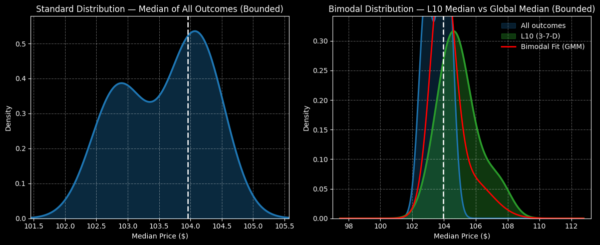
For example, based on data going back to January 2019, a 10-week long position in COP stock would be expected to generate a forward distribution between $101.50 and $105.50 (assuming a starting price of $103.96, Tuesday’s close). Given the shape of the probability mass, you’d be looking at a neutral-to-slightly-bearish bias.

In other words, if you bought COP stock over a 10-week period, it’s basically 50/50 whether you would be profitable or not. So, if you were trading COP conditioned on a specific signal, that signal would have to generate a performance better than 50/50 to be worthwhile.
ConocoPhillips-StockEarnings

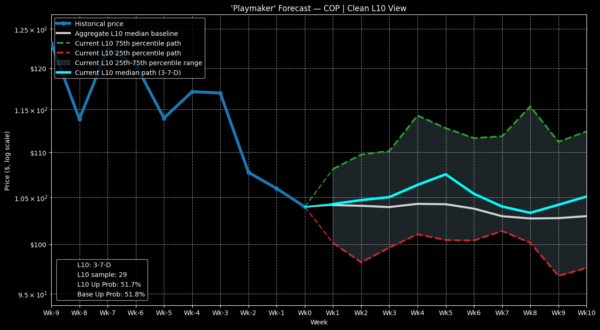
The next question is what’s the signal? I noticed that in the last 10 weeks, COP stock has printed only three up weeks, leading to an overall downward slope. Based on this 3-7-D sequence, the expected 10-week forward distribution would be between $101 and $110, which is noticeably better than the aforementioned random benchmark.

However, the improvement in expected performance isn’t linear. Under the 3-7-D signal, COP tends to rise over the next five weeks before mean-reverting downward. As such, if you accept the inductive framework that this time will be like the other times, a near-expiry bull call spread could be lucrative.

Identifying a Specific Idea

At the most aggressive, I would consider the 105/109 bull call spread expiring July 31. While the $109 strike is on the very edge of the expected distribution, the breakeven price of $107.41 offers a realistic safety buffer. Based on the expected median pathway following the 3-7-D signal, COP stock should be able to hit this target.
ConocoPhillips-StockEarnings

Now, the concept of the higher-order Markov chain (where the condition of one state yields a certain probability of transitioning to another state) is hardly foolproof. In fact, because there is no necessary reason why the 3-7-D signal must produce an above-average performance, traders can absolutely get blown up following observed patterns.

Keep in mind that this is a core criticism of all pattern recognition. Just because something happens a hundred times doesn’t necessarily mean that in the 101st time the same thing will also happen. It’s very possible that you can get an outlier, which would destroy the presupposition.

Still, without an inductive framework, there might not be a quantitative mechanism in analyzing public securities. Arguably, as imperfect as Markov chains may be, it’s the best solution we have.


Joshua Enomoto is a seasoned financial writer with a strong track record of in-depth stock analysis, offering clear, insightful commentary for retail investors across all levels of expertise. Renowned for his ability to blend analytical rigor with engaging wit, Joshua's work has been featured on leading investment platforms, including TipRanks, InvestorPlace, Barchart, Benzinga, and Fintel. He was also handpicked to spearhead high-impact initiatives such as InvestorPlace's "Trade of the Day" and Benzinga’s ETF coverage. As a frequent guest expert for CGTN America, Joshua discusses a wide range of economic, societal, and consumer market trends. A graduate of U.C. San Diego, Joshua brings a thoughtful and fresh perspective to complex financial narratives, helping enterprise clients connect with their audiences. He also composes music in his spare time.

Join over 1.2M+ investors/traders who receive daily and weekly notable earnings alerts with predicted move