ajax loader

Loading...


Ride-the-Wave Strategy – Best for Stock Traders

Ride-the-Wave targets multi-day price momentum following a company’s earnings announcement (EA). With this strategy:

  1. Buy a stock one day post-EA if a stock reacts positively post-earnings:
    1. Near the close of trading the EA-day for a pre-market-EA
    2. Near the close of the following day for a post-market-EA
  2. Sell-to-close after 7-10 days, or possibly earlier if a desired price target is reached

Similarly,

  1. short a stock one day post-EA if a stock reacts negatively post-earnings:
    1. near the close of trading the EA-day for a premarket-EA
    2. near the close of the following day for a post-market-EA
  2. then buy-to-close after 7-10 days, or possibly earlier if a desired price target is reached

Important: Ride-the-Wave is predicated on significant price momentum triggered by an EA. The 7-10 day scenario is the maximum trade hold-time. If you see post EA-momentum is halted or reversed by a significant opposite move, re-evaluate your presence in the trade.

This popular StockEarnings screen below will give you a list of stocks that historically exhibit significant price momentum following an EA for the next seven days:

  1. Stocks exhibiting positive post-EA price moves are buy-candidates
  2. Stocks exhibiting negative post-EA price moves are sell/short-candidates

The screen includes those stocks whose Earnings just came out in last two days.

Screen criteria:

  1. Earnings Date Start Date : Current Date + -1 Day
  2. Earnings Date End Date : Current Date + -2 Days
  3. Predicted Move (Next Day) Max : 7%
  4. Predicted Move (On 7th Day) Min : 7%

Strategy Guideline:

  1. Buy the stock if stock has reacted positively. Short the stock if stock has reacted negatively (see above).
  2. Close the position in 7-10 days, or possibly earlier based on price move.

Volatility Crush Strategy - Best for Options Traders

The Volatility Crush strategy is used with stocks that typically experience relatively low-to-moderate price moves (≤4%) following their Earnings Announcements (EA). The basic trade idea is to sell put or call options right before the EA, collecting a credit when options premium is very high due to elevated implied volatility (IV). You then close the position right after the EA by buying the option back much cheaper due to the significant drop in IV that occurs after the mystery of the EA disappears. In assessing this trade, you need to do your homework to ensure you collect sufficient premium to make the trade worthwhile.

This trade is practical due to the low-to-moderate price-move after the EA, which generally won’t significantly affect the options price, unlike an “action” stock, which experience great price moves post-EA. With these symbols, if you’re on the right side of the price move, that’s a great thing. But if you’re on the wrong side of the move, not so great. Consequently, by minimizing the effect of the post-EA price move, you have a much better chance to profit from the reduction in IV without it being ruined by a violent price move.

For this trade, open the position either (1) the night before the EA when the company announces earnings or (2) during the EA day when it announces post-market, generally capturing IV at or close to its peak.

For this trade, open the position either (1) the night before the EA when the company announces earnings or (2) during the EA day when it announces post-market, generally capturing IV at or close to its peak.

This popular stockearnings screen will give you a list of stocks which do not react more than 4% fpost-EA. It includes only those stocks whose earnings are releasing next day.

Screen criteria:

  1. Earnings Date Start Date : Current Date + 1
  2. Earnings Date End Date : Current Date + 1
  3. Predicted Move (Next Day) Max : 4%
  4. Options Type: Weekly

Strategy Guideline:

  1. Options Strategy: Sell Call and Put
  2. Options Strike Price: Current Stock Price – (% Predicated Move x 2)
  3. Expiration Date: It should generally be the closest expiry immediately after the EA.
  4. Buy Insurance: Buying back Call and Put at Strike price which 10% lower than Sell Strike Price is optional but recommended.

Watch Video for More Detail

Volatility Rush Strategy - Best for Options Traders

The Volatility Rush takes advantage of increasing options premiums into earnings announcements (EA) caused by an anticipated rise in Implied Volatility (IV). With this strategy, Buy a Call and Put at-the-money (a long straddle) 2-3 weeks before the EA when IV is lower. Sell the position either (1) the night before the EA when the company announces earnings pre-market, or (2) during the EA day when it announces post-market, generally capturing IV at or close to its peak.

This popular screen will give you a list of stocks whose Options premiums tend to rise into Earnings. It includes only those stocks whose Earnings are at least two weeks away from today.

Screen criteria:

  1. Earnings Date Start Date : Current Date + 15 Days
  2. Earnings Date End Date : Current Date + 30 Days
  3. Predicted Move (Next Day) Min : 5%
  4. Options Type: Weekly or Monthly if that lines up with the two to three-week lead-time for entering the trade

Strategy Guideline:

  1. Buy a Straddle at or close to the money two to three weeks pre-EA.
  2. Sell the position either the night before the EA when the company announces earnings pre-market, or during the EA day when it announces post-market.
  3. Expiration date should generally be the closest expiry immediately after the EA.
  4. Straddle price should not be more 60% of predicted move.

Predicted Move (Volatility)

Similar to Implied Volatility in Options. Expected volatility % based on our Proprietary Volatility Predication Model. We are expecting that stock price will likely to reach % in either direction by the end of next trading session after Earnings are released and not necessarily the closing volatility %.

Why is it important?

    This indicator helps

  1. Knowing expected volatility in stocks after Earnings helps to decide trading stocks before Earnings Announcement.
  2. Taking Advantage of volatility collapse following Earnings Results by using Advance Options strategies such as Spread and Straddles.

Since Last Earnings

Change in share price since last Earnings release.

Why is it Important?

When share has gained more than 10% since it's last Earning release, it tends to over react to minor bad news and give up some gains if not all. So, it contains more downside volatility than upside When share has dropped more than 10% since it's last Earning release, it tends to over react to minor good news and recover some drops if not all. So, it contains more upside volatility than downside.

EPS Surprise (%)

Occurs when a company's reported quarterly or annual profits are above or below analysts' expectations. Here is the formula to derive % EPS Surprice:

Actual EPS - Estimated EPS
------------------------------------- x 100
Estimated EPS

Why is it Important?

Earnings surprises can have a huge impact on a company's stock price. Several studies suggest that positive earnings surprises not only lead to an immediate hike in a stock's price, but also to a gradual increase over time. Hence, it's not surprising that some companies are known for routinely beating earning projections. A negative earnings surprise will usually result in a decline in share price.

Next Day Price Change (%)

Next Regular trading session Closing price following Earnings result.

For After Market Close Earnings, It is a next trading day closing price. For Before Market Open Earnings, It is the same trading day closing price.

Why is it Important?

Next Day price change is a reaction of Earnings result.

CLARITY Act Fails: Why Coinbase, Robinhood Stocks Are Sinking

Posted on Sep 16, 2026 by Chris Markoch

CLARITY Act Fails: Why Coinbase, Robinhood Stocks Are Sinking

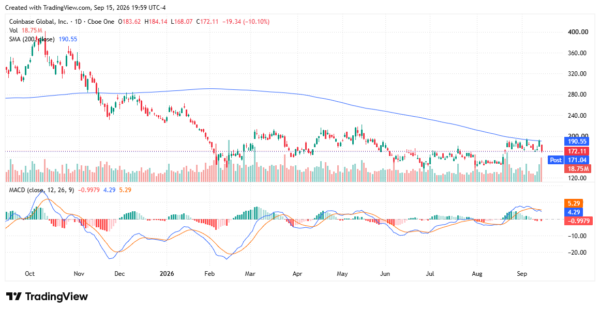
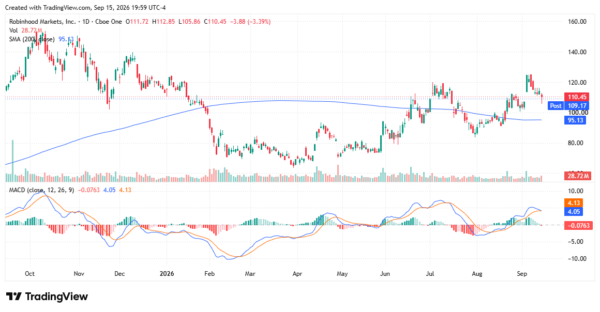
The CLARITY Act hit a wall in the Senate on September 15, and crypto stocks are paying the price. Coinbase (NASDAQ: COIN) dropped roughly 10% on the day, while Robinhood (NASDAQ: HOOD) fell about 3.3%. Both moves came after the chamber failed to reach the 60 votes needed to advance the bill, known formally as H.R. 3633.

The setback wasn’t a total surprise. Prediction-market odds for passage had already collapsed in the hours before the vote, after Sen. Cynthia Lummis (R-Wyo.) rejected a Democratic counterproposal she viewed as a dealbreaker. Polymarket traders had priced year-end passage odds near 30% on Monday. By Tuesday afternoon, those odds had fallen to roughly 15%.

The CLARITY Act matters because it would draw clearer lines between the SEC’s and the CFTC’s oversight of digital assets and set federal rules for stablecoins. Both issues sit at the center of Coinbase’s business model and Robinhood’s expansion plans. With the Senate set to leave Washington after October 2 for a state work period running through early November, there’s little runway left for another attempt before the midterms.

That timing uncertainty is now the dominant story for crypto-linked equities. Below, we break down what the failed vote means specifically for Coinbase and Robinhood, why the setback doesn’t erase the long-term case for crypto exposure, and why patient, risk-tolerant investors may still want to watch these names closely.

Coinbase Loses Its Regulatory Tailwind


Coinbase had the most riding on the CLARITY Act vote. The company has pushed hard for defined regulatory boundaries between the SEC and CFTC, and it has a direct financial stake in how Congress writes stablecoin rules. Coinbase products held an average of $20 billion in USDC last quarter. That’s more than 30% of all USDC in circulation. The company has said it captures roughly 50% of USDC’s economics.

Without a federal framework, that revenue stream stays exposed to regulatory ambiguity. The stock’s 10% drop reflects a market repricing to a world where clarity is delayed, not necessarily denied.

Adding to the pressure, ARK Invest sold about $7 million of Coinbase shares after a recent rally, a sign of profit-taking or portfolio rebalancing rather than a change in long-term conviction. Combined with Bitcoin’s decline on the day, the selling created a rougher tape than the vote alone would explain.

For investors, the read is straightforward: Coinbase’s near-term catalyst has been pushed out, but the underlying growth drivers behind that catalyst, stablecoin adoption and institutional custody, haven’t disappeared.
clarity act - StockEarnings

Robinhood Faces a Double Dose of Uncertainty

Robinhood’s decline was smaller than Coinbase’s, but the stock is navigating two separate headwinds at once. The first is the same regulatory uncertainty weighing on the whole sector. Robinhood has built out crypto trading, tokenization products, and prediction markets as core growth pillars, and clearer federal rules would reduce compliance risk across all three.

The second headwind is company-specific. AMC Entertainment (NYSE: AMC) has publicly challenged Robinhood’s tokenized stock products, arguing that Robinhood listed AMC-linked tokens without the company’s consent and that the structure confuses investors about their actual rights.

Robinhood’s leadership has pushed back, arguing that these tokens are separate securities that don’t require issuer approval. The dispute is unresolved and could invite regulatory scrutiny of Robinhood’s broader tokenization strategy.

Layer in valuation concerns, some analysts see HOOD as richly priced, plus a recent Rule 10b5-1 sale of 43,373 shares by director Baiju Bhatt worth about $5 million, and it’s easy to see why sentiment has cooled. The sale was pre-arranged and not necessarily a bearish signal, but it reinforces a narrative of profit-taking at elevated prices.
clarity act - StockEarnings

Why the CLARITY Act Setback Doesn’t Break the Crypto Thesis

A failed cloture vote is a procedural delay, not a verdict on crypto’s future. The CLARITY Act can still return in a revised form, and Tuesday’s outcome doesn’t change the structural trends driving digital-asset adoption: institutional custody demand, stablecoin usage, and tokenized markets are all still expanding.

Regulatory clarity has always been a matter of when, not if, for U.S. digital-asset policy. Both parties have shown willingness to negotiate, even if Tuesday’s talks broke down over ethics provisions and stablecoin details rather than the core market-structure framework. That’s a meaningfully different failure mode than a rejection of the underlying policy goals.

For Coinbase specifically, the company’s stablecoin economics and custody business generate revenue regardless of whether Congress acts this quarter. For Robinhood, crypto is one of several growth levers, including options, prediction markets, and international expansion.

Risk-tolerant investors who already believe in the multi-year crypto adoption story may view sharp, sentiment-driven drops like Tuesday’s as entry points rather than exits, particularly if legislative delay pushes shares lower still. Sizing positions moderately remains sensible given the uncertainty.

CLARITY Act Delay Creates Near-Term Uncertainty

Tuesday’s failed vote on the CLARITY Act adds a real, near-term overhang to both stocks. Coinbase’s stablecoin economics and Robinhood’s tokenization ambitions are both more valuable in a world with clear federal rules, and that world just got pushed further out. Company-specific issues, ARK’s selling in Coinbase and the AMC dispute at Robinhood compound the pressure.

None of that erases the longer-term thesis behind either stock. Legislative timelines are notoriously hard to predict, and crypto policy has moved in fits and starts for years without derailing adoption trends. Investors should watch for a revised bill, further Bitcoin price action, and how the AMC-Robinhood dispute resolves.

Given how many moving pieces are still in play, time will likely be the best way to determine the stock’s direction for both Coinbase and Robinhood.


A former marketing copywriter turned freelance financial writer and market analyst. I have a passion for delivering insights to investors. I write regularly about stocks for StockEarnings and MarketBeat. Posts are not advice.

Join over 1.2M+ investors/traders who receive daily and weekly notable earnings alerts with predicted move