ajax loader

Loading...


Ride-the-Wave Strategy – Best for Stock Traders

Ride-the-Wave targets multi-day price momentum following a company’s earnings announcement (EA). With this strategy:

  1. Buy a stock one day post-EA if a stock reacts positively post-earnings:
    1. Near the close of trading the EA-day for a pre-market-EA
    2. Near the close of the following day for a post-market-EA
  2. Sell-to-close after 7-10 days, or possibly earlier if a desired price target is reached

Similarly,

  1. short a stock one day post-EA if a stock reacts negatively post-earnings:
    1. near the close of trading the EA-day for a premarket-EA
    2. near the close of the following day for a post-market-EA
  2. then buy-to-close after 7-10 days, or possibly earlier if a desired price target is reached

Important: Ride-the-Wave is predicated on significant price momentum triggered by an EA. The 7-10 day scenario is the maximum trade hold-time. If you see post EA-momentum is halted or reversed by a significant opposite move, re-evaluate your presence in the trade.

This popular StockEarnings screen below will give you a list of stocks that historically exhibit significant price momentum following an EA for the next seven days:

  1. Stocks exhibiting positive post-EA price moves are buy-candidates
  2. Stocks exhibiting negative post-EA price moves are sell/short-candidates

The screen includes those stocks whose Earnings just came out in last two days.

Screen criteria:

  1. Earnings Date Start Date : Current Date + -1 Day
  2. Earnings Date End Date : Current Date + -2 Days
  3. Predicted Move (Next Day) Max : 7%
  4. Predicted Move (On 7th Day) Min : 7%

Strategy Guideline:

  1. Buy the stock if stock has reacted positively. Short the stock if stock has reacted negatively (see above).
  2. Close the position in 7-10 days, or possibly earlier based on price move.

Volatility Crush Strategy - Best for Options Traders

The Volatility Crush strategy is used with stocks that typically experience relatively low-to-moderate price moves (≤4%) following their Earnings Announcements (EA). The basic trade idea is to sell put or call options right before the EA, collecting a credit when options premium is very high due to elevated implied volatility (IV). You then close the position right after the EA by buying the option back much cheaper due to the significant drop in IV that occurs after the mystery of the EA disappears. In assessing this trade, you need to do your homework to ensure you collect sufficient premium to make the trade worthwhile.

This trade is practical due to the low-to-moderate price-move after the EA, which generally won’t significantly affect the options price, unlike an “action” stock, which experience great price moves post-EA. With these symbols, if you’re on the right side of the price move, that’s a great thing. But if you’re on the wrong side of the move, not so great. Consequently, by minimizing the effect of the post-EA price move, you have a much better chance to profit from the reduction in IV without it being ruined by a violent price move.

For this trade, open the position either (1) the night before the EA when the company announces earnings or (2) during the EA day when it announces post-market, generally capturing IV at or close to its peak.

For this trade, open the position either (1) the night before the EA when the company announces earnings or (2) during the EA day when it announces post-market, generally capturing IV at or close to its peak.

This popular stockearnings screen will give you a list of stocks which do not react more than 4% fpost-EA. It includes only those stocks whose earnings are releasing next day.

Screen criteria:

  1. Earnings Date Start Date : Current Date + 1
  2. Earnings Date End Date : Current Date + 1
  3. Predicted Move (Next Day) Max : 4%
  4. Options Type: Weekly

Strategy Guideline:

  1. Options Strategy: Sell Call and Put
  2. Options Strike Price: Current Stock Price – (% Predicated Move x 2)
  3. Expiration Date: It should generally be the closest expiry immediately after the EA.
  4. Buy Insurance: Buying back Call and Put at Strike price which 10% lower than Sell Strike Price is optional but recommended.

Watch Video for More Detail

Volatility Rush Strategy - Best for Options Traders

The Volatility Rush takes advantage of increasing options premiums into earnings announcements (EA) caused by an anticipated rise in Implied Volatility (IV). With this strategy, Buy a Call and Put at-the-money (a long straddle) 2-3 weeks before the EA when IV is lower. Sell the position either (1) the night before the EA when the company announces earnings pre-market, or (2) during the EA day when it announces post-market, generally capturing IV at or close to its peak.

This popular screen will give you a list of stocks whose Options premiums tend to rise into Earnings. It includes only those stocks whose Earnings are at least two weeks away from today.

Screen criteria:

  1. Earnings Date Start Date : Current Date + 15 Days
  2. Earnings Date End Date : Current Date + 30 Days
  3. Predicted Move (Next Day) Min : 5%
  4. Options Type: Weekly or Monthly if that lines up with the two to three-week lead-time for entering the trade

Strategy Guideline:

  1. Buy a Straddle at or close to the money two to three weeks pre-EA.
  2. Sell the position either the night before the EA when the company announces earnings pre-market, or during the EA day when it announces post-market.
  3. Expiration date should generally be the closest expiry immediately after the EA.
  4. Straddle price should not be more 60% of predicted move.

Predicted Move (Volatility)

Similar to Implied Volatility in Options. Expected volatility % based on our Proprietary Volatility Predication Model. We are expecting that stock price will likely to reach % in either direction by the end of next trading session after Earnings are released and not necessarily the closing volatility %.

Why is it important?

    This indicator helps

  1. Knowing expected volatility in stocks after Earnings helps to decide trading stocks before Earnings Announcement.
  2. Taking Advantage of volatility collapse following Earnings Results by using Advance Options strategies such as Spread and Straddles.

Since Last Earnings

Change in share price since last Earnings release.

Why is it Important?

When share has gained more than 10% since it's last Earning release, it tends to over react to minor bad news and give up some gains if not all. So, it contains more downside volatility than upside When share has dropped more than 10% since it's last Earning release, it tends to over react to minor good news and recover some drops if not all. So, it contains more upside volatility than downside.

EPS Surprise (%)

Occurs when a company's reported quarterly or annual profits are above or below analysts' expectations. Here is the formula to derive % EPS Surprice:

Actual EPS - Estimated EPS
------------------------------------- x 100
Estimated EPS

Why is it Important?

Earnings surprises can have a huge impact on a company's stock price. Several studies suggest that positive earnings surprises not only lead to an immediate hike in a stock's price, but also to a gradual increase over time. Hence, it's not surprising that some companies are known for routinely beating earning projections. A negative earnings surprise will usually result in a decline in share price.

Next Day Price Change (%)

Next Regular trading session Closing price following Earnings result.

For After Market Close Earnings, It is a next trading day closing price. For Before Market Open Earnings, It is the same trading day closing price.

Why is it Important?

Next Day price change is a reaction of Earnings result.

Can the Upcoming World Cup Turn Nike (NKE) Stock’s Fortunes Around?

Posted on May 26, 2026 by Joshua Enomoto

Can the Upcoming World Cup Turn Nike (NKE) Stock’s Fortunes Around?

Among the world’s most recognized brands, Nike (NYSE: NKE) is currently suffering a bit of a mini-crisis. Since the start of the year, NKE stock is down nearly 30%, a reflection of rising skepticism by Wall Street that the athletic apparel manufacturer can right the ship. Although it’s possible that the upcoming World Cup could help bring some much-needed joy to stakeholders, it’s market physics that could be the better play in the near term.

It probably goes without saying that soccer’s biggest tournament — which will be held in stadiums across North America — is likely to catalyze sales and enthusiasm for Nike. While the American audience celebrates massive events like the Super Bowl, nothing compares to the grandeur of the World Cup. With Nike as the kit provider for several top-flight nations, that’s going to translate into a large chunk of consumer dollars.

When combined with the passion of global fans, along with the tournament expanding to 48 teams (rather than the previous 32 teams), that’s a lot of cash registers going off. However, before you buy NKE stock for that reason, it should bear reminding that this narrative has more than likely been priced in. After all, the World Cup didn’t just materialize out of thin air — it’s been one of the most well-publicized (and perhaps well-criticized) events on the planet.

Of course, I can’t make absolute pronouncements. However, it’s highly doubtful that professional traders and major institutions haven’t taken the World Cup catalyst into account. What’s worrying, then, is that even with the upcoming event, NKE stock is still an underperformer. In fact, over the past five years, the security is down more than 67%.

World Cup or not, Nike has not been able to address the Chinese market slump, where Greater China has historically been the company’s largest international growth driver. On a related note, rising tariffs have impacted the apparel giant by severely hurting margins. These problems may not magically disappear because of a quadrennial tournament.

So yes, there is a reason why investors are skeptical.

Volatility Skew Confirms Uneasiness with NKE Stock


Over in the options market, the usual participants — the smart money — are expressing their pensiveness toward NKE stock, as evidenced by the volatility skew. By definition, the skew represents implied volatility (IV) across the strike price spectrum of a given options chain. Since IV reflects the kinetic potential of a security at the affected strike, a higher volatility reading can be interpreted as greater demand to cover the underlying implications.

It’s an awfully confusing definition. Therefore, the skew is best expressed as an insurance market. Basically, any popular security risks moving either higher or lower on any given day. For a debit-based trader, guessing the wrong trajectory could mean heavy losses, depending on the magnitude of how wrong they are. Since nobody knows where NKE stock may head next with 100% certainty, a sophisticated market participant will hedge their position.

Now, what one individual trader may think about NKE stock really doesn’t matter. But when you multiply hedging activities at scale, the insurance policies that are being bid will tilt the volatility skew across different strike prices. This tilting effect is what clues us into what the smart money is thinking.

Granted, because no one has a crystal ball, you cannot use the skew to frame a probabilistic model of what might happen to NKE stock, just like you wouldn’t use auto insurance premiums to predict when you might be involved in a car accident. Nevertheless, the skew provides us with useful intel about the sentiment toward the target security.

In the case of Nike stock, smart money traders for the options chain expiring June 26 are willing to pay a premium for protection against catastrophic losses. Fundamentally, the key here is the positional dominance of put options relative to calls. For the strikes lower than the spot price (from $33 and lower), traders are bidding up downside protection. For the strikes higher than spot, put dominance over calls indicates that there’s relatively little in the way of upside convexity.

Using soccer lexicon, NKE stock traders are very much in a defensive formation, eschewing an offensive-related mindset to protect their own lines from being penetrated.

Why Take the Risk on Nike Stock?

Given the smart money’s pensiveness, why would anyone take the risk and buy Nike stock? The answer, as alluded to earlier, comes down to market physics.

When I say market physics, I’m not referring to a fundamental law of nature that is guaranteed to repeat. However, it’s also a fair presupposition to say that a stock’s forward distribution isn’t always consistent across all circumstances. In the case of NKE stock, it has already suffered extensively and significantly. To suffer more, there arguably needs to be more evidence to be sour about.

Again, it’s not a law of nature, but a security isn’t likely to continue falling on old news — just like it probably wouldn’t rise sharply on old news either. If the bad news is already baked into Nike stock, then there likely needs to be additional bad news for it to go lower.
nike - StockEarnings

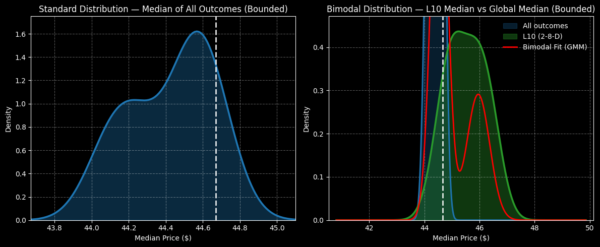
That’s where I think speculative options traders can take a risk on the apparel giant. Over the past 10 weeks, NKE stock has printed only two up weeks, thereby leading to a downward slope across the period. Under this specific condition — which has materialized 20 times on a rolling basis since 2019 — NKE has demonstrated a forward 10-week distribution landing between $43 and $48 (assuming a starting price of $44.67).

Why is this significant? Because under aggregate conditions (since 2019), the forward 10-week distribution would be expected to only range between $43.60 and $45.20 (assuming the same starting point). Further, by the fifth week (coinciding with the June 26 expiration date), prices on a median basis tend to cluster around $46.

Aggressive buyers may consider the 44/47 bull call spread expiring June 26. While this trade requires NKE stock to rise through the $47 strike to trigger the 100% maximum payout, the breakeven price is $45.50 — right below the expected clustering on week five.

Another factor to consider is that Nike will release its next earnings report on June 25. A positive result here could provide an extra boost for Nike stock.


Joshua Enomoto is a seasoned financial writer with a strong track record of in-depth stock analysis, offering clear, insightful commentary for retail investors across all levels of expertise. Renowned for his ability to blend analytical rigor with engaging wit, Joshua's work has been featured on leading investment platforms, including TipRanks, InvestorPlace, Barchart, Benzinga, and Fintel. He was also handpicked to spearhead high-impact initiatives such as InvestorPlace's "Trade of the Day" and Benzinga’s ETF coverage. As a frequent guest expert for CGTN America, Joshua discusses a wide range of economic, societal, and consumer market trends. A graduate of U.C. San Diego, Joshua brings a thoughtful and fresh perspective to complex financial narratives, helping enterprise clients connect with their audiences. He also composes music in his spare time.

Join over 1.2M+ investors/traders who receive daily and weekly notable earnings alerts with predicted move