ajax loader

Loading...


Ride-the-Wave Strategy – Best for Stock Traders

Ride-the-Wave targets multi-day price momentum following a company’s earnings announcement (EA). With this strategy:

  1. Buy a stock one day post-EA if a stock reacts positively post-earnings:
    1. Near the close of trading the EA-day for a pre-market-EA
    2. Near the close of the following day for a post-market-EA
  2. Sell-to-close after 7-10 days, or possibly earlier if a desired price target is reached

Similarly,

  1. short a stock one day post-EA if a stock reacts negatively post-earnings:
    1. near the close of trading the EA-day for a premarket-EA
    2. near the close of the following day for a post-market-EA
  2. then buy-to-close after 7-10 days, or possibly earlier if a desired price target is reached

Important: Ride-the-Wave is predicated on significant price momentum triggered by an EA. The 7-10 day scenario is the maximum trade hold-time. If you see post EA-momentum is halted or reversed by a significant opposite move, re-evaluate your presence in the trade.

This popular StockEarnings screen below will give you a list of stocks that historically exhibit significant price momentum following an EA for the next seven days:

  1. Stocks exhibiting positive post-EA price moves are buy-candidates
  2. Stocks exhibiting negative post-EA price moves are sell/short-candidates

The screen includes those stocks whose Earnings just came out in last two days.

Screen criteria:

  1. Earnings Date Start Date : Current Date + -1 Day
  2. Earnings Date End Date : Current Date + -2 Days
  3. Predicted Move (Next Day) Max : 7%
  4. Predicted Move (On 7th Day) Min : 7%

Strategy Guideline:

  1. Buy the stock if stock has reacted positively. Short the stock if stock has reacted negatively (see above).
  2. Close the position in 7-10 days, or possibly earlier based on price move.

Volatility Crush Strategy - Best for Options Traders

The Volatility Crush strategy is used with stocks that typically experience relatively low-to-moderate price moves (≤4%) following their Earnings Announcements (EA). The basic trade idea is to sell put or call options right before the EA, collecting a credit when options premium is very high due to elevated implied volatility (IV). You then close the position right after the EA by buying the option back much cheaper due to the significant drop in IV that occurs after the mystery of the EA disappears. In assessing this trade, you need to do your homework to ensure you collect sufficient premium to make the trade worthwhile.

This trade is practical due to the low-to-moderate price-move after the EA, which generally won’t significantly affect the options price, unlike an “action” stock, which experience great price moves post-EA. With these symbols, if you’re on the right side of the price move, that’s a great thing. But if you’re on the wrong side of the move, not so great. Consequently, by minimizing the effect of the post-EA price move, you have a much better chance to profit from the reduction in IV without it being ruined by a violent price move.

For this trade, open the position either (1) the night before the EA when the company announces earnings or (2) during the EA day when it announces post-market, generally capturing IV at or close to its peak.

For this trade, open the position either (1) the night before the EA when the company announces earnings or (2) during the EA day when it announces post-market, generally capturing IV at or close to its peak.

This popular stockearnings screen will give you a list of stocks which do not react more than 4% fpost-EA. It includes only those stocks whose earnings are releasing next day.

Screen criteria:

  1. Earnings Date Start Date : Current Date + 1
  2. Earnings Date End Date : Current Date + 1
  3. Predicted Move (Next Day) Max : 4%
  4. Options Type: Weekly

Strategy Guideline:

  1. Options Strategy: Sell Call and Put
  2. Options Strike Price: Current Stock Price – (% Predicated Move x 2)
  3. Expiration Date: It should generally be the closest expiry immediately after the EA.
  4. Buy Insurance: Buying back Call and Put at Strike price which 10% lower than Sell Strike Price is optional but recommended.

Watch Video for More Detail

Volatility Rush Strategy - Best for Options Traders

The Volatility Rush takes advantage of increasing options premiums into earnings announcements (EA) caused by an anticipated rise in Implied Volatility (IV). With this strategy, Buy a Call and Put at-the-money (a long straddle) 2-3 weeks before the EA when IV is lower. Sell the position either (1) the night before the EA when the company announces earnings pre-market, or (2) during the EA day when it announces post-market, generally capturing IV at or close to its peak.

This popular screen will give you a list of stocks whose Options premiums tend to rise into Earnings. It includes only those stocks whose Earnings are at least two weeks away from today.

Screen criteria:

  1. Earnings Date Start Date : Current Date + 15 Days
  2. Earnings Date End Date : Current Date + 30 Days
  3. Predicted Move (Next Day) Min : 5%
  4. Options Type: Weekly or Monthly if that lines up with the two to three-week lead-time for entering the trade

Strategy Guideline:

  1. Buy a Straddle at or close to the money two to three weeks pre-EA.
  2. Sell the position either the night before the EA when the company announces earnings pre-market, or during the EA day when it announces post-market.
  3. Expiration date should generally be the closest expiry immediately after the EA.
  4. Straddle price should not be more 60% of predicted move.

Predicted Move (Volatility)

Similar to Implied Volatility in Options. Expected volatility % based on our Proprietary Volatility Predication Model. We are expecting that stock price will likely to reach % in either direction by the end of next trading session after Earnings are released and not necessarily the closing volatility %.

Why is it important?

    This indicator helps

  1. Knowing expected volatility in stocks after Earnings helps to decide trading stocks before Earnings Announcement.
  2. Taking Advantage of volatility collapse following Earnings Results by using Advance Options strategies such as Spread and Straddles.

Since Last Earnings

Change in share price since last Earnings release.

Why is it Important?

When share has gained more than 10% since it's last Earning release, it tends to over react to minor bad news and give up some gains if not all. So, it contains more downside volatility than upside When share has dropped more than 10% since it's last Earning release, it tends to over react to minor good news and recover some drops if not all. So, it contains more upside volatility than downside.

EPS Surprise (%)

Occurs when a company's reported quarterly or annual profits are above or below analysts' expectations. Here is the formula to derive % EPS Surprice:

Actual EPS - Estimated EPS
------------------------------------- x 100
Estimated EPS

Why is it Important?

Earnings surprises can have a huge impact on a company's stock price. Several studies suggest that positive earnings surprises not only lead to an immediate hike in a stock's price, but also to a gradual increase over time. Hence, it's not surprising that some companies are known for routinely beating earning projections. A negative earnings surprise will usually result in a decline in share price.

Next Day Price Change (%)

Next Regular trading session Closing price following Earnings result.

For After Market Close Earnings, It is a next trading day closing price. For Before Market Open Earnings, It is the same trading day closing price.

Why is it Important?

Next Day price change is a reaction of Earnings result.

Is Pfizer’s Pipeline Big Enough to Buy PFE for Its Dividend Today?

Posted on May 25, 2026 by Chris Markoch

Is Pfizer’s Pipeline Big Enough to Buy PFE for Its Dividend Today?

Pfizer (NYSE: PFE) finds itself at a crossroads that dividend investors know well. The stock has been beaten up, the yield looks attractive, and the company is telling a compelling growth story. But is it real?

With 96 pipeline candidates, including 31 in Phase 3, a freshly beaten-down share price, and a Q1 2026 earnings report that actually surprised to the upside, there’s a genuine debate to be had here. This isn’t about whether Pfizer is a bad company. Broadly focused, the question is whether there’s enough credible growth ahead to justify buying PFE today for its dividend, with the expectation that the pipeline eventually does the heavy lifting for stock price and payout growth.

Q1 2026 Earnings: More Good Than Bad, But Not Without Asterisks


Pfizer’s first quarter of 2026 was, by most measures, better than expected. Revenue came in at $14.5 billion, up 2% operationally from a year ago. The more interesting number was the 22% operational revenue growth from recently launched and acquired products. Strip out the still-declining COVID franchise (Comirnaty fell 59% and Paxlovid dropped 63% operationally), and the rest of the business grew 7%.

  • PADCEV was up 39%
  • NURTC was up 41%
  • Lorbrena was up 32%
  • Oncology biosimilars surged 52%

The takeaway is that the Seagen acquisition and the Biohaven deal are proving their worth. NURTEC is showing impressive momentum in the treatment of migraines.

Now for the asterisks. Adjusted diluted EPS of $0.75 was down 19% from $0.92 a year ago. A chunk of that was timing, specifically, a favorable royalty adjustment in Q1 2025 didn’t repeat. But R&D spending also jumped 11% as Pfizer pours money into oncology and obesity candidates. Cost of sales as a percentage of revenue crept higher as well.

The company also confirmed it anticipates roughly $1.5 billion in revenue headwinds this year from generic and biosimilar competition on products losing patent protection. None of these are catastrophic, but they’re real headwinds that investors should factor into their modeling of near-term earnings power.

That said, Pfizer affirmed its full-year guidance of $59.5 to $62.5 billion in revenue with adjusted diluted EPS of $2.80 to $3.00. That signals management has confidence in the rest of the year.

The Pipeline Story: Compelling, But Patience Required

Here’s where the bull case is interesting, but where you have to be honest with yourself about timelines. Pfizer has 96 pipeline candidates with 31 in Phase 3 and several already at the registration stage. That is a legitimate late-stage pipeline, not a collection of early-stage lottery tickets.

The near-term catalysts are real

  • PADCEV has already received priority FDA review for expanded use in muscle-invasive bladder cancer, with a decision targeted for August 2026.
  • ELREXFIO just posted strong Phase 3 results in multiple myeloma.
  • TUKYSA is advancing toward a new approval in HER2-positive breast cancer maintenance.
  • The Lyme disease vaccine candidate, while it didn’t hit its pre-specified statistical criterion in the Phase 3 VALOR trial, was still 73-74% efficacious, and Pfizer is planning regulatory submissions.

These aren’t moonshots — they’re programs with real data behind them.

The obesity angle is the wildcard everyone is watching. Pfizer’s GLP-1 candidate berobenatide (from the Metsera acquisition) has 10 pivotal studies planned for 2026. Monthly dosing could be a meaningful differentiator in a market dominated by weekly injections.

But berobenatide is still in Phase 3 — it’s not approved, not generating revenue, and realistically won’t be a commercial driver until 2028 at the earliest, assuming trial success and a reasonable regulatory timeline. The combo candidate with an amylin analog is at an even earlier stage. So if you’re buying Pfizer today for its obesity optionality, you’re buying a call option that likely doesn’t pay off for several years.

Pfizer itself is transparent about this: their stated goal is a high single-digit 5-year revenue CAGR from year-end 2028 to year-end 2033. That’s a post-2028 growth story. The bridge to get there — navigating loss-of-exclusivity headwinds on several products while the new pipeline matures — is the uncomfortable middle chapter for current shareholders.

The Chart: A Potential Floor, But Overhead Resistance Is Real

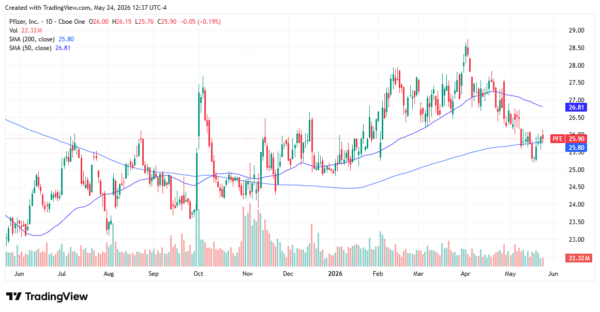
For investors dollar-cost averaging into PFE, the technical picture actually offers a modestly encouraging backdrop, even if it shouldn’t be the primary thesis. The stock has been in a fairly defined range since mid-2025, trading mostly between $23 and $29, and the recent pullback from April highs near $28.50 back toward the $25.75–$26 area has brought it close to the 200-day moving average (currently around $25.80). That level has acted as support on prior tests, and the stock appears to be finding a footing there again.

The 50-day moving average at $26.81 sits just overhead as near-term resistance, and the stock is currently trading below it. That’s not ideal for momentum investors, but for someone building a position over time, buying near the 200-day with a long time horizon is historically a reasonable entry discipline.
pfizer - StockEarnings

The Single Biggest Risk: Patent Cliffs and the Coverage Gap

If there’s one thing that should give a prospective PFE buyer pause, it’s the 2026–2028 exclusivity window. Pfizer is heading into a period where several meaningful products face generic or biosimilar competition. The Vyndamax patent settlement is actually good news — it extended effective exclusivity to mid-2031, which was a significant positive legal development disclosed this quarter — but other products across the portfolio face pressure.

The company has already baked in $1.5 billion of revenue impact this year alone. The pipeline products that are supposed to fill the gap are mostly 2028 and beyond stories. That middle stretch of 2026 to 2028 is where the dividend coverage argument gets tested most directly.

Pfizer paid out $2.4 billion in dividends in Q1 alone, or $0.43 per share. With adjusted EPS guided at $2.80–$3.00 for the full year, the math on dividend coverage is workable but not comfortable. There isn’t much cushion. If a couple of pipeline readouts go the wrong way, or if COVID revenue falls faster than expected, the dividend could come under pressure. Pfizer has said explicitly that maintaining the dividend is a strategic priority — and large pharma companies fight hard to protect their payouts — but “priority” and “guaranteed” are different words.

Conclusion: A Reasonable Bet for Patient Dividend Investors — With Eyes Open

So, is Pfizer worth owning today for its dividend with the expectation of future growth? Tentatively, yes — but with a clear-eyed understanding of what you’re actually signing up for. You’re not buying a company whose growth is around the corner. You’re buying a company whose growth is likely several years away, supported by a deep but not-yet-monetized pipeline, while collecting a meaningful dividend yield along the way.

The Q1 earnings report showed an underlying commercial business performing better than the headline COVID-related declines suggest. The pipeline has genuine late-stage depth, and the legal wins on Vyndamax and COMIRNATY patent protection improve the cash flow picture post-2028 more than the market has perhaps appreciated. For someone dollar-cost averaging over the next 12 to 24 months, the current price range — near or below the 200-day moving average — is not an unreasonable place to accumulate. Just don’t expect a quick payoff. This is a 2028–2030 thesis with a dividend yield as a down payment.


A former marketing copywriter turned freelance financial writer and market analyst. I have a passion for delivering insights to investors. I write regularly about stocks for StockEarnings and MarketBeat. Posts are not advice.

Join over 1.2M+ investors/traders who receive daily and weekly notable earnings alerts with predicted move