ajax loader

Loading...


Ride-the-Wave Strategy – Best for Stock Traders

Ride-the-Wave targets multi-day price momentum following a company’s earnings announcement (EA). With this strategy:

  1. Buy a stock one day post-EA if a stock reacts positively post-earnings:
    1. Near the close of trading the EA-day for a pre-market-EA
    2. Near the close of the following day for a post-market-EA
  2. Sell-to-close after 7-10 days, or possibly earlier if a desired price target is reached

Similarly,

  1. short a stock one day post-EA if a stock reacts negatively post-earnings:
    1. near the close of trading the EA-day for a premarket-EA
    2. near the close of the following day for a post-market-EA
  2. then buy-to-close after 7-10 days, or possibly earlier if a desired price target is reached

Important: Ride-the-Wave is predicated on significant price momentum triggered by an EA. The 7-10 day scenario is the maximum trade hold-time. If you see post EA-momentum is halted or reversed by a significant opposite move, re-evaluate your presence in the trade.

This popular StockEarnings screen below will give you a list of stocks that historically exhibit significant price momentum following an EA for the next seven days:

  1. Stocks exhibiting positive post-EA price moves are buy-candidates
  2. Stocks exhibiting negative post-EA price moves are sell/short-candidates

The screen includes those stocks whose Earnings just came out in last two days.

Screen criteria:

  1. Earnings Date Start Date : Current Date + -1 Day
  2. Earnings Date End Date : Current Date + -2 Days
  3. Predicted Move (Next Day) Max : 7%
  4. Predicted Move (On 7th Day) Min : 7%

Strategy Guideline:

  1. Buy the stock if stock has reacted positively. Short the stock if stock has reacted negatively (see above).
  2. Close the position in 7-10 days, or possibly earlier based on price move.

Volatility Crush Strategy - Best for Options Traders

The Volatility Crush strategy is used with stocks that typically experience relatively low-to-moderate price moves (≤4%) following their Earnings Announcements (EA). The basic trade idea is to sell put or call options right before the EA, collecting a credit when options premium is very high due to elevated implied volatility (IV). You then close the position right after the EA by buying the option back much cheaper due to the significant drop in IV that occurs after the mystery of the EA disappears. In assessing this trade, you need to do your homework to ensure you collect sufficient premium to make the trade worthwhile.

This trade is practical due to the low-to-moderate price-move after the EA, which generally won’t significantly affect the options price, unlike an “action” stock, which experience great price moves post-EA. With these symbols, if you’re on the right side of the price move, that’s a great thing. But if you’re on the wrong side of the move, not so great. Consequently, by minimizing the effect of the post-EA price move, you have a much better chance to profit from the reduction in IV without it being ruined by a violent price move.

For this trade, open the position either (1) the night before the EA when the company announces earnings or (2) during the EA day when it announces post-market, generally capturing IV at or close to its peak.

For this trade, open the position either (1) the night before the EA when the company announces earnings or (2) during the EA day when it announces post-market, generally capturing IV at or close to its peak.

This popular stockearnings screen will give you a list of stocks which do not react more than 4% fpost-EA. It includes only those stocks whose earnings are releasing next day.

Screen criteria:

  1. Earnings Date Start Date : Current Date + 1
  2. Earnings Date End Date : Current Date + 1
  3. Predicted Move (Next Day) Max : 4%
  4. Options Type: Weekly

Strategy Guideline:

  1. Options Strategy: Sell Call and Put
  2. Options Strike Price: Current Stock Price – (% Predicated Move x 2)
  3. Expiration Date: It should generally be the closest expiry immediately after the EA.
  4. Buy Insurance: Buying back Call and Put at Strike price which 10% lower than Sell Strike Price is optional but recommended.

Watch Video for More Detail

Volatility Rush Strategy - Best for Options Traders

The Volatility Rush takes advantage of increasing options premiums into earnings announcements (EA) caused by an anticipated rise in Implied Volatility (IV). With this strategy, Buy a Call and Put at-the-money (a long straddle) 2-3 weeks before the EA when IV is lower. Sell the position either (1) the night before the EA when the company announces earnings pre-market, or (2) during the EA day when it announces post-market, generally capturing IV at or close to its peak.

This popular screen will give you a list of stocks whose Options premiums tend to rise into Earnings. It includes only those stocks whose Earnings are at least two weeks away from today.

Screen criteria:

  1. Earnings Date Start Date : Current Date + 15 Days
  2. Earnings Date End Date : Current Date + 30 Days
  3. Predicted Move (Next Day) Min : 5%
  4. Options Type: Weekly or Monthly if that lines up with the two to three-week lead-time for entering the trade

Strategy Guideline:

  1. Buy a Straddle at or close to the money two to three weeks pre-EA.
  2. Sell the position either the night before the EA when the company announces earnings pre-market, or during the EA day when it announces post-market.
  3. Expiration date should generally be the closest expiry immediately after the EA.
  4. Straddle price should not be more 60% of predicted move.

Predicted Move (Volatility)

Similar to Implied Volatility in Options. Expected volatility % based on our Proprietary Volatility Predication Model. We are expecting that stock price will likely to reach % in either direction by the end of next trading session after Earnings are released and not necessarily the closing volatility %.

Why is it important?

    This indicator helps

  1. Knowing expected volatility in stocks after Earnings helps to decide trading stocks before Earnings Announcement.
  2. Taking Advantage of volatility collapse following Earnings Results by using Advance Options strategies such as Spread and Straddles.

Since Last Earnings

Change in share price since last Earnings release.

Why is it Important?

When share has gained more than 10% since it's last Earning release, it tends to over react to minor bad news and give up some gains if not all. So, it contains more downside volatility than upside When share has dropped more than 10% since it's last Earning release, it tends to over react to minor good news and recover some drops if not all. So, it contains more upside volatility than downside.

EPS Surprise (%)

Occurs when a company's reported quarterly or annual profits are above or below analysts' expectations. Here is the formula to derive % EPS Surprice:

Actual EPS - Estimated EPS
------------------------------------- x 100
Estimated EPS

Why is it Important?

Earnings surprises can have a huge impact on a company's stock price. Several studies suggest that positive earnings surprises not only lead to an immediate hike in a stock's price, but also to a gradual increase over time. Hence, it's not surprising that some companies are known for routinely beating earning projections. A negative earnings surprise will usually result in a decline in share price.

Next Day Price Change (%)

Next Regular trading session Closing price following Earnings result.

For After Market Close Earnings, It is a next trading day closing price. For Before Market Open Earnings, It is the same trading day closing price.

Why is it Important?

Next Day price change is a reaction of Earnings result.

Three of the Best Rare Earth Stocks to Buy and Hold Today

Posted on Jan 26, 2026 by Ian Cooper

Three of the Best Rare Earth Stocks to Buy and Hold Today

Rare earth stocks are moving from an obscure corner of the market to the center of a major geopolitical and industrial shift. For years, the U.S. has been overly dependent on China, which controls roughly 80% of the world’s rare earth supply. That reliance once seemed like a manageable trade-off. Today, that looks like a strategic vulnerability. As recent supply-chain shocks have shown, depending on a single country for critical materials is a risk the U.S. and its allies can no longer afford to take.

Rare earths are not optional inputs. Without them, the global push toward electrification and advanced technology stalls out. Electric vehicles, millions of which governments want on the road, require rare earth magnets for motors and drivetrains. Smartphones, computers, flat-panel televisions, and digital cameras all rely on rare earth elements to function. Wind turbines use them for high-efficiency power generation, while semiconductors and computer chips need them to meet modern performance standards.

The implications go beyond consumer technology. Defense systems, guidance equipment, radar, and other advanced military hardware all depend on rare earth materials. Even the U.S. Department of Defense has warned that prolonged shortages could affect readiness and the production of critical warfighting systems. In other words, this isn’t just an economic issue; it’s a national security concern.

The good news is that the world is actively working to break its dependence on China. Governments are funding domestic mining, processing, and recycling efforts, while private companies race to build alternative supply chains. That shift is creating a powerful, long-term opportunity for investors willing to look closely at the rare earth stocks positioned to benefit from this global realignment.

Rare Earth Stocks #1: USA Rare Earth


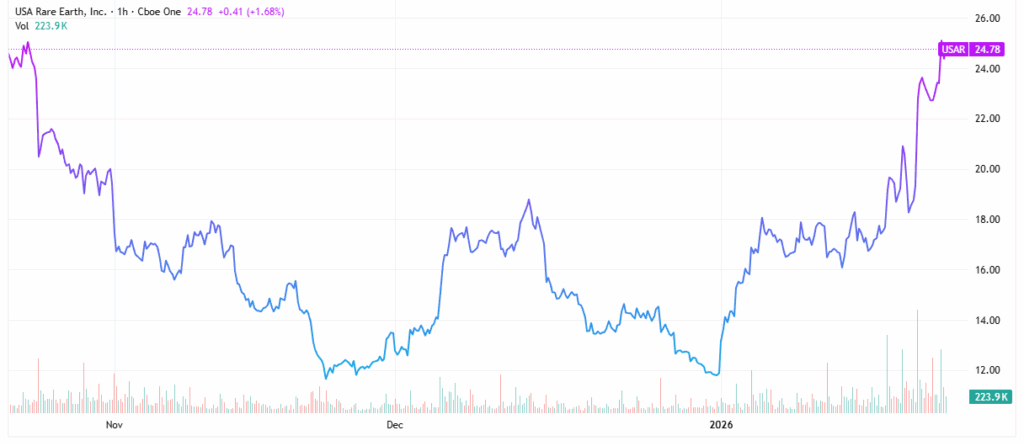
USA Rare Earth (NASDAQ: USAR) is a development-stage critical minerals company focused on advancing a fully integrated rare earth element (REE) and lithium project in the United States. Its flagship asset is the Round Top deposit in West Texas, a large, polymetallic concentration of light and heavy rare earth elements, lithium and other co-products.

That illustrates the risk and the reward of USAR stock. The company is not profitable, nor is it generating revenue. Nevertheless, shares of are exploding higher, up over 70% in the 30 days ending Jan. 23.

Fueling that upside, the company just got a buy rating from analysts at Benchmark, with a price target of $15. Benchmark noted that USAR’s plans to construct a 1,600-metric-ton-per-annum oxide processing facility in Lacq, which is scheduled for commissioning in late 20, will help strengthen the supply chain for rare earth in Europe.

“The French government will provide substantial subsidies for the project, covering 45% of eligible equipment costs and €130 million for real estate expenses,” added Investing.com.

In addition, USAR just selected Fluor Corp and WSP Global as its Engineering, Procurement and Construction Management (EPCM) partners for its Round Top Rare Earth Project in Texas. “Fluor and WSP are key partners with the experience and expertise required to move Round Top toward commercial delivery,” said Alex Moyes, Vice President of Mining & Processing at USA Rare Earth, as noted in a press release. 

“Their teams know how to deliver complex mining and processing projects, and that matters as we work to bring a secure, domestic supply of heavy rare earth elements, inclusive of yttrium, into production, along with critical technology metals such as hafnium, zirconium, and gallium.”
rare earth stocks - StockEarnings

Rare Earth Stocks #2: MP Materials

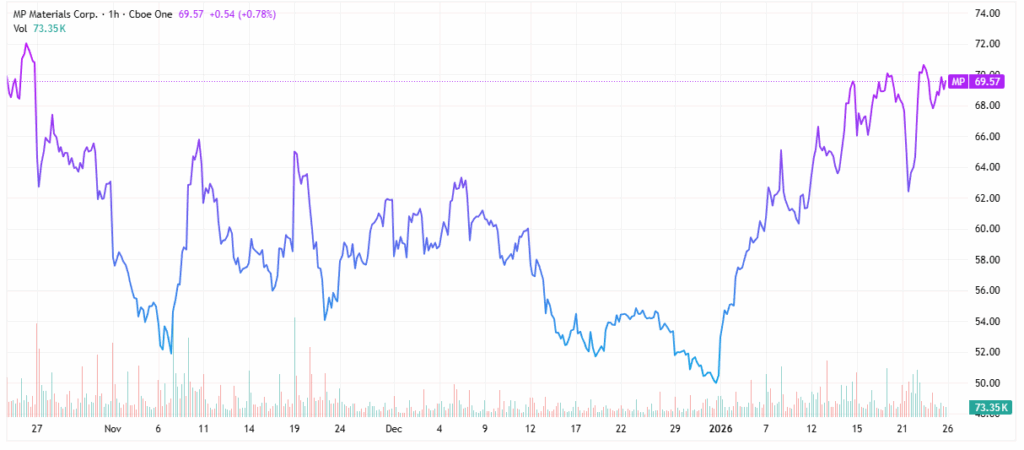
MP Materials Corporation (NYSE: MP) operates as a vertically integrated producer of rare earth materials in North America. The company owns and manages the Mountain Pass Rare Earth Mine and Processing Facility in California, the only commercially viable rare earth mining and processing site in the United States

That means that, unlike USA Rare Earths, MP Materials is generating revenue. However, it’s not yet profitable. But like USAR, MP stock is off to a strong start in 2026, up 23% in the 30 days ending Jan. 23.

Analysts are taking notice. In fact, on Jan. 13, analysts at William Blair launched a buy rating for MP Materials (MP). 

We also have to consider MP Materials has become a powerhouse stock after announcing a deal with the U.S. Department of Defense in July 2025, which would help accelerate the build-out of an end-to-end U.S. rare earth magnet supply chain and reduce foreign dependency.

As noted in a company press release, “Rare earth magnets are one of the most strategically important components in advanced technology systems spanning defense and commercial applications. Yet today, the U.S. relies almost entirely on foreign sources. This strategic partnership builds on MP Materials’ operational foundation to catalyze domestic production, strengthen industrial resilience, and secure critical supply chains for high-growth industries and future dual-use applications.”
rare earth stocks - StockEarnings

Rare Earth Stocks #3: VanEck Rare Earth and Strategic Metals ETF

Of course, you may want exposure to rare earth stocks without choosing individual stocks. One of the most popular options for fund investors is the VanEck Rare Earth and Strategic Metals ETF (NYSEARCA: REMX).

With an expense ratio of 0.58%, the VanEck Rare Earth and Strategic Metals ETF (REMX) attempts to replicate the performance of the MVIS Global Rare Earth/Strategic Metals Index, which is intended to track the overall performance of companies involved in producing, refining, and recycling of rare earth and strategic metals and minerals. Some of its 30 holdings include MP Materials, Lynas Rare Earths, Albemarle, Pilbara Minerals, and Ganfeng Lithium.

A Long-Term Bet on Strategic Materials

Rare earth stocks aren’t a short-term trade driven by hype—they’re tied to structural changes in global supply chains. As the U.S. and its allies invest in domestic production to support EVs, clean energy, and defense systems, companies with rare earth exposure could see sustained demand growth. Whether investors prefer individual stocks like USAR and MP or diversified exposure through REMX, the theme offers a compelling way to invest in national security and next-generation technology.


Over the last 26 years, he’s taught thousands of investors how to trade news flow and herd mentality using a unique blend of technical and fundamental analysis. Cooper was among the few analysts to spot the financial crisis of 2008, the top of subprime and Alt-A, the death of Lehman Brothers, Bear Stearns, and New Century Financial, and even the Dow’s collapse to 6,500, as well as its recovery. He even called for gold to rally well above $1.500 when it traded under $600. At the moment, Cooper makes use of technical, fundamental and news analysis, to help individual investors grow their wealth. He’s a firm believer that hard work and thorough research will lead to investment success.

Join over 1.2M+ investors/traders who receive daily and weekly notable earnings alerts with predicted move