ajax loader

Loading...


Ride-the-Wave Strategy – Best for Stock Traders

Ride-the-Wave targets multi-day price momentum following a company’s earnings announcement (EA). With this strategy:

  1. Buy a stock one day post-EA if a stock reacts positively post-earnings:
    1. Near the close of trading the EA-day for a pre-market-EA
    2. Near the close of the following day for a post-market-EA
  2. Sell-to-close after 7-10 days, or possibly earlier if a desired price target is reached

Similarly,

  1. short a stock one day post-EA if a stock reacts negatively post-earnings:
    1. near the close of trading the EA-day for a premarket-EA
    2. near the close of the following day for a post-market-EA
  2. then buy-to-close after 7-10 days, or possibly earlier if a desired price target is reached

Important: Ride-the-Wave is predicated on significant price momentum triggered by an EA. The 7-10 day scenario is the maximum trade hold-time. If you see post EA-momentum is halted or reversed by a significant opposite move, re-evaluate your presence in the trade.

This popular StockEarnings screen below will give you a list of stocks that historically exhibit significant price momentum following an EA for the next seven days:

  1. Stocks exhibiting positive post-EA price moves are buy-candidates
  2. Stocks exhibiting negative post-EA price moves are sell/short-candidates

The screen includes those stocks whose Earnings just came out in last two days.

Screen criteria:

  1. Earnings Date Start Date : Current Date + -1 Day
  2. Earnings Date End Date : Current Date + -2 Days
  3. Predicted Move (Next Day) Max : 7%
  4. Predicted Move (On 7th Day) Min : 7%

Strategy Guideline:

  1. Buy the stock if stock has reacted positively. Short the stock if stock has reacted negatively (see above).
  2. Close the position in 7-10 days, or possibly earlier based on price move.

Volatility Crush Strategy - Best for Options Traders

The Volatility Crush strategy is used with stocks that typically experience relatively low-to-moderate price moves (≤4%) following their Earnings Announcements (EA). The basic trade idea is to sell put or call options right before the EA, collecting a credit when options premium is very high due to elevated implied volatility (IV). You then close the position right after the EA by buying the option back much cheaper due to the significant drop in IV that occurs after the mystery of the EA disappears. In assessing this trade, you need to do your homework to ensure you collect sufficient premium to make the trade worthwhile.

This trade is practical due to the low-to-moderate price-move after the EA, which generally won’t significantly affect the options price, unlike an “action” stock, which experience great price moves post-EA. With these symbols, if you’re on the right side of the price move, that’s a great thing. But if you’re on the wrong side of the move, not so great. Consequently, by minimizing the effect of the post-EA price move, you have a much better chance to profit from the reduction in IV without it being ruined by a violent price move.

For this trade, open the position either (1) the night before the EA when the company announces earnings or (2) during the EA day when it announces post-market, generally capturing IV at or close to its peak.

For this trade, open the position either (1) the night before the EA when the company announces earnings or (2) during the EA day when it announces post-market, generally capturing IV at or close to its peak.

This popular stockearnings screen will give you a list of stocks which do not react more than 4% fpost-EA. It includes only those stocks whose earnings are releasing next day.

Screen criteria:

  1. Earnings Date Start Date : Current Date + 1
  2. Earnings Date End Date : Current Date + 1
  3. Predicted Move (Next Day) Max : 4%
  4. Options Type: Weekly

Strategy Guideline:

  1. Options Strategy: Sell Call and Put
  2. Options Strike Price: Current Stock Price – (% Predicated Move x 2)
  3. Expiration Date: It should generally be the closest expiry immediately after the EA.
  4. Buy Insurance: Buying back Call and Put at Strike price which 10% lower than Sell Strike Price is optional but recommended.

Watch Video for More Detail

Volatility Rush Strategy - Best for Options Traders

The Volatility Rush takes advantage of increasing options premiums into earnings announcements (EA) caused by an anticipated rise in Implied Volatility (IV). With this strategy, Buy a Call and Put at-the-money (a long straddle) 2-3 weeks before the EA when IV is lower. Sell the position either (1) the night before the EA when the company announces earnings pre-market, or (2) during the EA day when it announces post-market, generally capturing IV at or close to its peak.

This popular screen will give you a list of stocks whose Options premiums tend to rise into Earnings. It includes only those stocks whose Earnings are at least two weeks away from today.

Screen criteria:

  1. Earnings Date Start Date : Current Date + 15 Days
  2. Earnings Date End Date : Current Date + 30 Days
  3. Predicted Move (Next Day) Min : 5%
  4. Options Type: Weekly or Monthly if that lines up with the two to three-week lead-time for entering the trade

Strategy Guideline:

  1. Buy a Straddle at or close to the money two to three weeks pre-EA.
  2. Sell the position either the night before the EA when the company announces earnings pre-market, or during the EA day when it announces post-market.
  3. Expiration date should generally be the closest expiry immediately after the EA.
  4. Straddle price should not be more 60% of predicted move.

Predicted Move (Volatility)

Similar to Implied Volatility in Options. Expected volatility % based on our Proprietary Volatility Predication Model. We are expecting that stock price will likely to reach % in either direction by the end of next trading session after Earnings are released and not necessarily the closing volatility %.

Why is it important?

    This indicator helps

  1. Knowing expected volatility in stocks after Earnings helps to decide trading stocks before Earnings Announcement.
  2. Taking Advantage of volatility collapse following Earnings Results by using Advance Options strategies such as Spread and Straddles.

Since Last Earnings

Change in share price since last Earnings release.

Why is it Important?

When share has gained more than 10% since it's last Earning release, it tends to over react to minor bad news and give up some gains if not all. So, it contains more downside volatility than upside When share has dropped more than 10% since it's last Earning release, it tends to over react to minor good news and recover some drops if not all. So, it contains more upside volatility than downside.

EPS Surprise (%)

Occurs when a company's reported quarterly or annual profits are above or below analysts' expectations. Here is the formula to derive % EPS Surprice:

Actual EPS - Estimated EPS
------------------------------------- x 100
Estimated EPS

Why is it Important?

Earnings surprises can have a huge impact on a company's stock price. Several studies suggest that positive earnings surprises not only lead to an immediate hike in a stock's price, but also to a gradual increase over time. Hence, it's not surprising that some companies are known for routinely beating earning projections. A negative earnings surprise will usually result in a decline in share price.

Next Day Price Change (%)

Next Regular trading session Closing price following Earnings result.

For After Market Close Earnings, It is a next trading day closing price. For Before Market Open Earnings, It is the same trading day closing price.

Why is it Important?

Next Day price change is a reaction of Earnings result.

AutoZone’s Q3 Earnings: Is This The Death Of Disposable Thinking?

Posted on May 26, 2026 by Grayson Cavern

AutoZone’s Q3 Earnings: Is This The Death Of Disposable Thinking?

In the decades following World War II, America perfected the art of replacement. A car wore out, you bought another. An appliance failed, you upgraded it. Back then, prosperity wasn’t measured by how long something lasted but by how quickly you could afford the next one.

AutoZone Inc. (NYSE: AZO) just delivered an earnings report that suggests that mindset is changing fast.

AutoZone reported third-quarter FY2026 earnings with revenue of $4.46 billion and earnings per share of $35.36, beating expectations while delivering domestic same-store sales growth of 4.1%.

However, this quarter reinforced a simple idea: consumers are becoming more selective about replacement and more committed to preservation.

Americans Are Choosing Preservation


The easiest explanation for AutoZone’s performance is an aging vehicle fleet.

I think the quarter revealed something deeper. Let me explain.

In the first quarter, domestic same-store sales grew 4.8%.

In the second quarter, that growth slowed to 3.4%.

By the third quarter, domestic same-store sales accelerated back to 4.1%.

That progression tells you that maintenance spending isn’t fading. New vehicles remain expensive. Financing remains expensive. Insurance remains expensive. Consumers understand those realities every time they make a monthly payment, renew a policy, or walk into a dealership.

And since every increase in replacement costs strengthens the economics of maintenance, this means that AutoZone’s opportunity expands each time consumers choose preservation over replacement.

The Trend Is Bigger Than DIY Customers

One figure deserves more attention than it received among investors.

I’m talking about the commercial sales that grew 7.3% to $1.4 billion during this quarter.

Professional repair shops are seeing the same behavior that individual consumers are seeing. Vehicles are staying on the road longer, generating demand for maintenance, repairs, and replacement parts long after many owners might have traded them in during previous cycles.

At the same time, AutoZone generated gross profit of $2.37 billion and operating profit of $885 million.

Commercial sales growing faster than the overall business confirms that preservation is no longer confined to DIY consumers. Repair shops are benefiting from the same behavior, reinforcing the idea that maintenance has become a financial decision rather than a temporary response to economic uncertainty.

Management Is Turning Preservation Into Cash

During the first thirty-six weeks of fiscal 2026, AutoZone generated approximately $1.6 billion in operating cash flow.

Management didn’t simply collect it.

The company continued investing in inventory, technology, distribution capacity, store growth, and commercial expansion while repurchasing approximately $741.7 million worth of stock.

Even better, they repurchased $741.7 million of stock while funding those purchases primarily through operating cash flow, a decision that signals confidence in both the durability of demand and the company’s ability to keep converting that demand into cash.

If preservation continues proving resilient, AutoZone’s buyback machine could remain one of the most powerful drivers of shareholder returns.

Wall Street Keeps Watching Tomorrow’s Vehicle

While Wall Street remains fascinated by the vehicle of the future, AutoZone continues generating cash from the vehicle already sitting in the driveway.

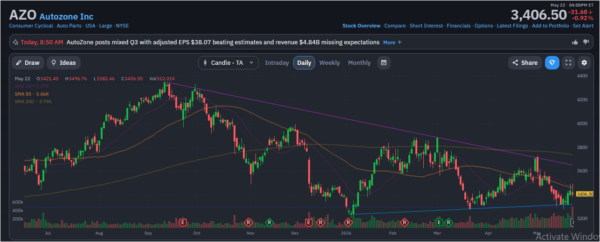
Take a look at the chart; shares remain trapped beneath a long-term downtrend line that has capped rallies since last September, suggesting many investors remain cautious about the company’s future. 

Yet every major selloff has attracted buyers near the $3,250-$3,300 area, creating a support zone that has held repeatedly throughout 2026. The stock continues trading near its 50-day moving average while attempting to stabilize above support, even as the declining 200-day moving average overhead suggests skepticism has not fully dissipated.

To me, that looks like a market struggling to reconcile two competing realities: the transportation future it keeps talking about and the maintenance economy AutoZone continues profiting from today.
autozone - StockEarnings

There’s no doubt about it, electric and autonomous technology vehicles will continue gaining market share.

But the overwhelming majority of vehicles on American roads today still require maintenance, repairs, replacement parts, and ongoing investment from their owners. That reality helped drive another quarter of sales growth, profit growth, and cash generation.

And as long as consumers continue extending the life of the vehicles they already own, the company remains positioned on the right side of that decision.

The Market May Be Looking Too Far Ahead

AutoZone’s earnings delivered a simple reminder.

Consumers still maintain the vehicles they own. They still repair them. They still postpone replacement when the economics make sense. And management continues turning that behavior into sales growth, profit growth, cash flow, and aggressive share repurchases.

I don’t view that as a bet on old cars at all. If anything, this is a bet on a consumer who increasingly treats replacement as a financial decision rather than a habit.

Wall Street may continue debating the future of transportation. But AutoZone keeps getting paid by the present.

That’s a position I find difficult to ignore.

Join over 1.2M+ investors/traders who receive daily and weekly notable earnings alerts with predicted move