When I go through earnings season looking for stocks worth owning, my work doesn’t end at revenue or EPS beats, because a company can excite Wall Street with spectacular growth while burning through cash to keep that growth alive.
So I went back through the earnings reports we covered over the past few weeks and used a tougher filter: after the sales are booked and the expenses are paid, how much cash is actually left, what is feeding that cash generation, and what could eventually break the machine?
That process led me to Broadcom Inc (NASDAQ:AVGO), Home Depot (NYSE:HD), Analog Devices (NASDAQ: ADI), Walmart (NYSE:WMT) and Lockheed Martin Corp (NYSE: LMT), five companies from completely different corners of the market that survived for different reasons.
Broadcom was the easiest name to include once I saw how much of its AI growth was actually reaching the cash-flow statement. The company generated $10.49 billion in operating cash flow during fiscal Q2 while spending just $231 million on capital expenditures, leaving $10.26 billion in free cash flow, equal to 46% of quarterly revenue.
The growth behind those numbers was equally difficult to ignore. Revenue jumped 48% to $22.19 billion, while AI semiconductor revenue surged 143% to $10.8 billion, and Broadcom generated $18.27 billion in free cash flow during the first six months.
The risk is that everybody already sees the story, and so, hyperscaler spending, custom-chip demand and AI infrastructure investment need to remain strong because the stock is priced for the company to keep delivering.
But Broadcom gives me what I want from an AI winner, which is the fact that the growth is not sitting inside a PowerPoint slide. The cash is already there.
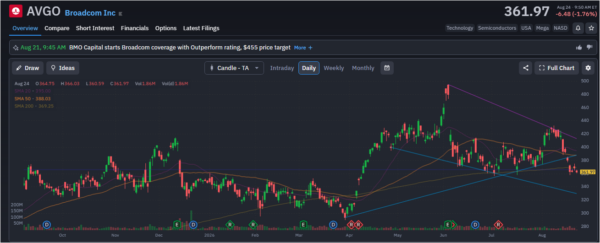
Home Depot Inc
Home Depot Inc became more interesting to me because its cash generation arrived before the housing market itself had properly recovered. During the first six months of fiscal 2026, the company generated $11.42 billion in operating cash flow and spent $1.72 billion on capital expenditures, leaving roughly $9.70 billion in cash after those investments.
Those numbers are even more compelling against the operating backdrop. Q2 sales rose 5.7% to $47.9 billion, comparable sales increased 1.7%, and adjusted EPS came in at $4.92, yet management still does not believe the housing market has reached its inflection point.
The obvious risk is that mortgage rates remain elevated and larger home-improvement projects stay delayed longer than investors expect.
What keeps Home Depot Inc on my list is the possibility that investors are getting paid to wait for that recovery. The company is already throwing off enormous cash while the bigger housing catalyst has yet to arrive.
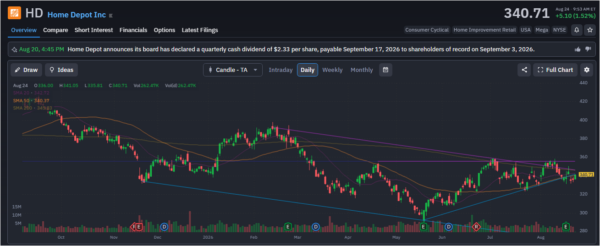
Analog Devices
Analog Devices earned its place because it combines elite cash conversion with an AI opportunity that does not depend on winning the GPU race. During fiscal Q3, ADI generated $1.60 billion in operating cash flow and spent just $145.7 million on capital expenditures, producing $1.46 billion in free cash flow, or 36% of quarterly revenue.
The trailing-12-month figure was even stronger at $4.94 billion in free cash flow, a record for the company. Management is positioning ADI across the infrastructure problems surrounding AI, including power management, sensing, connectivity and its broader grid-to-chip strategy. The company does not need to manufacture the GPU to get paid from the infrastructure required to power and connect it.
The risk is valuation and the possibility that the AI spending cycle eventually cools. Still, I like Analog Devices because it gives me exposure to the less obvious parts of the buildout while already producing serious cash
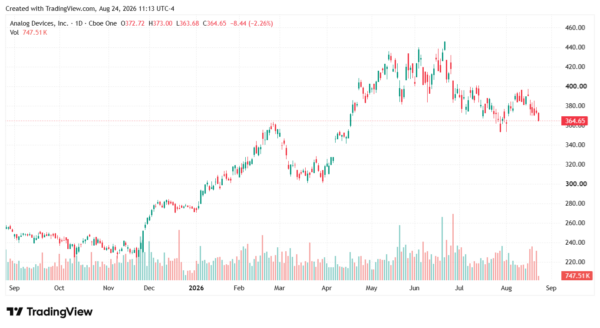
Walmart
Walmart free-cash-flow figure initially looks less impressive until you see where the missing cash actually went. During the first six months of fiscal 2027, operating cash flow rose to $19.71 billion, while capital expenditures jumped to $14.18 billion, leaving $5.53 billion in free cash flow.
That spending is the point of the story because Walmart is pouring billions into e-commerce, technology, faster delivery and the infrastructure behind its next phase of growth, yet the underlying business is still generating nearly $20 billion in operating cash over six months.
The risk is execution because those investments must eventually produce attractive returns, particularly as Walmart competes more aggressively with Amazon across multiple parts of retail.
But the company has something few competitors possess: enough internal cash generation to fund its reinvention without breaking the machine underneath it.
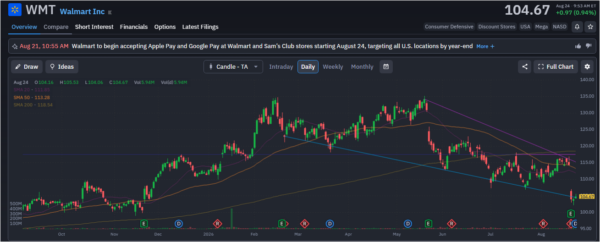
Lockheed Martin Corp
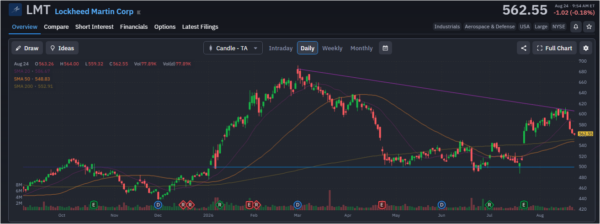
Lockheed Martin Corp second-quarter cash generation was exceptional, but investors should be careful about treating it as a perfectly normal run rate. The company generated $3.24 billion in operating cash flow and $2.92 billion in free cash flow, then raised its full-year free-cash-flow outlook to more than $7 billion.
Management also acknowledged that the sharp increase in quarterly cash flow benefited from the timing of customer receipts and lower tax payments, which is why I would not simply annualize the $2.92 billion quarter.
What keeps me bullish is the business supporting the cash. Lockheed Martin Corp ended the quarter with a record $230.4 billion backlog, giving the company an enormous amount of contracted work to execute over time.
Government budgets, program delays and contract execution remain real risks, but few businesses offer the same combination of current cash generation and visible future demand.
My Take
These five stocks do not have identical profiles, nether are they five versions of the same trade, but five different businesses producing cash for five different reasons, and each one has a clear risk sitting beside the opportunity. Which is exactly why I like the list.