ajax loader

Loading...


Ride-the-Wave Strategy – Best for Stock Traders

Ride-the-Wave targets multi-day price momentum following a company’s earnings announcement (EA). With this strategy:

  1. Buy a stock one day post-EA if a stock reacts positively post-earnings:
    1. Near the close of trading the EA-day for a pre-market-EA
    2. Near the close of the following day for a post-market-EA
  2. Sell-to-close after 7-10 days, or possibly earlier if a desired price target is reached

Similarly,

  1. short a stock one day post-EA if a stock reacts negatively post-earnings:
    1. near the close of trading the EA-day for a premarket-EA
    2. near the close of the following day for a post-market-EA
  2. then buy-to-close after 7-10 days, or possibly earlier if a desired price target is reached

Important: Ride-the-Wave is predicated on significant price momentum triggered by an EA. The 7-10 day scenario is the maximum trade hold-time. If you see post EA-momentum is halted or reversed by a significant opposite move, re-evaluate your presence in the trade.

This popular StockEarnings screen below will give you a list of stocks that historically exhibit significant price momentum following an EA for the next seven days:

  1. Stocks exhibiting positive post-EA price moves are buy-candidates
  2. Stocks exhibiting negative post-EA price moves are sell/short-candidates

The screen includes those stocks whose Earnings just came out in last two days.

Screen criteria:

  1. Earnings Date Start Date : Current Date + -1 Day
  2. Earnings Date End Date : Current Date + -2 Days
  3. Predicted Move (Next Day) Max : 7%
  4. Predicted Move (On 7th Day) Min : 7%

Strategy Guideline:

  1. Buy the stock if stock has reacted positively. Short the stock if stock has reacted negatively (see above).
  2. Close the position in 7-10 days, or possibly earlier based on price move.

Volatility Crush Strategy - Best for Options Traders

The Volatility Crush strategy is used with stocks that typically experience relatively low-to-moderate price moves (≤4%) following their Earnings Announcements (EA). The basic trade idea is to sell put or call options right before the EA, collecting a credit when options premium is very high due to elevated implied volatility (IV). You then close the position right after the EA by buying the option back much cheaper due to the significant drop in IV that occurs after the mystery of the EA disappears. In assessing this trade, you need to do your homework to ensure you collect sufficient premium to make the trade worthwhile.

This trade is practical due to the low-to-moderate price-move after the EA, which generally won’t significantly affect the options price, unlike an “action” stock, which experience great price moves post-EA. With these symbols, if you’re on the right side of the price move, that’s a great thing. But if you’re on the wrong side of the move, not so great. Consequently, by minimizing the effect of the post-EA price move, you have a much better chance to profit from the reduction in IV without it being ruined by a violent price move.

For this trade, open the position either (1) the night before the EA when the company announces earnings or (2) during the EA day when it announces post-market, generally capturing IV at or close to its peak.

For this trade, open the position either (1) the night before the EA when the company announces earnings or (2) during the EA day when it announces post-market, generally capturing IV at or close to its peak.

This popular stockearnings screen will give you a list of stocks which do not react more than 4% fpost-EA. It includes only those stocks whose earnings are releasing next day.

Screen criteria:

  1. Earnings Date Start Date : Current Date + 1
  2. Earnings Date End Date : Current Date + 1
  3. Predicted Move (Next Day) Max : 4%
  4. Options Type: Weekly

Strategy Guideline:

  1. Options Strategy: Sell Call and Put
  2. Options Strike Price: Current Stock Price – (% Predicated Move x 2)
  3. Expiration Date: It should generally be the closest expiry immediately after the EA.
  4. Buy Insurance: Buying back Call and Put at Strike price which 10% lower than Sell Strike Price is optional but recommended.

Watch Video for More Detail

Volatility Rush Strategy - Best for Options Traders

The Volatility Rush takes advantage of increasing options premiums into earnings announcements (EA) caused by an anticipated rise in Implied Volatility (IV). With this strategy, Buy a Call and Put at-the-money (a long straddle) 2-3 weeks before the EA when IV is lower. Sell the position either (1) the night before the EA when the company announces earnings pre-market, or (2) during the EA day when it announces post-market, generally capturing IV at or close to its peak.

This popular screen will give you a list of stocks whose Options premiums tend to rise into Earnings. It includes only those stocks whose Earnings are at least two weeks away from today.

Screen criteria:

  1. Earnings Date Start Date : Current Date + 15 Days
  2. Earnings Date End Date : Current Date + 30 Days
  3. Predicted Move (Next Day) Min : 5%
  4. Options Type: Weekly or Monthly if that lines up with the two to three-week lead-time for entering the trade

Strategy Guideline:

  1. Buy a Straddle at or close to the money two to three weeks pre-EA.
  2. Sell the position either the night before the EA when the company announces earnings pre-market, or during the EA day when it announces post-market.
  3. Expiration date should generally be the closest expiry immediately after the EA.
  4. Straddle price should not be more 60% of predicted move.

Predicted Move (Volatility)

Similar to Implied Volatility in Options. Expected volatility % based on our Proprietary Volatility Predication Model. We are expecting that stock price will likely to reach % in either direction by the end of next trading session after Earnings are released and not necessarily the closing volatility %.

Why is it important?

    This indicator helps

  1. Knowing expected volatility in stocks after Earnings helps to decide trading stocks before Earnings Announcement.
  2. Taking Advantage of volatility collapse following Earnings Results by using Advance Options strategies such as Spread and Straddles.

Since Last Earnings

Change in share price since last Earnings release.

Why is it Important?

When share has gained more than 10% since it's last Earning release, it tends to over react to minor bad news and give up some gains if not all. So, it contains more downside volatility than upside When share has dropped more than 10% since it's last Earning release, it tends to over react to minor good news and recover some drops if not all. So, it contains more upside volatility than downside.

EPS Surprise (%)

Occurs when a company's reported quarterly or annual profits are above or below analysts' expectations. Here is the formula to derive % EPS Surprice:

Actual EPS - Estimated EPS
------------------------------------- x 100
Estimated EPS

Why is it Important?

Earnings surprises can have a huge impact on a company's stock price. Several studies suggest that positive earnings surprises not only lead to an immediate hike in a stock's price, but also to a gradual increase over time. Hence, it's not surprising that some companies are known for routinely beating earning projections. A negative earnings surprise will usually result in a decline in share price.

Next Day Price Change (%)

Next Regular trading session Closing price following Earnings result.

For After Market Close Earnings, It is a next trading day closing price. For Before Market Open Earnings, It is the same trading day closing price.

Why is it Important?

Next Day price change is a reaction of Earnings result.

McDonald’s Stock Is Down. Here’s Why It’s a Buy

Posted on Aug 24, 2026 by Chris Markoch

McDonald’s Stock Is Down. Here’s Why It’s a Buy

McDonald’s (NYSE: MCD) delivered a mixed earnings report in early August, and investors are still trying to decide what to do with the stock. There are legitimate concerns about soft comparable store sales, but the sales are still growing, which can get lost when revenue comes in lighter than expected. 

But a more plausible story is that MCD was one of the best ways to invest in the restaurant sector for several years. Now, other names are starting to catch up, and it’s causing a repricing of the stock. That means the downward price action since Feb. 2026 is a healthy, albeit unwelcome, pullback. Still, it seems like a good time for investors to take a bite.  

A Sector Catching Up, not a Company Falling Behind 


For years, McDonald’s traded at a premium to its restaurant peers. That premium reflected real advantages: an unmatched scale, a fortress balance sheet, and a franchise model that generates cash in almost any environment. Investors willingly paid for that stability, especially when other restaurant stocks looked shakier. 

That gap has narrowed in 2026. Competitors have sharpened their value offerings and improved execution, closing some of the distance that once separated them from McDonald’s. When a market leader’s advantage shrinks, even slightly, the stock often gets repriced before the fundamentals catch up. That’s arguably what’s happening here. 

This distinction matters in how investors read the chart. A stock falling because the business is deteriorating is a different animal from one falling because its relative advantage is normalizing. The first scenario is a warning sign. The second is often a buying opportunity in disguise, particularly for a company with McDonald’s balance sheet. 

It’s worth remembering that MCD is a Dividend King, having raised its payout for over 45 consecutive years. That track record didn’t happen by accident. It reflects a business model built to generate consistent free cash flow, even through recessions, pandemics, and shifting consumer habits. 

None of that means the current pullback is painless for shareholders. Watching a long-time market leader underperform is uncomfortable, and it’s tempting to read every headline as confirmation that something is fundamentally broken. But a repricing driven by sector convergence is a very different story from one driven by a company losing its grip on its core business. 

That’s the tension at the heart of this analysis. The narrative around MCD has shifted from “best-in-class compounder” to “story stock in trouble.” The numbers, though, still tell a more boring, more reassuring story. That gap between perception and fundamentals is exactly where opportunity tends to hide. 

McDonald’s and the Consumer: Where the Concern Lies? 

When McDonald’s delivered its Q2 2026 earnings report, it expressed concern about a consumer who is under pressure. The company’s core consumer is value-oriented, and it made some missteps with promotions that impacted sales in the quarter.  

Until gas prices, and by extension other prices, move lower. That’s a story that’s not likely to change. That’s where the concern rests for MCD. 

On the other hand, concerns about the impact of GLP-1 drugs remain anecdotal. That’s not to say they don’t exist, but it’s not showing up in a meaningful way in McDonald’s sales and earnings data. Consumers may look for smaller portions, but that’s not an existential threat.  

MCD Technical Analysis: Two Sides of a Coin 

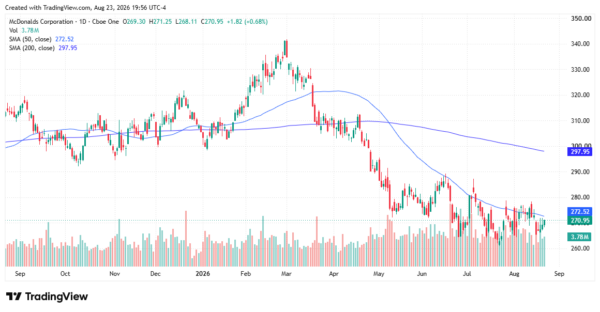
The MCD chart is brutal; there’s no getting around it. In addition to being in a downtrend since February, investors are dealing with a descending 200-day simple moving average (SMA) and a descending 50-day SMA. The latter has acted as a source of resistance throughout the summer.  

But there’s another signal on the chart that is a cause for optimism. That is, on multiple occasions, MCD has confirmed a bottom at around $260. That’s right around what some analysts consider to be the stock’s fair value. 

The consensus price target for MCD is around $320. That would put the stock right around its Jan. 2026 high. However, investors need to remember that these are often 12-month targets. Many investors will want to see a confirmation of a gain above the 50-day SMA before starting a position.  
mcdonalds - StockEarnings

Why Investors Shouldn’t Give Up on MCD 

So what’s the difference between McDonald’s now and McDonald’s then? The only thing I can really see is the stock price. Yes, the company, by its own admission, botched the execution of some promotions. But this is a company that’s still posting year-over-year beats on its top and bottom lines. That’s not the sign of a business or a stock that’s in trouble.  

But the stock did get overvalued. And at around 21x forward earnings, it may still have further to drop. But if some DCF analyses are correct, MCD is getting close to a fair value of around $260. That means, this could be a time to start snacking on the stock, which pays one of the most reliable dividends in the industry.  

A former marketing copywriter turned freelance financial writer and market analyst. I have a passion for delivering insights to investors. I write regularly about stocks for StockEarnings and MarketBeat. Posts are not advice.

Join over 1.2M+ investors/traders who receive daily and weekly notable earnings alerts with predicted move