ajax loader

Loading...


Ride-the-Wave Strategy – Best for Stock Traders

Ride-the-Wave targets multi-day price momentum following a company’s earnings announcement (EA). With this strategy:

  1. Buy a stock one day post-EA if a stock reacts positively post-earnings:
    1. Near the close of trading the EA-day for a pre-market-EA
    2. Near the close of the following day for a post-market-EA
  2. Sell-to-close after 7-10 days, or possibly earlier if a desired price target is reached

Similarly,

  1. short a stock one day post-EA if a stock reacts negatively post-earnings:
    1. near the close of trading the EA-day for a premarket-EA
    2. near the close of the following day for a post-market-EA
  2. then buy-to-close after 7-10 days, or possibly earlier if a desired price target is reached

Important: Ride-the-Wave is predicated on significant price momentum triggered by an EA. The 7-10 day scenario is the maximum trade hold-time. If you see post EA-momentum is halted or reversed by a significant opposite move, re-evaluate your presence in the trade.

This popular StockEarnings screen below will give you a list of stocks that historically exhibit significant price momentum following an EA for the next seven days:

  1. Stocks exhibiting positive post-EA price moves are buy-candidates
  2. Stocks exhibiting negative post-EA price moves are sell/short-candidates

The screen includes those stocks whose Earnings just came out in last two days.

Screen criteria:

  1. Earnings Date Start Date : Current Date + -1 Day
  2. Earnings Date End Date : Current Date + -2 Days
  3. Predicted Move (Next Day) Max : 7%
  4. Predicted Move (On 7th Day) Min : 7%

Strategy Guideline:

  1. Buy the stock if stock has reacted positively. Short the stock if stock has reacted negatively (see above).
  2. Close the position in 7-10 days, or possibly earlier based on price move.

Volatility Crush Strategy - Best for Options Traders

The Volatility Crush strategy is used with stocks that typically experience relatively low-to-moderate price moves (≤4%) following their Earnings Announcements (EA). The basic trade idea is to sell put or call options right before the EA, collecting a credit when options premium is very high due to elevated implied volatility (IV). You then close the position right after the EA by buying the option back much cheaper due to the significant drop in IV that occurs after the mystery of the EA disappears. In assessing this trade, you need to do your homework to ensure you collect sufficient premium to make the trade worthwhile.

This trade is practical due to the low-to-moderate price-move after the EA, which generally won’t significantly affect the options price, unlike an “action” stock, which experience great price moves post-EA. With these symbols, if you’re on the right side of the price move, that’s a great thing. But if you’re on the wrong side of the move, not so great. Consequently, by minimizing the effect of the post-EA price move, you have a much better chance to profit from the reduction in IV without it being ruined by a violent price move.

For this trade, open the position either (1) the night before the EA when the company announces earnings or (2) during the EA day when it announces post-market, generally capturing IV at or close to its peak.

For this trade, open the position either (1) the night before the EA when the company announces earnings or (2) during the EA day when it announces post-market, generally capturing IV at or close to its peak.

This popular stockearnings screen will give you a list of stocks which do not react more than 4% fpost-EA. It includes only those stocks whose earnings are releasing next day.

Screen criteria:

  1. Earnings Date Start Date : Current Date + 1
  2. Earnings Date End Date : Current Date + 1
  3. Predicted Move (Next Day) Max : 4%
  4. Options Type: Weekly

Strategy Guideline:

  1. Options Strategy: Sell Call and Put
  2. Options Strike Price: Current Stock Price – (% Predicated Move x 2)
  3. Expiration Date: It should generally be the closest expiry immediately after the EA.
  4. Buy Insurance: Buying back Call and Put at Strike price which 10% lower than Sell Strike Price is optional but recommended.

Watch Video for More Detail

Volatility Rush Strategy - Best for Options Traders

The Volatility Rush takes advantage of increasing options premiums into earnings announcements (EA) caused by an anticipated rise in Implied Volatility (IV). With this strategy, Buy a Call and Put at-the-money (a long straddle) 2-3 weeks before the EA when IV is lower. Sell the position either (1) the night before the EA when the company announces earnings pre-market, or (2) during the EA day when it announces post-market, generally capturing IV at or close to its peak.

This popular screen will give you a list of stocks whose Options premiums tend to rise into Earnings. It includes only those stocks whose Earnings are at least two weeks away from today.

Screen criteria:

  1. Earnings Date Start Date : Current Date + 15 Days
  2. Earnings Date End Date : Current Date + 30 Days
  3. Predicted Move (Next Day) Min : 5%
  4. Options Type: Weekly or Monthly if that lines up with the two to three-week lead-time for entering the trade

Strategy Guideline:

  1. Buy a Straddle at or close to the money two to three weeks pre-EA.
  2. Sell the position either the night before the EA when the company announces earnings pre-market, or during the EA day when it announces post-market.
  3. Expiration date should generally be the closest expiry immediately after the EA.
  4. Straddle price should not be more 60% of predicted move.

Predicted Move (Volatility)

Similar to Implied Volatility in Options. Expected volatility % based on our Proprietary Volatility Predication Model. We are expecting that stock price will likely to reach % in either direction by the end of next trading session after Earnings are released and not necessarily the closing volatility %.

Why is it important?

    This indicator helps

  1. Knowing expected volatility in stocks after Earnings helps to decide trading stocks before Earnings Announcement.
  2. Taking Advantage of volatility collapse following Earnings Results by using Advance Options strategies such as Spread and Straddles.

Since Last Earnings

Change in share price since last Earnings release.

Why is it Important?

When share has gained more than 10% since it's last Earning release, it tends to over react to minor bad news and give up some gains if not all. So, it contains more downside volatility than upside When share has dropped more than 10% since it's last Earning release, it tends to over react to minor good news and recover some drops if not all. So, it contains more upside volatility than downside.

EPS Surprise (%)

Occurs when a company's reported quarterly or annual profits are above or below analysts' expectations. Here is the formula to derive % EPS Surprice:

Actual EPS - Estimated EPS
------------------------------------- x 100
Estimated EPS

Why is it Important?

Earnings surprises can have a huge impact on a company's stock price. Several studies suggest that positive earnings surprises not only lead to an immediate hike in a stock's price, but also to a gradual increase over time. Hence, it's not surprising that some companies are known for routinely beating earning projections. A negative earnings surprise will usually result in a decline in share price.

Next Day Price Change (%)

Next Regular trading session Closing price following Earnings result.

For After Market Close Earnings, It is a next trading day closing price. For Before Market Open Earnings, It is the same trading day closing price.

Why is it Important?

Next Day price change is a reaction of Earnings result.

Could These 3 Slow-Growth Stocks Really Make Investors Richer?

Posted on Aug 25, 2026 by Grayson Cavern

Could These 3 Slow-Growth Stocks Really Make Investors Richer?

The stock market has conditioned investors to hunt for growth above almost everything else. We chase the company posting 30% revenue growth, then 50%, then 100%, because the math feels obvious. But that obsession with hypergrowth can cause investors to overlook the wealth-building potential of slow-growth companies that steadily return capital to shareholders.

If the business gets bigger quickly enough, the stock should follow. But that thinking can make investors overlook a second route to compounding, one where the company itself barely changes the size of the pie while steadily making your slice of it bigger.

That is what stood out to me when I went back through the latest earnings from Visa Inc (NYSE: V), McDonald’s Corp (NYSE: MCD), and Booking Holdings Inc (NASDAQ: BKNG).

As you’ll see, they all generated solid numbers in previous quarters, but none of these companies belong in the conversation with hypergrowth stocks. Still, all three have another lever in terms of enormous cash generation paired with share repurchases.

Visa


Visa’s latest quarter showed why a mature business can still compound with frightening efficiency.

Net revenue grew 14% to $11.6 billion, GAAP EPS rose 10% to $2.97, and non-GAAP EPS increased 11% to $3.32, supported by 10% growth in payments volume, 12% growth in cross-border volume excluding intra-Europe, and another 10% increase in processed transactions. 

The business is still growing, but the capital allocation machine is doing serious work underneath those numbers. During the quarter, Visa repurchased about 14.5 million shares for $4.9 billion at an average cost of $330.71, while dividends and buybacks together returned $6.2 billion to shareholders. Over the first nine months of fiscal 2026, the company spent $16.4 billion repurchasing Class A shares. 

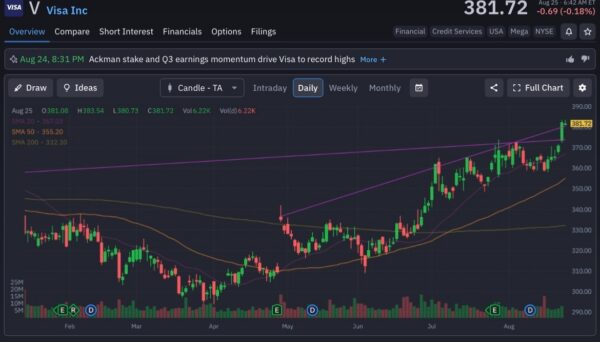
That is how a company with mature global penetration can keep improving the economics per share. Visa closed at $381.72, comfortably above its 20-day SMA of $367.03, 50-day SMA of $355.20, and 200-day SMA of $332.30, with the latest session recording 6.22K in volume. The stock is near record territory because investors are still willing to pay up for a business that combines steady growth with relentless capital returns.

The risk, naturally, is valuation. A premium stock can become expensive enough that even excellent execution produces mediocre returns. But Visa does not need to reinvent itself every quarter; it only needs to keep growing transaction volumes and shrinking the share count without damaging its balance sheet.
slow-growth-StockEarnings

McDonald’s

McDonald’s offers a different version of the same compounding equation, built on a franchise system that turns global restaurant sales into unusually durable cash flows.

Second-quarter revenue grew 4% to $7.1 billion, net income increased 5% to $2.36 billion, and diluted EPS climbed 6% to $3.32, while the diluted share count fell from 717.6 million to 711.1 million. 

That last figure is easy to ignore, but it is central to this thesis.

McDonald’s does not need to own and operate most of its more than 45,000 restaurants to benefit from their growth. Roughly 95% are operated by independent business owners, allowing the company to collect franchise revenue while avoiding the full capital burden of owning every location. 

So modest sales growth can produce something more valuable when it passes through an asset-light system and is then divided across fewer shares.

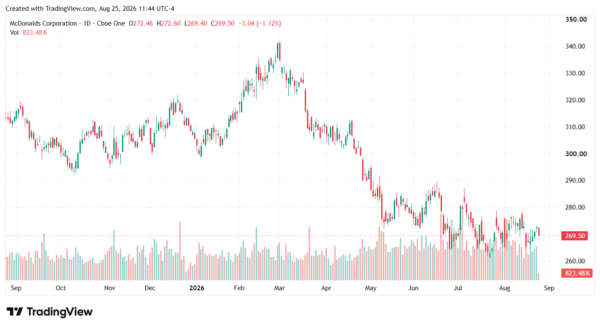
At $272.27, MCD sits almost exactly on its 20-day SMA of $271.12 and 50-day SMA of $272.03, while remaining below its 200-day SMA of $297.65, with 4.48K in volume during the latest session.

That is a stalled stock, but a stalled stock can still compound shareholder value underneath the surface.

My concern would be whether buybacks and dividends start consuming too much capital relative to the growth coming from the business. Slow growth only becomes attractive when the underlying cash engine remains healthy enough to keep feeding shareholders.
slow-growth-StockEarnings

Booking Holdings

Booking Holdings may be the cleanest demonstration of how this strategy works when a company throws off obscene amounts of cash.

Revenue grew 8% to $7.4 billion during the second quarter, room nights increased 5% to 325 million, adjusted EBITDA rose 9% to $2.6 billion, and free cash flow jumped 16% to $3.6 billion. 

That means Booking converted nearly half of its quarterly revenue into free cash flow.

Now look at what that cash allows management to do. The company can invest in technology, expand its travel ecosystem, fund its Transformation Program, and still have enormous financial flexibility. It has already increased the expected annual run-rate savings from that program to about $650 million by the end of 2027. 

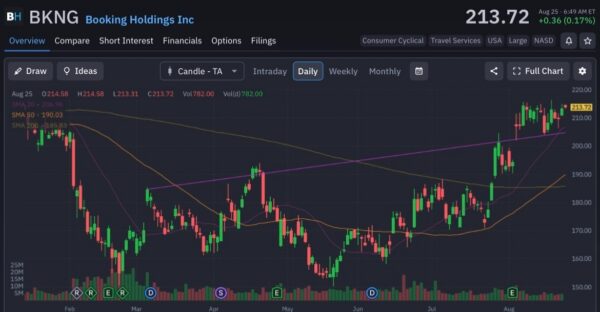
BKNG closed at $213.72, above its 20-day SMA of $206.96, 50-day SMA of $190.03, and 200-day SMA of $185.83, with 782 in volume on the latest session.

This is the type of stock where investors can become richer without needing to see 30% revenue growth. The danger comes if travel demand weakens sharply or the company uses its cash poorly, because buybacks amplify good capital allocation and bad capital allocation equally.

For now, though, Booking is producing enough cash to keep giving management options.
slow-growth-StockEarnings

Final Words

What I like about this trio is that none needs a moonshot. Visa can keep monetizing a growing global payment network while buying back billions in stock. McDonald’s can collect more cash from a franchise model that does not require it to own every restaurant. Booking can turn a relatively modest increase in travel activity into billions of dollars in free cash flow.

My point is, when a company cannot grow the pie dramatically faster, look at whether it can keep increasing your ownership of it anyway, because sometimes the slowest revenue grower is not always the slowest wealth creator. Sometimes the company does the compounding for you, one repurchased share at a time.


Join over 1.2M+ investors/traders who receive daily and weekly notable earnings alerts with predicted move