ajax loader

Loading...


Ride-the-Wave Strategy – Best for Stock Traders

Ride-the-Wave targets multi-day price momentum following a company’s earnings announcement (EA). With this strategy:

  1. Buy a stock one day post-EA if a stock reacts positively post-earnings:
    1. Near the close of trading the EA-day for a pre-market-EA
    2. Near the close of the following day for a post-market-EA
  2. Sell-to-close after 7-10 days, or possibly earlier if a desired price target is reached

Similarly,

  1. short a stock one day post-EA if a stock reacts negatively post-earnings:
    1. near the close of trading the EA-day for a premarket-EA
    2. near the close of the following day for a post-market-EA
  2. then buy-to-close after 7-10 days, or possibly earlier if a desired price target is reached

Important: Ride-the-Wave is predicated on significant price momentum triggered by an EA. The 7-10 day scenario is the maximum trade hold-time. If you see post EA-momentum is halted or reversed by a significant opposite move, re-evaluate your presence in the trade.

This popular StockEarnings screen below will give you a list of stocks that historically exhibit significant price momentum following an EA for the next seven days:

  1. Stocks exhibiting positive post-EA price moves are buy-candidates
  2. Stocks exhibiting negative post-EA price moves are sell/short-candidates

The screen includes those stocks whose Earnings just came out in last two days.

Screen criteria:

  1. Earnings Date Start Date : Current Date + -1 Day
  2. Earnings Date End Date : Current Date + -2 Days
  3. Predicted Move (Next Day) Max : 7%
  4. Predicted Move (On 7th Day) Min : 7%

Strategy Guideline:

  1. Buy the stock if stock has reacted positively. Short the stock if stock has reacted negatively (see above).
  2. Close the position in 7-10 days, or possibly earlier based on price move.

Volatility Crush Strategy - Best for Options Traders

The Volatility Crush strategy is used with stocks that typically experience relatively low-to-moderate price moves (≤4%) following their Earnings Announcements (EA). The basic trade idea is to sell put or call options right before the EA, collecting a credit when options premium is very high due to elevated implied volatility (IV). You then close the position right after the EA by buying the option back much cheaper due to the significant drop in IV that occurs after the mystery of the EA disappears. In assessing this trade, you need to do your homework to ensure you collect sufficient premium to make the trade worthwhile.

This trade is practical due to the low-to-moderate price-move after the EA, which generally won’t significantly affect the options price, unlike an “action” stock, which experience great price moves post-EA. With these symbols, if you’re on the right side of the price move, that’s a great thing. But if you’re on the wrong side of the move, not so great. Consequently, by minimizing the effect of the post-EA price move, you have a much better chance to profit from the reduction in IV without it being ruined by a violent price move.

For this trade, open the position either (1) the night before the EA when the company announces earnings or (2) during the EA day when it announces post-market, generally capturing IV at or close to its peak.

For this trade, open the position either (1) the night before the EA when the company announces earnings or (2) during the EA day when it announces post-market, generally capturing IV at or close to its peak.

This popular stockearnings screen will give you a list of stocks which do not react more than 4% fpost-EA. It includes only those stocks whose earnings are releasing next day.

Screen criteria:

  1. Earnings Date Start Date : Current Date + 1
  2. Earnings Date End Date : Current Date + 1
  3. Predicted Move (Next Day) Max : 4%
  4. Options Type: Weekly

Strategy Guideline:

  1. Options Strategy: Sell Call and Put
  2. Options Strike Price: Current Stock Price – (% Predicated Move x 2)
  3. Expiration Date: It should generally be the closest expiry immediately after the EA.
  4. Buy Insurance: Buying back Call and Put at Strike price which 10% lower than Sell Strike Price is optional but recommended.

Watch Video for More Detail

Volatility Rush Strategy - Best for Options Traders

The Volatility Rush takes advantage of increasing options premiums into earnings announcements (EA) caused by an anticipated rise in Implied Volatility (IV). With this strategy, Buy a Call and Put at-the-money (a long straddle) 2-3 weeks before the EA when IV is lower. Sell the position either (1) the night before the EA when the company announces earnings pre-market, or (2) during the EA day when it announces post-market, generally capturing IV at or close to its peak.

This popular screen will give you a list of stocks whose Options premiums tend to rise into Earnings. It includes only those stocks whose Earnings are at least two weeks away from today.

Screen criteria:

  1. Earnings Date Start Date : Current Date + 15 Days
  2. Earnings Date End Date : Current Date + 30 Days
  3. Predicted Move (Next Day) Min : 5%
  4. Options Type: Weekly or Monthly if that lines up with the two to three-week lead-time for entering the trade

Strategy Guideline:

  1. Buy a Straddle at or close to the money two to three weeks pre-EA.
  2. Sell the position either the night before the EA when the company announces earnings pre-market, or during the EA day when it announces post-market.
  3. Expiration date should generally be the closest expiry immediately after the EA.
  4. Straddle price should not be more 60% of predicted move.

Predicted Move (Volatility)

Similar to Implied Volatility in Options. Expected volatility % based on our Proprietary Volatility Predication Model. We are expecting that stock price will likely to reach % in either direction by the end of next trading session after Earnings are released and not necessarily the closing volatility %.

Why is it important?

    This indicator helps

  1. Knowing expected volatility in stocks after Earnings helps to decide trading stocks before Earnings Announcement.
  2. Taking Advantage of volatility collapse following Earnings Results by using Advance Options strategies such as Spread and Straddles.

Since Last Earnings

Change in share price since last Earnings release.

Why is it Important?

When share has gained more than 10% since it's last Earning release, it tends to over react to minor bad news and give up some gains if not all. So, it contains more downside volatility than upside When share has dropped more than 10% since it's last Earning release, it tends to over react to minor good news and recover some drops if not all. So, it contains more upside volatility than downside.

EPS Surprise (%)

Occurs when a company's reported quarterly or annual profits are above or below analysts' expectations. Here is the formula to derive % EPS Surprice:

Actual EPS - Estimated EPS
------------------------------------- x 100
Estimated EPS

Why is it Important?

Earnings surprises can have a huge impact on a company's stock price. Several studies suggest that positive earnings surprises not only lead to an immediate hike in a stock's price, but also to a gradual increase over time. Hence, it's not surprising that some companies are known for routinely beating earning projections. A negative earnings surprise will usually result in a decline in share price.

Next Day Price Change (%)

Next Regular trading session Closing price following Earnings result.

For After Market Close Earnings, It is a next trading day closing price. For Before Market Open Earnings, It is the same trading day closing price.

Why is it Important?

Next Day price change is a reaction of Earnings result.

3 Stocks That Could Ride the $1.7 Trillion SpaceX IPO Wave

Posted on May 27, 2026 by Grayson Cavern

3 Stocks That Could Ride the $1.7 Trillion SpaceX IPO Wave

If SpaceX (NASDAQ: SPCX) ultimately reaches public markets at a valuation approaching $1.7 trillion, most investors will focus only on getting shares.

That’s understandable.

For years, ordinary investors have watched one of the most important private companies in the world create value from the sidelines. The moment shares become available, demand will be enormous.

But by the time many investors gain access to the stock, investment banks will have completed their models, institutional investors will have established positions, and analysts will have spent months determining what they believe the company is worth.

This is why you should pay attention to what happens next.

Because the moment Wall Street places a public-market value on SpaceX, analysts, portfolio managers, and institutional investors will gain something they’ve never had before: a benchmark for the future of space.

And once that benchmark exists, they’ll start looking for other companies operating in adjacent markets that may offer more room for upside.

Here are 3 companies that stand out.

Intuitive Machines Is Building the Lunar Economy


Wall Street rarely gets the chance to value an entirely new industry from the ground floor. That’s what makes Intuitive Machines (NASDAQ: LUNR) so interesting.

You see, while investors debate whether the moon will eventually support meaningful economic activity, NASA officials, defense agencies, and commercial customers are already spending money as if that future is coming.

The company generated $186.7 million in first-quarter revenue while contracted backlog reached about $1.1 billion, providing substantial visibility into future business activity. Indicating that customers are already paying the company to build pieces of it.

NASA isn’t preparing astronauts to revisit the moon for a photo opportunity. Agency officials are funding communications systems, navigation networks, and surface operations because they expect people and equipment to keep returning there. Intuitive Machines sits directly in the middle of that effort.

If analysts begin using SpaceX as a benchmark for future space infrastructure, companies already generating revenue from lunar development, like Intuit, could attract significant attention.

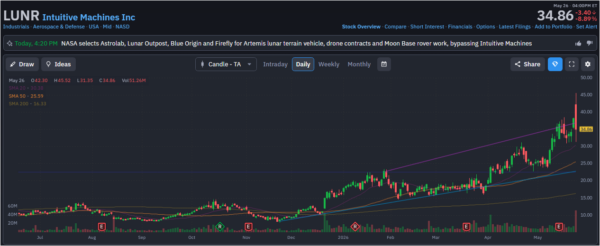
Recent weakness hasn’t been enough to break the stock’s larger uptrend. Shares recently traded around $34.86, and buyers continue stepping in after pullbacks. That tells me investors remain focused on the company’s long-term role in the lunar economy rather than short-term contract headlines. 
spacex - StockEarnings

Rocket Lab Is Becoming More Than a Launch Company

The story around Rocket Lab (NASDAQ: RKLB) stopped being about rockets a long time ago.

Today, the company generates revenue from launch services, spacecraft manufacturing, satellite components, engineering solutions, and government contracts.

No wonder why in its Q1 2026 earnings release, the company reported a revenue of $200.3 million, a 63% YOY growth. Gross margin reached 38.2%, while backlog expanded to about $2.2 billion.

The market’s fascination with SpaceX tends to obscure an important reality.

A future space economy will require more than one launch provider.

From government agencies needing launch capacity, to defense contractors needing spacecraft systems, and commercial customers needing satellites.

Rocket Lab is building products that serve all three groups.

The company’s continued investment in the Neutron rocket reflects what customers are increasingly demanding: larger payloads, more frequent launches, and greater flexibility.

That’s where the SpaceX IPO could matter.

Once analysts assign a public-market value to the dominant launch company in the world, investors will inevitably ask what smaller companies with growing market share might be worth.

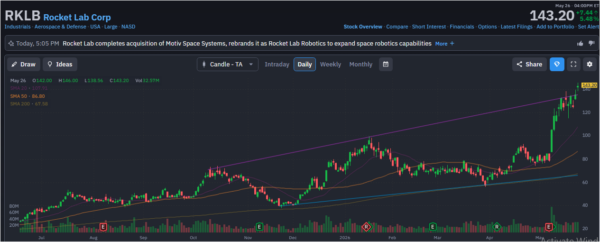
The chart suggests many investors may already be reaching that conclusion.

RKLB stock shares traded at $143.20 after extending one of the strongest uptrends in the market. Buyers spent months building a base before pushing the stock sharply higher in May on expanding volume. The stock remains comfortably above both its 50-day and 200-day moving averages, indicating that institutions continue to accumulate shares despite the massive advance.
spacex - StockEarnings

AST SpaceMobile Wants to Transform Global Connectivity

Every major technological revolution creates two categories of winners.

The companies that build the infrastructure.

And the companies that use that infrastructure to deliver services.

SpaceX helped convince governments, corporations, and investors that orbital infrastructure can support real businesses.

AST SpaceMobile (NASDAQ: ASTS) wants to build one of those businesses.

The company is developing a satellite network designed to connect ordinary smartphones directly to space-based communications systems.

If successful, AST could become part of the global telecommunications industry.

The company reported $14.7 million in first-quarter revenue and ended the quarter with approximately $3.5 billion in cash and cash equivalents, providing substantial resources to continue deploying satellites and expanding commercial capabilities.

The opportunity here extends far beyond launches.

Billions of people carry smartphones.

Hundreds of millions live or work in areas where connectivity remains unreliable.

AST is pursuing a future in which those devices connect directly to satellites without specialized equipment.

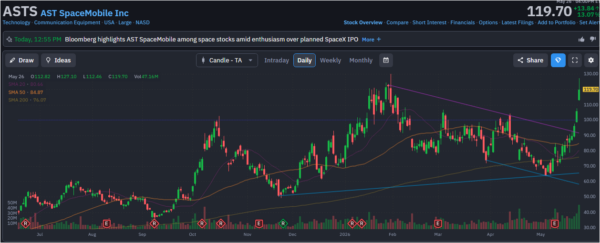
And technically, momentum has returned in a big way as shares recently traded around $119.70 after surging through a key resistance level that had held for months. The combination of heavy volume and a strong breakout suggests investors are becoming optimistic about the company’s direct-to-device satellite network. 
spacex - StockEarnings

Why Smaller Space Stocks Could Benefit the Most From the SpaceX IPO

Most investors assume the SpaceX IPO story begins when shares start trading.

I think it begins when analysts publish their valuation models.

The moment Wall Street places a public-market value on SpaceX, thousands of analysts, portfolio managers, and institutional investors will start reassessing what launch networks, orbital communications systems, and lunar infrastructure might be worth.

Some will buy SpaceX.

Others will search for companies operating in markets that SpaceX helped validate, but that still trade at a fraction of their valuation.

That’s where Intuitive Machines, Rocket Lab, and AST SpaceMobile enter the conversation.

NASA officials are already funding lunar infrastructure. Government agencies and commercial customers are already buying launch services and spacecraft systems. Telecom providers are already exploring satellite-based connectivity.

Those trends existed before the IPO.

A public SpaceX valuation may force more investors to notice them.

And when capital starts flowing into an emerging industry, the biggest gains don’t always belong to the company making the headlines. Sometimes they belong to the companies that investors discover immediately afterward.


Join over 1.2M+ investors/traders who receive daily and weekly notable earnings alerts with predicted move