ajax loader

Loading...


Ride-the-Wave Strategy – Best for Stock Traders

Ride-the-Wave targets multi-day price momentum following a company’s earnings announcement (EA). With this strategy:

  1. Buy a stock one day post-EA if a stock reacts positively post-earnings:
    1. Near the close of trading the EA-day for a pre-market-EA
    2. Near the close of the following day for a post-market-EA
  2. Sell-to-close after 7-10 days, or possibly earlier if a desired price target is reached

Similarly,

  1. short a stock one day post-EA if a stock reacts negatively post-earnings:
    1. near the close of trading the EA-day for a premarket-EA
    2. near the close of the following day for a post-market-EA
  2. then buy-to-close after 7-10 days, or possibly earlier if a desired price target is reached

Important: Ride-the-Wave is predicated on significant price momentum triggered by an EA. The 7-10 day scenario is the maximum trade hold-time. If you see post EA-momentum is halted or reversed by a significant opposite move, re-evaluate your presence in the trade.

This popular StockEarnings screen below will give you a list of stocks that historically exhibit significant price momentum following an EA for the next seven days:

  1. Stocks exhibiting positive post-EA price moves are buy-candidates
  2. Stocks exhibiting negative post-EA price moves are sell/short-candidates

The screen includes those stocks whose Earnings just came out in last two days.

Screen criteria:

  1. Earnings Date Start Date : Current Date + -1 Day
  2. Earnings Date End Date : Current Date + -2 Days
  3. Predicted Move (Next Day) Max : 7%
  4. Predicted Move (On 7th Day) Min : 7%

Strategy Guideline:

  1. Buy the stock if stock has reacted positively. Short the stock if stock has reacted negatively (see above).
  2. Close the position in 7-10 days, or possibly earlier based on price move.

Volatility Crush Strategy - Best for Options Traders

The Volatility Crush strategy is used with stocks that typically experience relatively low-to-moderate price moves (≤4%) following their Earnings Announcements (EA). The basic trade idea is to sell put or call options right before the EA, collecting a credit when options premium is very high due to elevated implied volatility (IV). You then close the position right after the EA by buying the option back much cheaper due to the significant drop in IV that occurs after the mystery of the EA disappears. In assessing this trade, you need to do your homework to ensure you collect sufficient premium to make the trade worthwhile.

This trade is practical due to the low-to-moderate price-move after the EA, which generally won’t significantly affect the options price, unlike an “action” stock, which experience great price moves post-EA. With these symbols, if you’re on the right side of the price move, that’s a great thing. But if you’re on the wrong side of the move, not so great. Consequently, by minimizing the effect of the post-EA price move, you have a much better chance to profit from the reduction in IV without it being ruined by a violent price move.

For this trade, open the position either (1) the night before the EA when the company announces earnings or (2) during the EA day when it announces post-market, generally capturing IV at or close to its peak.

For this trade, open the position either (1) the night before the EA when the company announces earnings or (2) during the EA day when it announces post-market, generally capturing IV at or close to its peak.

This popular stockearnings screen will give you a list of stocks which do not react more than 4% fpost-EA. It includes only those stocks whose earnings are releasing next day.

Screen criteria:

  1. Earnings Date Start Date : Current Date + 1
  2. Earnings Date End Date : Current Date + 1
  3. Predicted Move (Next Day) Max : 4%
  4. Options Type: Weekly

Strategy Guideline:

  1. Options Strategy: Sell Call and Put
  2. Options Strike Price: Current Stock Price – (% Predicated Move x 2)
  3. Expiration Date: It should generally be the closest expiry immediately after the EA.
  4. Buy Insurance: Buying back Call and Put at Strike price which 10% lower than Sell Strike Price is optional but recommended.

Watch Video for More Detail

Volatility Rush Strategy - Best for Options Traders

The Volatility Rush takes advantage of increasing options premiums into earnings announcements (EA) caused by an anticipated rise in Implied Volatility (IV). With this strategy, Buy a Call and Put at-the-money (a long straddle) 2-3 weeks before the EA when IV is lower. Sell the position either (1) the night before the EA when the company announces earnings pre-market, or (2) during the EA day when it announces post-market, generally capturing IV at or close to its peak.

This popular screen will give you a list of stocks whose Options premiums tend to rise into Earnings. It includes only those stocks whose Earnings are at least two weeks away from today.

Screen criteria:

  1. Earnings Date Start Date : Current Date + 15 Days
  2. Earnings Date End Date : Current Date + 30 Days
  3. Predicted Move (Next Day) Min : 5%
  4. Options Type: Weekly or Monthly if that lines up with the two to three-week lead-time for entering the trade

Strategy Guideline:

  1. Buy a Straddle at or close to the money two to three weeks pre-EA.
  2. Sell the position either the night before the EA when the company announces earnings pre-market, or during the EA day when it announces post-market.
  3. Expiration date should generally be the closest expiry immediately after the EA.
  4. Straddle price should not be more 60% of predicted move.

Predicted Move (Volatility)

Similar to Implied Volatility in Options. Expected volatility % based on our Proprietary Volatility Predication Model. We are expecting that stock price will likely to reach % in either direction by the end of next trading session after Earnings are released and not necessarily the closing volatility %.

Why is it important?

    This indicator helps

  1. Knowing expected volatility in stocks after Earnings helps to decide trading stocks before Earnings Announcement.
  2. Taking Advantage of volatility collapse following Earnings Results by using Advance Options strategies such as Spread and Straddles.

Since Last Earnings

Change in share price since last Earnings release.

Why is it Important?

When share has gained more than 10% since it's last Earning release, it tends to over react to minor bad news and give up some gains if not all. So, it contains more downside volatility than upside When share has dropped more than 10% since it's last Earning release, it tends to over react to minor good news and recover some drops if not all. So, it contains more upside volatility than downside.

EPS Surprise (%)

Occurs when a company's reported quarterly or annual profits are above or below analysts' expectations. Here is the formula to derive % EPS Surprice:

Actual EPS - Estimated EPS
------------------------------------- x 100
Estimated EPS

Why is it Important?

Earnings surprises can have a huge impact on a company's stock price. Several studies suggest that positive earnings surprises not only lead to an immediate hike in a stock's price, but also to a gradual increase over time. Hence, it's not surprising that some companies are known for routinely beating earning projections. A negative earnings surprise will usually result in a decline in share price.

Next Day Price Change (%)

Next Regular trading session Closing price following Earnings result.

For After Market Close Earnings, It is a next trading day closing price. For Before Market Open Earnings, It is the same trading day closing price.

Why is it Important?

Next Day price change is a reaction of Earnings result.

3 Stocks That Tell America’s Story Better Than The S&P 500

Posted on Jul 07, 2026 by Grayson Cavern

3 Stocks That Tell America’s Story Better Than The S&P 500

The S&P 500 is the most widely cited barometer of American economic health, and for good reason – 500 companies, every major industry, generations of compounding returns. But an index tells you what the market owns. It rarely explains why America has remained the world’s dominant economic power for over a century, and it does an even worse job of showing you where that dominance actually lives.

Beneath the surface, three enduring forces have driven American economic leadership across every era: the capacity to innovate faster than anyone else, the spending power of its consumers, and the industrial strength to protect the global system that lets both of those forces operate freely. Three stocks capture those pillars more cleanly than any index ever could – NVIDIA (NASDAQ: NVDA), Walmart (NYSE: WMT), and Lockheed Martin (NYSE: LMT). And understanding why each one belongs in that framework tells you more about the American economy than tracking 500 tickers ever will.

Every Generation Gets One Company Like NVIDIA


IBM defined the mainframe era. Intel powered the personal computer. Apple reinvented the relationship between hardware and human behavior. Each one sat at the center of a technological shift that reshaped how the American economy functioned, and each one was dismissed as overvalued by investors who missed the full arc of what they were actually watching.

NVIDIA is writing that same chapter for artificial intelligence, and the numbers make it increasingly difficult to argue otherwise. The company reported $81.6 billion in revenue last quarter, up 85% year-over-year, with Data Center revenue climbing 92% to $75.2 billion as Blackwell AI systems ramped at a pace the company itself described as record speed. Even with export restrictions cutting into China exposure, gross margins held above 60%… a level most hardware businesses never approach at any point in their lifecycle, let alone during a product ramp of this magnitude.

What keeps this story credible beyond the revenue print is the ecosystem NVIDIA sits inside, and that ecosystem is distinctly American. Cloud providers, software developers, university research labs, venture-backed startups, and the deepest capital markets in the world all reinforce each other in ways that no other country has managed to replicate at scale. That’s not a valuation argument. It’s a structural one, and it’s the reason breakthrough AI research keeps converting into commercial revenue faster in the United States than anywhere else.

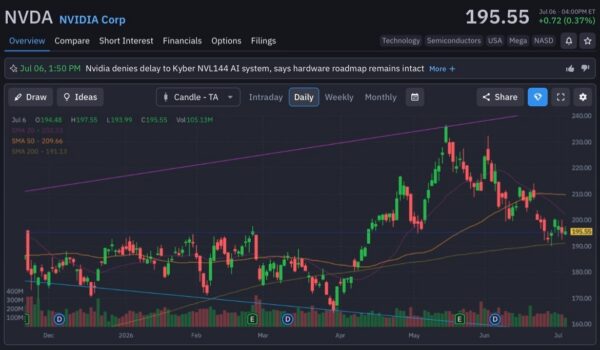
The chart shows a market taking profits rather than abandoning the thesis. After an extraordinary run, NVIDIA has spent recent weeks consolidating near its rising 200-day moving average while attracting buyers consistently around the $190 level. Momentum has cooled. Institutional demand has not.
america-StockEarnings

Nobody Spends Like The American Consumer

The United States doesn’t lead the global economy because it manufactures everything cheaply, it dominates because nobody on earth spends the way American consumers do, and that spending sustains retailers, logistics networks, advertisers, payment processors, software vendors, and thousands of suppliers across every continent simultaneously. Walmart sits at the center of that network, and the business being built inside its revenue lines looks nothing like the discount chain most investors still picture when they hear the name.

Last quarter, Walmart reported revenue of $177.8 billion, up 7.3% year-over-year, while global e-commerce surged 26%, advertising revenue grew 37%, and membership income climbed 17.4%. U.S. comparable sales advanced 4.1%.

The composition of that growth matters as much as the size of it. Advertising and membership are higher-margin businesses than grocery sales, and their acceleration signals that Walmart is successfully transforming from a retail operator into a technology platform wrapped around the world’s largest consumer base. Automation, marketplace services, digital advertising, and Walmart+ are steadily reshaping the company’s earnings profile in ways that make the next decade look structurally different from the last one.

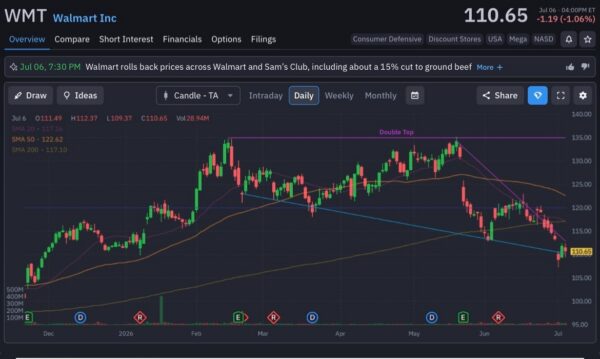
Its stock has corrected sharply from recent highs, slipping below shorter-term moving averages after a powerful multi-year advance. Even so, the longer-term uptrend remains intact, suggesting investors are resetting expectations rather than questioning the business itself. Corrections inside secular winners often feel uncomfortable while they’re happening, yet history shows they frequently become opportunities when the underlying business keeps improving.
america-StockEarnings

National Power Makes The Other Two Possible.

Every assumption built into an NVIDIA investment and every dollar of consumer spending captured by Walmart depends on something most investors never stop to price: the stability of the global system that allows innovation and commerce to function in the first place. Stable trade routes, secure alliances, functioning supply chains, and the long-term confidence businesses need to invest decades ahead don’t emerge naturally. They get built and defended, and Lockheed Martin represents the industrial backbone doing exactly that.

The company reported $18.0 billion in quarterly sales and $6.44 in earnings per share, backed by an $186.4 billion backlog that gives investors a level of forward revenue visibility almost no other business can offer. Management reaffirmed full-year guidance and announced framework agreements to expand production of critical missile systems by three to four times current output as global demand keeps rising.

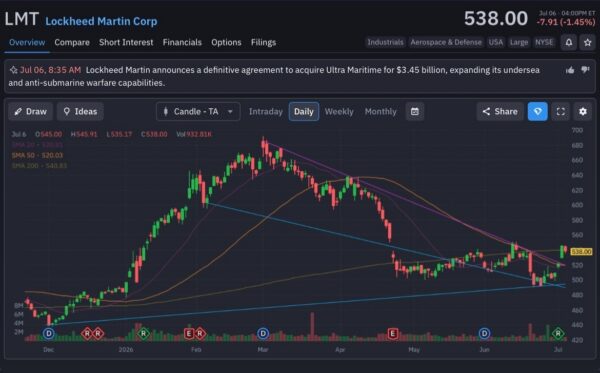
The Ultra Maritime acquisition deepens Lockheed’s position in undersea warfare at precisely the moment geopolitical competition is shifting toward protecting critical shipping lanes and naval infrastructure — a strategic move that extends well beyond any single contract. Technically, after months of sideways action, the stock has quietly reclaimed both its 20-day and 50-day moving averages while finding consistent support near $500, suggesting institutional accumulation rather than indifference.
america-StockEarnings

Three Stocks. One American Story.

The S&P 500 will continue evolving. Companies will enter the index, others will disappear, and market leadership will inevitably change. Names change, but the pillars rarely do. That’s why I keep looking beyond quarterly earnings into businesses tied to America’s enduring strengths because they will continue shaping markets long after today’s headlines have faded.


Join over 1.2M+ investors/traders who receive daily and weekly notable earnings alerts with predicted move