ajax loader

Loading...


Ride-the-Wave Strategy – Best for Stock Traders

Ride-the-Wave targets multi-day price momentum following a company’s earnings announcement (EA). With this strategy:

  1. Buy a stock one day post-EA if a stock reacts positively post-earnings:
    1. Near the close of trading the EA-day for a pre-market-EA
    2. Near the close of the following day for a post-market-EA
  2. Sell-to-close after 7-10 days, or possibly earlier if a desired price target is reached

Similarly,

  1. short a stock one day post-EA if a stock reacts negatively post-earnings:
    1. near the close of trading the EA-day for a premarket-EA
    2. near the close of the following day for a post-market-EA
  2. then buy-to-close after 7-10 days, or possibly earlier if a desired price target is reached

Important: Ride-the-Wave is predicated on significant price momentum triggered by an EA. The 7-10 day scenario is the maximum trade hold-time. If you see post EA-momentum is halted or reversed by a significant opposite move, re-evaluate your presence in the trade.

This popular StockEarnings screen below will give you a list of stocks that historically exhibit significant price momentum following an EA for the next seven days:

  1. Stocks exhibiting positive post-EA price moves are buy-candidates
  2. Stocks exhibiting negative post-EA price moves are sell/short-candidates

The screen includes those stocks whose Earnings just came out in last two days.

Screen criteria:

  1. Earnings Date Start Date : Current Date + -1 Day
  2. Earnings Date End Date : Current Date + -2 Days
  3. Predicted Move (Next Day) Max : 7%
  4. Predicted Move (On 7th Day) Min : 7%

Strategy Guideline:

  1. Buy the stock if stock has reacted positively. Short the stock if stock has reacted negatively (see above).
  2. Close the position in 7-10 days, or possibly earlier based on price move.

Volatility Crush Strategy - Best for Options Traders

The Volatility Crush strategy is used with stocks that typically experience relatively low-to-moderate price moves (≤4%) following their Earnings Announcements (EA). The basic trade idea is to sell put or call options right before the EA, collecting a credit when options premium is very high due to elevated implied volatility (IV). You then close the position right after the EA by buying the option back much cheaper due to the significant drop in IV that occurs after the mystery of the EA disappears. In assessing this trade, you need to do your homework to ensure you collect sufficient premium to make the trade worthwhile.

This trade is practical due to the low-to-moderate price-move after the EA, which generally won’t significantly affect the options price, unlike an “action” stock, which experience great price moves post-EA. With these symbols, if you’re on the right side of the price move, that’s a great thing. But if you’re on the wrong side of the move, not so great. Consequently, by minimizing the effect of the post-EA price move, you have a much better chance to profit from the reduction in IV without it being ruined by a violent price move.

For this trade, open the position either (1) the night before the EA when the company announces earnings or (2) during the EA day when it announces post-market, generally capturing IV at or close to its peak.

For this trade, open the position either (1) the night before the EA when the company announces earnings or (2) during the EA day when it announces post-market, generally capturing IV at or close to its peak.

This popular stockearnings screen will give you a list of stocks which do not react more than 4% fpost-EA. It includes only those stocks whose earnings are releasing next day.

Screen criteria:

  1. Earnings Date Start Date : Current Date + 1
  2. Earnings Date End Date : Current Date + 1
  3. Predicted Move (Next Day) Max : 4%
  4. Options Type: Weekly

Strategy Guideline:

  1. Options Strategy: Sell Call and Put
  2. Options Strike Price: Current Stock Price – (% Predicated Move x 2)
  3. Expiration Date: It should generally be the closest expiry immediately after the EA.
  4. Buy Insurance: Buying back Call and Put at Strike price which 10% lower than Sell Strike Price is optional but recommended.

Watch Video for More Detail

Volatility Rush Strategy - Best for Options Traders

The Volatility Rush takes advantage of increasing options premiums into earnings announcements (EA) caused by an anticipated rise in Implied Volatility (IV). With this strategy, Buy a Call and Put at-the-money (a long straddle) 2-3 weeks before the EA when IV is lower. Sell the position either (1) the night before the EA when the company announces earnings pre-market, or (2) during the EA day when it announces post-market, generally capturing IV at or close to its peak.

This popular screen will give you a list of stocks whose Options premiums tend to rise into Earnings. It includes only those stocks whose Earnings are at least two weeks away from today.

Screen criteria:

  1. Earnings Date Start Date : Current Date + 15 Days
  2. Earnings Date End Date : Current Date + 30 Days
  3. Predicted Move (Next Day) Min : 5%
  4. Options Type: Weekly or Monthly if that lines up with the two to three-week lead-time for entering the trade

Strategy Guideline:

  1. Buy a Straddle at or close to the money two to three weeks pre-EA.
  2. Sell the position either the night before the EA when the company announces earnings pre-market, or during the EA day when it announces post-market.
  3. Expiration date should generally be the closest expiry immediately after the EA.
  4. Straddle price should not be more 60% of predicted move.

Predicted Move (Volatility)

Similar to Implied Volatility in Options. Expected volatility % based on our Proprietary Volatility Predication Model. We are expecting that stock price will likely to reach % in either direction by the end of next trading session after Earnings are released and not necessarily the closing volatility %.

Why is it important?

    This indicator helps

  1. Knowing expected volatility in stocks after Earnings helps to decide trading stocks before Earnings Announcement.
  2. Taking Advantage of volatility collapse following Earnings Results by using Advance Options strategies such as Spread and Straddles.

Since Last Earnings

Change in share price since last Earnings release.

Why is it Important?

When share has gained more than 10% since it's last Earning release, it tends to over react to minor bad news and give up some gains if not all. So, it contains more downside volatility than upside When share has dropped more than 10% since it's last Earning release, it tends to over react to minor good news and recover some drops if not all. So, it contains more upside volatility than downside.

EPS Surprise (%)

Occurs when a company's reported quarterly or annual profits are above or below analysts' expectations. Here is the formula to derive % EPS Surprice:

Actual EPS - Estimated EPS
------------------------------------- x 100
Estimated EPS

Why is it Important?

Earnings surprises can have a huge impact on a company's stock price. Several studies suggest that positive earnings surprises not only lead to an immediate hike in a stock's price, but also to a gradual increase over time. Hence, it's not surprising that some companies are known for routinely beating earning projections. A negative earnings surprise will usually result in a decline in share price.

Next Day Price Change (%)

Next Regular trading session Closing price following Earnings result.

For After Market Close Earnings, It is a next trading day closing price. For Before Market Open Earnings, It is the same trading day closing price.

Why is it Important?

Next Day price change is a reaction of Earnings result.

The Semiconductor Boom Just Entered Its Second Act

Posted on Jul 08, 2026 by Grayson Cavern

The Semiconductor Boom Just Entered Its Second Act

When people think about the California Gold Rush, they usually picture miners racing into rivers with nothing more than a pan and a dream. History tells a different story. Many of the largest fortunes ultimately belonged to the businesses supplying the picks, shovels, railroads, banks, and equipment that made the rush possible. Every technological revolution reaches a point where success begins spreading far beyond its original winner. I think the AI semiconductor boom is arriving at that moment now.

For the past two years, NVIDIA Corp. (NASDAQ: NVDA) has become almost synonymous with artificial intelligence after reporting fiscal first-quarter 2027 revenue of $81.6 billion, data center revenue of $75.2 billion, and a GAAP gross margin of 74.9%. Those numbers comfortably surpassed Wall Street’s expectations, but they also point to a much bigger question. 

If AI continues expanding at today’s pace, can one company realistically capture all of the value being created, or has the semiconductor industry quietly entered an entirely new phase?

The AI Semiconductor Boom Is Expanding Beyond Nvidia


History rarely allows one company to dominate an entire technological revolution forever.

Henry Ford transformed automobile manufacturing, but the industry’s long-term wealth eventually spread across tire manufacturers, oil producers, insurance companies, steelmakers, highway construction firms, and dealerships. The internet initially rewarded networking companies before cloud computing, cybersecurity, and enterprise software emerged as equally important investment themes.

Artificial intelligence is now following that same script. Nvidia still occupies the center of AI computing. Its GPUs remain the preferred choice for training many of the world’s largest language models, and demand continues exceeding supply in several product categories. But the infrastructure required to support AI has become far larger than graphics processors alone.

Broadcom Inc. (NASDAQ: AVGO) illustrates that shift perfectly in the fiscal second quarter report. “Q2 semiconductor revenue from AI of $10.8 billion grew 143% year-over-year, above forecast, driven by increasing demand for custom AI accelerators and AI networking,” said Hock Tan, President and CEO of Broadcom Inc. “The momentum continues and in Q3 we expect semiconductor revenue from AI to grow over 200 percent year-over-year to $16.0 billion.”  Those numbers tell me hyperscalers are increasingly investing in custom AI accelerators designed specifically for their own workloads.

Advanced Micro Devices Inc. (NASDAQ: AMD) is benefiting from the same diversification. The company’s data center segment produced $5.8 billion in first-quarter revenue, rising 57% from a year earlier as cloud providers expanded deployments of its Instinct accelerators alongside Nvidia’s hardware.

Notice what’s happening underneath these earnings? Wall Street is no longer debating whether AI spending exists. It’s debating where that spending flows after leaving Nvidia’s doorstep.

The Next AI Bottleneck Isn’t Computing

Once you look beyond processors, the investment story becomes even more interesting.

Every AI system depends on enormous quantities of high-bandwidth memory, advanced packaging, custom networking, interconnect technologies, and cutting-edge manufacturing capacity. Each of those layers is becoming a competitive bottleneck in its own right.

Micron Technology Inc. (NASDAQ: MU) may offer one of the clearest examples. The company recently disclosed more than $22 billion in multi-year customer agreements tied largely to AI memory demand, while CEO Sanjay Mehrotra said High Bandwidth Memory supply is expected to remain constrained through at least 2027. That’s a remarkable statement because it tells investors the shortage surrounding AI has already expanded beyond processors into memory infrastructure itself.

Taiwan Semiconductor Manufacturing Co. (NYSE: TSM) reinforces the same conclusion from a different angle. High Performance Computing accounted for 59% of the company’s wafer revenue during the latest quarter, making it TSMC’s largest end market by a considerable margin. Even more revealing, 3-nanometer and 5-nanometer technologies together represented 58% of wafer revenue, demonstrating that customers continue migrating aggressively toward the world’s most advanced manufacturing processes.

Put differently, AI isn’t creating one winner anymore. It’s creating an ecosystem where every constraint becomes an investment opportunity. That’s exactly how industrial revolutions mature.

Wall Street Is Broadening Its AI Bets

The price action across the semiconductor sector reinforces that broader thesis.

The charts reinforce the same conclusion emerging from the earnings. NVIDIA Corp. continues holding above its 200-day moving average near $191.26 despite remaining below its 20-day and 50-day averages, with 124.15 million shares traded as investors digest one of the strongest rallies in AI history rather than abandoning it.
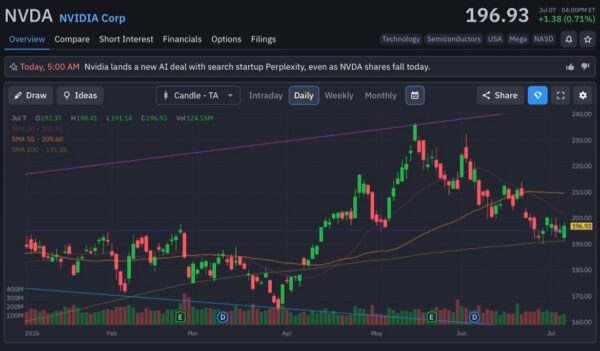
semiconductor-StockEarnings

Broadcom Inc. paints a different picture. Shares have consolidated sharply from the June highs, yet continue trading above the 200-day moving average near $361.64 as 24.11 million shares changed hands. That looks less like distribution and more like institutions cooling excessive optimism after an extraordinary run.


Join over 1.2M+ investors/traders who receive daily and weekly notable earnings alerts with predicted move